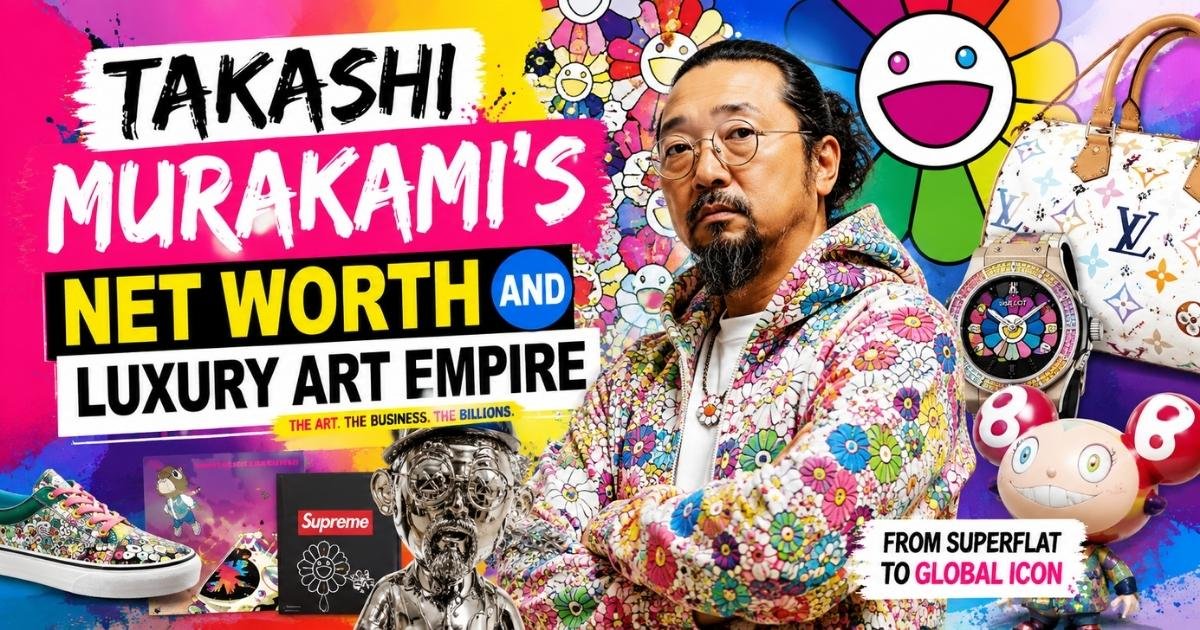
Takashi Murakami has an estimated net worth of $100 million as of 2024. The Japanese contemporary artist built his immense wealth by pioneering the “Superflat” art movement, founding the art production and management company Kaikai Kiki Co., Ltd., and executing highly lucrative, long-term collaborations with global luxury brands like Louis Vuitton and Hublot.
Japanese contemporary artist Takashi Murakami has completely blurred the line between high-end gallery exhibitions and mass-market consumer goods. For decades, the traditional art market maintained a strict boundary between fine art and commercial merchandise. Murakami dismantled that boundary, creating a sprawling ecosystem where multi-million-dollar sculptures exist alongside affordable plush toys, skateboard decks, and luxury handbags.
By commercializing his distinctly colorful, anime-inspired aesthetic, Murakami successfully engineered an enterprise that operates much like a multinational corporation. He employs hundreds of studio assistants, manages a roster of emerging artists, and consistently partners with some of the most profitable fashion houses on the planet. This strategic approach to art creation and distribution has cemented his status as one of the wealthiest living artists.
Understanding how Takashi Murakami built his luxury art empire requires looking beyond the canvas. His financial success stems from a calculated blend of art history, Japanese pop culture, and aggressive business expansion. The result is a self-sustaining brand that appeals equally to prestigious art collectors and young streetwear enthusiasts.
Table of Contents
What is Takashi Murakami’s net worth in 2024?
Takashi Murakami’s estimated net worth is currently valued at approximately $100 million. This wealth is not derived solely from gallery sales, but rather from a diversified portfolio of income streams that span multiple industries.
Unlike traditional artists who rely entirely on gallery representation and auction house commissions, Murakami operates a comprehensive business model. His net worth is fueled by high-ticket original artwork sales, limited-edition print releases, mass-produced consumer merchandise, and lucrative licensing agreements. His art production company, Kaikai Kiki Co., Ltd., serves as the central hub for these operations, generating tens of millions of dollars in annual revenue.
Murakami also holds significant real estate assets, including massive studio spaces in Tokyo, Saitama, and New York. These production facilities function as modern-day factories, allowing him to scale his artistic output to meet global demand. By maintaining complete control over his intellectual property and manufacturing processes, Takashi Murakami maximizes profit margins across every product category bearing his iconic designs.
How did Takashi Murakami build his luxury art empire?
The foundation of Takashi Murakami’s art empire is built upon a distinct theoretical framework and a highly organized corporate structure. He did not achieve global recognition by accident; he designed a specific artistic movement and established a company to monetize it globally.
Why is the Superflat movement critical to his success?
In the year 2000, Takashi Murakami published his “Superflat” theory, which serves as the intellectual backbone of his entire empire. Superflat refers to the two-dimensional nature of traditional Japanese art, which Murakami seamlessly connected to the flat aesthetics of modern anime and manga. Furthermore, the concept refers to the flattening of culture itself—the removal of the hierarchy between “high” culture (fine art) and “low” culture (consumer goods).
This theory gave Murakami the critical validation needed to sell his artwork in prestigious international galleries while simultaneously mass-producing consumer products. By branding his specific style as a legitimate art movement, he created immense demand among wealthy collectors. When collectors bought into Superflat, they were buying a recognized piece of art history. This critical acclaim drove up the prices of his original paintings and sculptures, which in turn increased the perceived value of his accessible merchandise.
How does Kaikai Kiki Co., Ltd. generate revenue?
Takashi Murakami founded Kaikai Kiki Co., Ltd. in 2001. The company functions as an art production studio, a talent management agency, and a merchandise manufacturer. Headquartered in Tokyo with additional offices globally, Kaikai Kiki is the engine that drives Murakami’s wealth.
Kaikai Kiki employs over 200 people, including painters, digital artists, fabricators, and administrative staff. This massive workforce allows Murakami to produce intricate, large-scale artworks at a volume that a single artist could never achieve alone. The company also manages a roster of highly successful Japanese artists, including Aya Takano and Mr., taking a percentage of their sales and helping them navigate the international art market.
Additionally, Kaikai Kiki manufactures and distributes the artist’s vast catalog of merchandise. From the famous smiling flower cushions to keychains and apparel, the company controls the supply chain. This vertical integration ensures that Takashi Murakami retains the majority of the profits from merchandise sales, rather than losing revenue to third-party manufacturers and distributors.
What are Takashi Murakami’s most lucrative brand collaborations?
Brand collaborations are a massive contributor to Takashi Murakami’s net worth. By partnering with established luxury houses and streetwear titans, he continuously introduces his artwork to new demographics.
| Brand Partner | Year of Initial Collaboration | Industry | Impact on the Takashi Murakami Brand |
|---|---|---|---|
| Louis Vuitton | 2003 | Luxury Fashion | Transformed Murakami into a global household name and generated hundreds of millions in retail sales for the fashion house. |
| Supreme | 2007 | Streetwear | Solidified Murakami’s relevance in urban youth culture and the highly lucrative streetwear resale market. |
| Hublot | 2021 | Luxury Watches | Pushed his aesthetic into the ultra-high-net-worth horology market, with watches retailing for well over $100,000. |
| RTFKT (Nike) | 2021 | Digital Assets (NFTs) | Successfully transitioned the Murakami brand into Web3, generating massive trading volumes through CloneX avatars. |
How did the Louis Vuitton partnership change his career?
The collaboration between Takashi Murakami and Louis Vuitton remains one of the most successful intersections of art and fashion in history. Initiated by then-creative director Marc Jacobs in 2003, the partnership lasted for 13 years. Murakami reimagined the classic Louis Vuitton monogram, injecting it with vibrant colors and his signature characters.
The “Multicolore” monogram line was an instant commercial phenomenon. It drove massive foot traffic to Louis Vuitton boutiques and generated hundreds of millions of dollars in revenue. For Takashi Murakami, the partnership provided unparalleled global exposure. His artwork was suddenly being carried by celebrities and displayed on billboards worldwide. The collaboration proved that his Superflat aesthetic could drive serious consumer spending, making him an incredibly attractive partner for other major corporations in the years that followed.
Why does Takashi Murakami collaborate with streetwear brands?
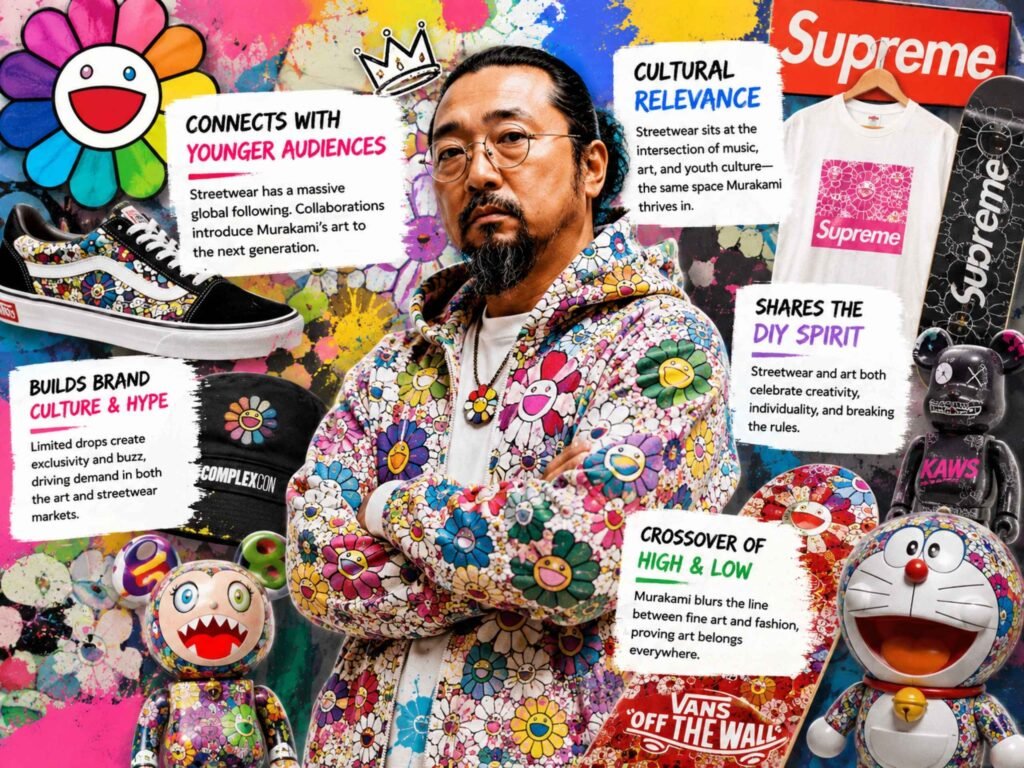
While Louis Vuitton secured his status in the luxury sector, collaborations with brands like Supreme, Vans, and ComplexCon solidified his influence in streetwear. The streetwear market operates on scarcity and hype, principles that align perfectly with the art market.
When Takashi Murakami collaborated with Supreme in 2007 to release custom skateboard decks, he tapped into a fiercely loyal consumer base. He later partnered with Supreme again in 2020 to release a charity box logo t-shirt, which raised over $1 million for COVID-19 relief. By aligning with streetwear culture, Murakami ensures his brand remains relevant to younger, trend-focused audiences who will eventually become the next generation of high-end art collectors.
How much do Takashi Murakami’s original artworks sell for?
While plush toys and sneakers generate consistent cash flow, Takashi Murakami’s original artworks produce massive, lump-sum infusions of capital. His paintings and sculptures regularly fetch millions of dollars at premier auction houses like Sotheby’s and Christie’s.
His most expensive artwork sold at auction is the sculpture My Lonesome Cowboy. The life-sized, anime-inspired fiberglass figure sold for an astonishing $15.1 million at a Sotheby’s auction in New York in 2008. Other notable sales include his painting The Castle of Tin Tin, which sold for over $4 million, and various large-scale flower paintings that routinely clear the $1 million mark.
The primary market (initial sales through galleries like Gagosian or Perrotin) is equally lucrative. Because Takashi Murakami utilizes his Kaikai Kiki staff to produce multiple high-quality pieces simultaneously, he can supply galleries with enough inventory to satisfy wealthy buyers without diluting the market. This high-volume, high-price strategy is central to his $100 million net worth.
The future trajectory of the Takashi Murakami enterprise
Takashi Murakami shows no signs of slowing down his commercial expansion. In recent years, he has successfully pivoted into the digital asset space, recognizing the financial potential of Web3.
His entry into the Non-Fungible Token (NFT) market with projects like Murakami.Flowers and his collaboration with RTFKT on the CloneX avatars generated tens of millions of dollars in initial minting fees and secondary market royalties. By embracing blockchain technology, Murakami established a new, highly profitable revenue stream that requires zero physical manufacturing or shipping logistics.
As he continues to bridge the gap between physical luxury goods and digital collectibles, the Takashi Murakami brand is positioned for sustained financial growth. His ability to adapt to shifting consumer behaviors while maintaining his core aesthetic ensures that his luxury art empire will outlast the current generation of collectors.
Kenshi Yonezu’s creative achievements showcase the diverse talent emerging from Japan’s cultural industries. Elon Musk remains one of the world’s most influential entrepreneurs and investor.
Frequently Asked Questions
What is Takashi Murakami’s most famous artwork?
Takashi Murakami is most widely recognized for his “Smiling Flowers” motif. These colorful, multi-petaled flowers with joyful faces appear in his multi-million-dollar canvas paintings, as well as on consumer merchandise like cushions, pins, and clothing. Another highly famous piece is My Lonesome Cowboy, a provocative fiberglass sculpture that sold for $15.1 million in 2008.
Can anyone buy Takashi Murakami’s art?
Yes, Takashi Murakami’s business model is designed to offer products at almost every price point. Wealthy collectors can purchase original paintings and sculptures for hundreds of thousands or millions of dollars through exclusive galleries. However, the general public can purchase Kaikai Kiki merchandise, posters, and limited-edition prints starting anywhere from $20 to a few thousand dollars online or at specialized museum shops.
Why is Kaikai Kiki Co., Ltd. important?
Kaikai Kiki Co., Ltd. is the corporate entity that manages all of Takashi Murakami’s artistic output, merchandising, and brand collaborations. Founded in 2001, the company allows Murakami to scale his production by employing hundreds of assistants. It also acts as an incubator for younger Japanese contemporary artists, further expanding the brand’s influence in the global art market.
Did Takashi Murakami design a Kanye West album cover?
Yes, Takashi Murakami designed the iconic album artwork for Kanye West’s 2007 album, Graduation. The artwork features Murakami’s signature colorful style and introduced the “Dropout Bear” character in a vibrant, Superflat universe. This collaboration significantly boosted Murakami’s profile within the Western music and pop culture industries.
How does Takashi Murakami make his money?
Takashi Murakami builds his net worth through a highly diversified revenue model. He earns money through the sale of original fine art in galleries and auction houses, the mass production and sale of Kaikai Kiki merchandise, royalty agreements from brand collaborations (like Hublot and Vans), and, more recently, the sale and trading royalties of digital NFT projects like Murakami.Flowers.
