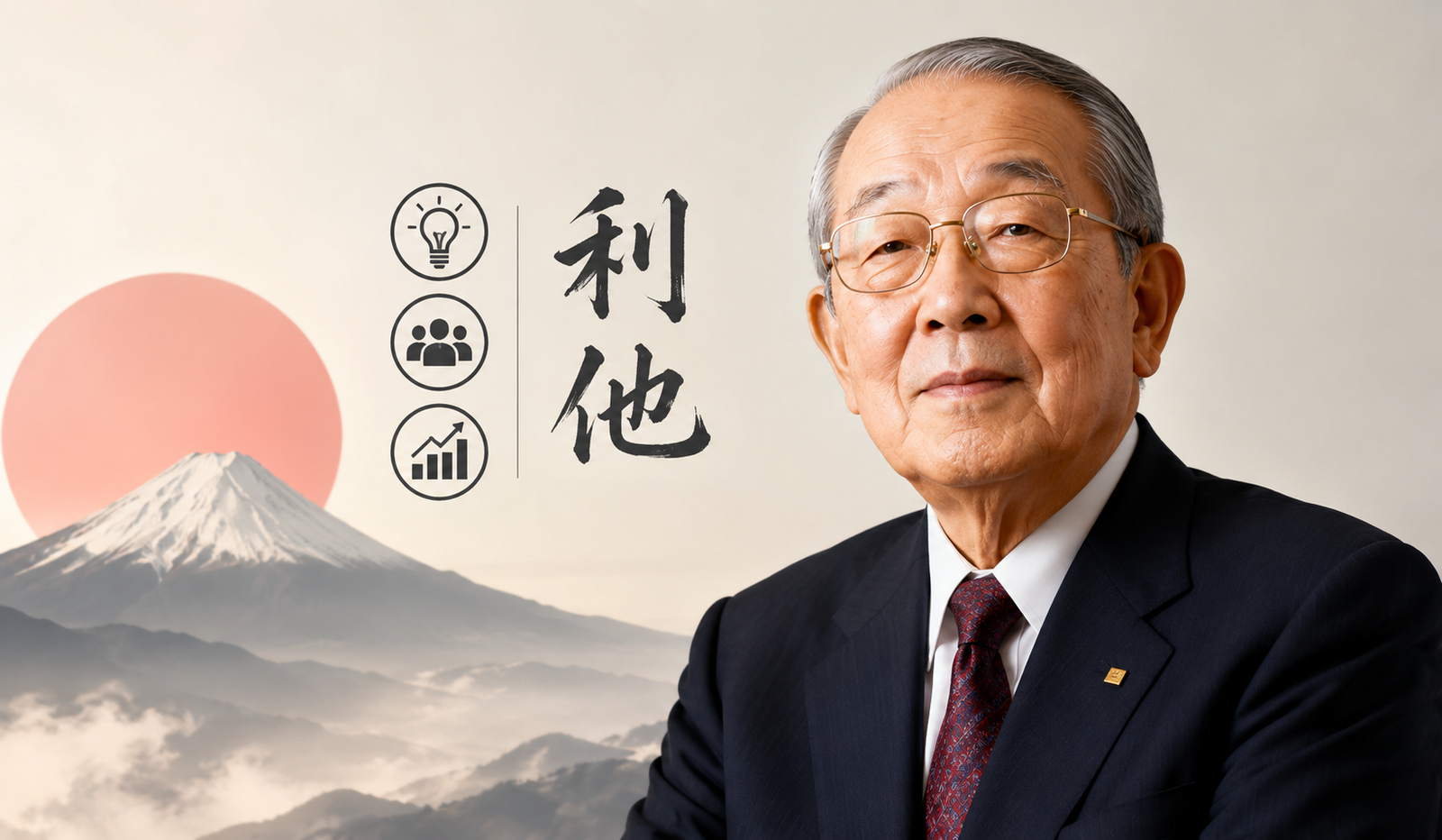
Kazuo Inamori was a Japanese entrepreneur and philosopher who founded Kyocera Corporation in 1959 and co-founded KDDI Corporation, building two Fortune Global 500 companies from scratch. His leadership philosophy—rooted in ethics, humility, and the belief that business exists to serve people—continues to shape how executives and organizations operate worldwide.
There are entrepreneurs who build great companies. Then there are those who redefine what it means to lead. Kazuo Inamori belongs firmly in the second category. Born in 1932 in Kagoshima, Japan, Inamori rose from modest beginnings to found Kyocera Corporation—one of the world’s most respected electronics and ceramics manufacturers—and later co-found what would become KDDI Corporation, Japan’s second-largest telecommunications company. When he passed away in August 2022 at the age of 90, the business world lost not just a prolific builder, but a moral voice that had guided thousands of executives for decades.
What set Inamori apart was not simply his ability to grow companies. It was his insistence that profit and ethics are not opposites—that a business built on integrity and respect for people is not just a good thing to aspire to, but the only sustainable path forward. His ideas were neither abstract nor idealistic. They were tested in the real world, through downturns, crises, and rebuilding efforts that few leaders ever face.
This post explores who Kazuo Inamori was, what he believed, and why his philosophy remains one of the most relevant frameworks for business leadership today.
How Did Kazuo Inamori Start His Career, and What Led to the Founding of Kyocera?
Inamori’s early life was far from privileged. He contracted tuberculosis as a child, struggled academically, and failed his university entrance exam on the first attempt. He eventually graduated from Kagoshima University with a degree in applied chemistry and joined Shofu Industries, a ceramics company in Kyoto. The work was difficult, the company was poorly managed, and most of his colleagues quit out of frustration. Inamori stayed—not out of blind loyalty, but because he chose to find meaning in the work itself.
That decision proved formative. By immersing himself fully in fine ceramics research, Inamori developed a deep expertise that would soon attract outside attention. In 1959, at just 27 years old, he founded Kyocera Corporation (then Kyoto Ceramic Co., Ltd.) with backing from seven colleagues and a small group of investors. The company began manufacturing specialized ceramic components for electronic equipment—a niche but critical market as Japan’s postwar industrial economy accelerated.
From its earliest days, Kyocera reflected Inamori’s values. He implemented a management structure he called the “amoeba system,” in which the company was divided into small, semi-autonomous teams—each responsible for its own profit and loss. This decentralized model gave employees ownership over their work and accountability for outcomes, long before such ideas became standard management theory. According to Kyocera’s corporate history, the company grew from a small ceramics workshop into a global technology conglomerate with operations spanning solar energy, medical equipment, and telecommunications components.
What Is Kazuo Inamori’s Business Philosophy, and Why Does It Still Matter?
Inamori’s philosophy, which he called “management by the heart” or sometimes simply “Inamori Philosophy,” centers on one foundational premise: the purpose of a business is to make its employees and society better off. This is not a platitude. Inamori operationalized this belief through a set of principles he described in detail across his books, lectures, and the leadership development program he founded in 2000 called Seiwajuku.
His core ideas can be organized around three pillars:
The primacy of right thinking. Inamori believed that the outcomes in any person’s life—or any organization’s trajectory—are determined by the quality of their thinking. He argued that thinking rooted in selfishness, ego, or short-termism would always produce poor results, regardless of talent or market conditions. Ethical thinking, by contrast, creates clarity, trust, and long-term strength.
The role of effort and attitude over talent. Inamori famously proposed a formula for success: Results = Ability × Effort × Attitude. The multiplier that most people underestimate, he argued, is attitude—because unlike innate ability, attitude can range from negative to strongly positive, and that range determines everything. A talented person with a poor attitude will consistently underperform someone of moderate ability who brings total commitment and positivity to their work.
Service as the foundation of profit. Inamori was not anti-profit. Far from it. But he viewed profit as the outcome of genuinely serving customers and employees, not as the goal itself. Companies that chase profit directly, he argued, tend to cut corners, exploit relationships, and ultimately collapse. Those that focus relentlessly on delivering real value tend to generate sustainable profit almost as a byproduct.
These ideas are documented in depth in Inamori’s books, several of which have been translated into English, including Amoeba Management and A Passion for Success, both of which remain widely read in business schools and executive programs globally.
How Did Kazuo Inamori Help Save Japan Airlines From Bankruptcy?
Perhaps the most dramatic test of Inamori’s philosophy came in 2010, when the Japanese government asked him to become Chairman of Japan Airlines (JAL)—a company that had just filed for the largest corporate bankruptcy in Japan’s history, with debts exceeding ¥2.3 trillion (approximately $25 billion USD). Inamori was 78 years old. He had no background in aviation. He accepted the role for a salary of one yen.
What followed is now studied in business schools as one of the most remarkable corporate turnarounds ever recorded. Inamori rejected the conventional approach of aggressive cost-cutting and layoffs as the primary lever for recovery. Instead, he focused first on the mindset of JAL’s employees. He introduced his philosophy directly to senior management through study groups and workshops, arguing that no structural change would work unless the people executing it genuinely cared about the company and its customers.
Alongside cultural transformation, Inamori applied the amoeba management system to JAL’s operations, creating accountability structures within each division that had previously operated in silos. Within two years, JAL returned to profitability—posting an operating profit of approximately ¥180 billion in fiscal year 2012, the highest in the company’s history at that time. According to Harvard Business Review’s coverage of the JAL turnaround, the speed and scale of the recovery stunned industry analysts who had expected the restructuring to take a decade.
Inamori stepped down from the chairmanship once JAL was stable. He took no equity, no bonuses, and no ongoing compensation. The JAL turnaround stands as one of the clearest demonstrations that his philosophy was not theoretical—it worked under the most adverse conditions imaginable.
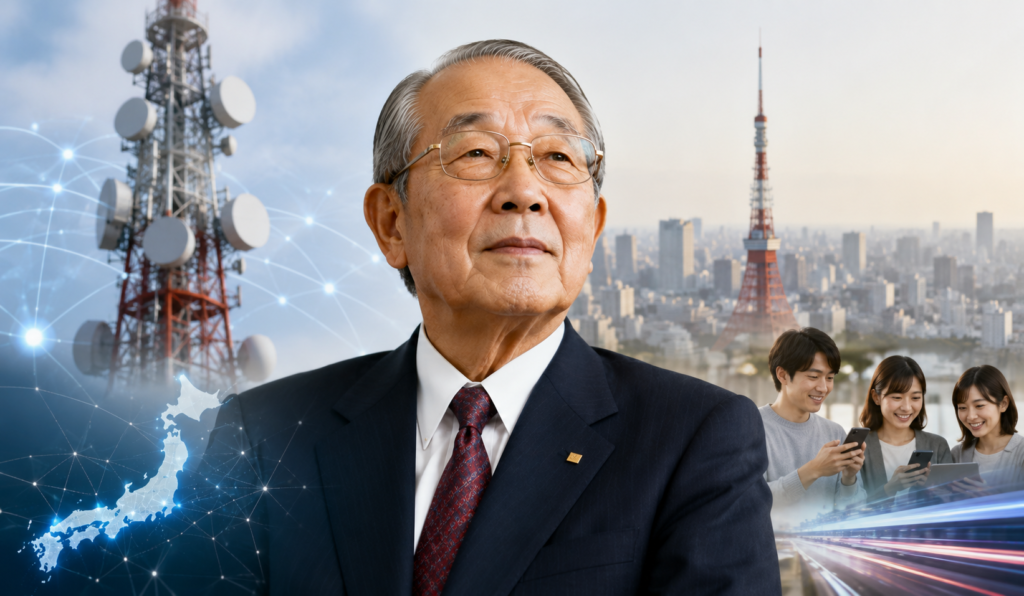
What Was Kazuo Inamori’s Role in Founding KDDI, and How Did It Reshape Japanese Telecommunications?
In 1984, when Japan began deregulating its telecommunications industry, Inamori made another bold move. He co-founded Daini-Denden Inc. (DDI), positioning it as a competitor to the state-backed giant Nippon Telegraph and Telephone (NTT). Critics questioned whether a ceramics entrepreneur had any business entering telecom. Inamori’s answer was consistent with his philosophy: he saw a public that was being underserved by a monopoly, and he believed DDI could deliver something better.
DDI eventually merged with KDD and IDO in 2000 to form KDDI Corporation, which today serves tens of millions of mobile subscribers and is listed on the Tokyo Stock Exchange as one of Japan’s most valuable companies. According to KDDI’s corporate profile, the company generated revenues of approximately ¥5.67 trillion in fiscal year 2023—a legacy that traces directly back to Inamori’s willingness to challenge an entrenched monopoly in service of consumer benefit.
What Can Modern Business Leaders Learn From Kazuo Inamori’s Leadership Style?
Inamori’s influence extends well beyond Kyocera and KDDI. Through Seiwajuku—the management philosophy school he founded—he trained thousands of small and medium-sized business owners across Japan and internationally. The curriculum centers on his published philosophy, encouraging leaders to examine their own motivations before attempting to lead others.
Several lessons from his career are particularly relevant to modern organizations:
Leaders must model the values they expect from others. Inamori never asked employees to sacrifice what he was unwilling to sacrifice himself. His one-yen salary at JAL was symbolic, but it sent an unmistakable message about shared hardship and integrity.
Culture change precedes structural change. At JAL, Inamori insisted on shifting mindsets before overhauling systems. This sequencing—people before processes—contradicts much conventional turnaround thinking but proved decisive.
Small teams with clear accountability outperform large, centralized ones. The amoeba system Inamori pioneered at Kyocera is now recognized as an early model of what modern management theorists call distributed leadership and agile organization design.
Meaning drives performance. Inamori consistently argued that employees who understand why their work matters perform at a fundamentally different level than those who do not. This idea now underpins decades of organizational psychology research, including Daniel Pink’s work on intrinsic motivation.
The Lasting Legacy of Kazuo Inamori’s Life and Work
Kazuo Inamori passed away on August 24, 2022. Tributes came from across the global business community—not just from those who had worked with him, but from executives and entrepreneurs who had been shaped by his books and ideas without ever meeting him. Japan’s Emperor Naruhito expressed condolences, and business publications from the Financial Times to the Wall Street Journal published extensive obituaries reflecting on his outsized influence.
What makes Inamori’s legacy durable is that his ideas do not depend on a particular market, technology, or era. They are grounded in human psychology and ethical reasoning—the same forces that determine organizational health regardless of industry or geography. His belief that business can be both profitable and deeply human was not a compromise. It was a conviction he proved, repeatedly, at scale.
For anyone building a company, leading a team, or trying to find coherence between personal values and professional ambition, Inamori’s life offers something rare: proof that it can be done.
Frequently Asked Questions About Kazuo Inamori
Who was Kazuo Inamori, and why is he significant in the business world?
Kazuo Inamori (1932–2022) was a Japanese entrepreneur who founded Kyocera Corporation in 1959 and co-founded KDDI Corporation in 1984. He is widely regarded as one of Japan’s most important business figures, known both for building two Fortune Global 500 companies and for developing a philosophy of ethical leadership that has influenced thousands of executives worldwide.
What is the Inamori Philosophy, and how is it applied in organizations?
The Inamori Philosophy is a management and life philosophy centered on ethical thinking, service to others, and the belief that attitude—not just talent—determines outcomes. It is applied through leadership training programs like Seiwajuku, through the amoeba management system at Kyocera, and through direct instruction that Inamori provided to teams at Japan Airlines during its restructuring.
What is the amoeba management system that Inamori developed at Kyocera?
The amoeba management system divides a company into small, semi-independent teams—each with its own profit-and-loss responsibility. Each team operates like a small business within the larger organization, creating transparency, accountability, and a sense of ownership among employees at every level.
How did Kazuo Inamori turn around Japan Airlines so quickly?
Inamori prioritized cultural and mindset transformation before structural change. He introduced his philosophy to senior leadership, implemented the amoeba management system to create division-level accountability, and rallied employees around a shared sense of purpose. JAL returned to profitability within two years—posting record operating profits in fiscal year 2012.
What books did Kazuo Inamori write, and which should I read first?
Inamori authored numerous books on business and philosophy. For those new to his thinking, A Passion for Success provides an accessible introduction to his core beliefs, while Amoeba Management offers a detailed look at the organizational system he pioneered at Kyocera. Both are available in English translation.
Is Kazuo Inamori’s philosophy relevant outside of Japan?
Yes. While Inamori’s philosophy is rooted in Japanese cultural values such as humility and collective responsibility, its core principles—ethical leadership, employee empowerment, and purpose-driven management—have been adopted by organizations worldwide. His turnaround of Japan Airlines, in particular, is studied internationally as a model of culturally agnostic leadership.
