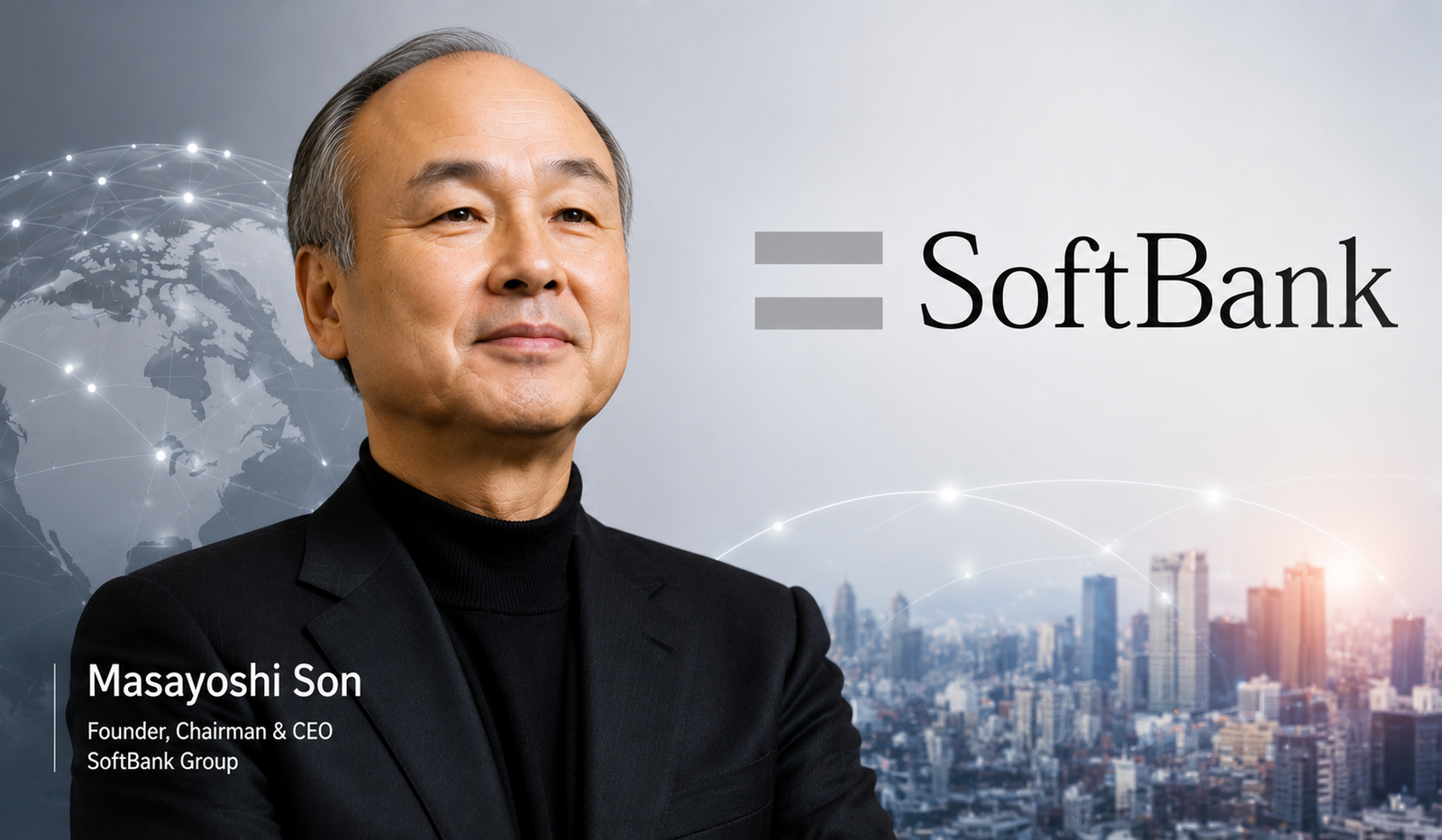
Masayoshi Son is the Japanese billionaire entrepreneur who founded SoftBank in 1981 and transformed it into one of the world’s largest technology investment companies. Known for bold, long-term bets on companies like Alibaba, ARM Holdings, and WeWork, Son’s investment philosophy centers on the belief that the AI revolution will reshape every industry on earth.
There are bold investors. Then there is Masayoshi Son.
The founder and CEO of SoftBank Group has made a career out of thinking decades ahead—sometimes to brilliant effect, sometimes at staggering cost. He bet $20 million on Alibaba in 2000, a stake that eventually grew to be worth over $60 billion. He lost nearly $70 billion in the dot-com crash, briefly becoming one of the largest single losses of personal wealth in history. He then rebuilt. And then bet again.
Son’s story is not a smooth arc from rags to riches. It is a series of extreme highs and catastrophic lows, held together by an almost irrational conviction that technology will transform human civilization—and that he is positioned to back the companies that will do it. Understanding Masayoshi Son means understanding how the most consequential technology investments of the last two decades were made, and what vision drove them.
How Did Masayoshi Son Rise from a Difficult Childhood to Become One of Japan’s Wealthiest Entrepreneurs?
Masayoshi Son was born on August 11, 1957, in Tosu, a small city in Saga Prefecture, Japan. His family were Zainichi Koreans—ethnic Koreans living in Japan—and grew up in poverty, living near a pig farm and dealing with significant social discrimination. Son has spoken openly about the hardships of his early years, including the shame his family experienced and the identity struggles that came with being Korean in Japan at a time when prejudice was deeply entrenched.
Those early experiences, rather than limiting him, appear to have sharpened his ambition. As a teenager, Son read an interview with Den Fujita, the entrepreneur who brought McDonald’s to Japan. Inspired, he cold-called Fujita and managed to secure a face-to-face meeting—a remarkable act of confidence for a 16-year-old. Fujita told him that computers would define the future. Son took the advice literally.
At 16, Son moved to the United States to pursue education. He attended the University of California, Berkeley, where he studied economics and computer science. While still a student, he developed a multilingual electronic translation device and licensed the patent to Sharp Corporation for approximately $1 million—an early indicator of both his entrepreneurial instincts and his willingness to bet on technology before it was mainstream. You can read more about his early career history via the SoftBank Group official corporate history page.
What Is SoftBank and How Did Masayoshi Son Build It From a Small Software Distributor Into a Global Tech Powerhouse?
Son founded SoftBank in 1981, initially as a software distribution company in Fukuoka, Japan. The name “SoftBank” reflected its original purpose: a bank of software. In its earliest days, the company sold packaged software to retailers from two rented market stalls—a far cry from the trillion-dollar tech conglomerate it would eventually become.
Growth came quickly. SoftBank expanded into publishing, acquiring computer magazines and establishing itself as a significant media presence in Japan’s burgeoning tech sector. In 1994, the company went public on the Tokyo Stock Exchange. The following year, Son made a pivotal move: he acquired a 77% stake in Ziff Davis, one of America’s leading technology media companies, for $2.1 billion. SoftBank was now an international player.
The late 1990s marked SoftBank’s transformation from a media and distribution company into a technology investor. Son recognized that the internet would restructure global commerce, and he moved aggressively—investing in hundreds of internet companies during the dot-com boom. At its peak, SoftBank’s portfolio made Son briefly the wealthiest person in the world, with an estimated net worth of $78 billion in early 2000. When the bubble burst, that figure collapsed to around $1 billion virtually overnight. It remains one of the most dramatic personal wealth evaporations in financial history, according to Forbes.
But Son didn’t retreat. He rebuilt SoftBank methodically, focusing on telecommunications, broadband infrastructure, and strategic internet investments. In 2006, SoftBank acquired Vodafone Japan for $15 billion, entering the mobile carrier market and establishing the domestic revenue base that would fund future ambitions. Two years later, Son struck an exclusive deal to bring the iPhone to Japan—a move that dramatically accelerated SoftBank Mobile’s subscriber growth and cemented the company’s reputation for visionary deal-making.
How Did Masayoshi Son’s $20 Million Bet on Alibaba Become One of the Greatest Investment Returns in History?
No story about Masayoshi Son is complete without Alibaba. In 2000, Son met Jack Ma, then a relatively unknown entrepreneur pitching a Chinese e-commerce platform. The meeting lasted roughly six minutes. Son invested $20 million.
What followed was extraordinary. Alibaba grew into one of the world’s largest e-commerce and technology companies. When Alibaba conducted its IPO on the New York Stock Exchange in September 2014—the largest IPO in history at the time, raising $25 billion—SoftBank’s 34% stake was valued at approximately $60 billion, according to Reuters. The original $20 million had generated a return of more than 2,900 times.
This single investment became the financial backbone of everything SoftBank would do next. It funded the Vision Fund, backed dozens of global unicorns, and gave Son the credibility to raise capital at a scale that few private investors had ever attempted.
What Is the SoftBank Vision Fund and Why Did It Change the Way Venture Capital Works?
In 2017, Masayoshi Son launched the SoftBank Vision Fund, a $100 billion technology investment vehicle—by far the largest venture capital fund ever created at the time. The fund raised money from institutional investors, sovereign wealth funds (notably Saudi Arabia’s Public Investment Fund, which committed $45 billion), and SoftBank itself.
The Vision Fund’s approach was deliberately disruptive. Rather than making small, diversified bets typical of venture capital, Son concentrated enormous capital into individual companies with the explicit goal of helping them dominate their categories. Portfolio companies received investments of $100 million, $500 million, or even several billion dollars at a time. The logic, as Son articulated it, was that the AI era would produce a small number of winner-take-all platforms—and those platforms needed capital to win fast.
The strategy produced remarkable successes. Investments in DoorDash, Coupang, and Grab delivered strong returns. However, the Vision Fund also produced highly publicized failures. The WeWork implosion was the most damaging: SoftBank invested approximately $10.65 billion in the office-sharing company, which collapsed spectacularly in 2019 when its IPO attempt failed following revelations about governance failures and mounting losses, as documented by The Wall Street Journal.
Despite these setbacks, Son launched Vision Fund 2 in 2019, primarily funded by SoftBank itself. As of 2023, the combined Vision Fund portfolio spans hundreds of companies across artificial intelligence, fintech, health tech, logistics, and autonomous vehicles.
How Does Masayoshi Son’s Investment Philosophy Differ From Traditional Venture Capital Thinking?
Son operates on a time horizon that most investors find either inspiring or alarming: 300 years. In various public speeches and presentations, he has articulated a vision for SoftBank that extends well beyond any conventional business plan. He speaks about the Singularity—the theoretical point at which artificial intelligence surpasses human intelligence—as an inevitability, not a hypothesis.
This long-termism shapes every investment decision. Son is not looking for companies that will generate returns in five to seven years. He is looking for companies he believes will define entire industries in the coming decades. He has described this as “cluster of No. 1 strategy”—backing market leaders across every major technology category so that SoftBank benefits regardless of which specific platforms prevail.
Son has also been unusually transparent about what drives him emotionally. He speaks about a desire to contribute to human happiness through technology and describes the pain of watching companies he believes in struggle with insufficient capital. His decision to invest huge sums in individual companies—rather than spreading smaller bets—reflects a genuine conviction that undercapitalized winners lose to well-funded competitors, not a failure of risk management. You can watch Son explain his philosophy directly in his 2010 SoftBank World keynote, which laid out his now-famous 30-year vision.
What Are the Most Significant Investments and Acquisitions in SoftBank’s History?
Beyond Alibaba and the Vision Fund portfolio, several other deals stand out as defining moments in SoftBank’s trajectory.
In 2012, SoftBank acquired a 70% controlling stake in Sprint, the American wireless carrier, for approximately $20 billion—a bold move into the competitive US telecommunications market. The acquisition gave SoftBank its first major US operating business, though Sprint’s subsequent struggles tested the investment’s thesis. Sprint eventually merged with T-Mobile in 2020.
In 2016, SoftBank acquired ARM Holdings, the British semiconductor and chip design company, for $32 billion in cash—the largest technology acquisition in European history at the time. ARM’s chip architecture powers the vast majority of the world’s smartphones, making it one of the most strategically important technology assets in existence. Son has described the ARM acquisition as central to his AI ambitions, viewing ARM’s chips as the foundational hardware layer of the intelligence revolution. SoftBank sold a portion of ARM shares through an IPO on the Nasdaq in September 2023, according to Bloomberg, valuing the company at approximately $54 billion at listing.
Other notable Vision Fund investments have included Uber, ByteDance (the parent company of TikTok), Slack, and Grab—giving SoftBank an extraordinary breadth of exposure across consumer technology, enterprise software, and emerging markets.
What Is Masayoshi Son’s Legacy and What Role Does SoftBank Play in the Future of Artificial Intelligence?
Son has been consistent about where he believes the world is heading: AI will be the defining technological force of the next century, and every industry—from healthcare to transportation to financial services—will be transformed by it. SoftBank’s current investment thesis is built almost entirely around this conviction.
In 2023 and into 2024, Son has refocused SoftBank’s strategy on artificial general intelligence (AGI), describing it as humanity’s most consequential technological development. He has publicly stated his intention to make SoftBank the most important company in the AI era—a statement that, given his track record, is not easily dismissed.
His legacy is already substantial and genuinely complex. He identified the internet’s potential earlier than almost anyone in Asia. He backed Alibaba when Jack Ma could barely get meetings. He created a new model for technology investment that, whatever its flaws, permanently changed how much capital can flow into private technology companies. He also presided over some of the most costly investment mistakes of the last decade.
What makes Son’s story compelling is precisely this contradiction. He is neither an infallible visionary nor a reckless gambler. He is something rarer: a person who genuinely believes the future will look radically different from the present, and who has committed his entire career to acting on that belief—even when, especially when, the consensus says otherwise.
Frequently Asked Questions About Masayoshi Son and SoftBank
Who is Masayoshi Son?
Masayoshi Son is a Japanese billionaire entrepreneur and the founder and CEO of SoftBank Group, one of the world’s largest technology investment companies. He is best known for his early investment in Alibaba and for creating the $100 billion SoftBank Vision Fund.
How did Masayoshi Son make his money?
Son built his wealth primarily through SoftBank, which he founded in 1981. His early investment in Alibaba—$20 million in 2000—became worth over $60 billion after Alibaba’s IPO in 2014. SoftBank’s telecommunications operations and Vision Fund investments have also contributed significantly to his net worth.
What is the SoftBank Vision Fund?
The SoftBank Vision Fund is a technology investment vehicle launched in 2017 with $100 billion in capital—the largest venture capital fund ever created at the time. It invests in late-stage technology companies with the goal of backing market leaders in artificial intelligence, fintech, health tech, and other high-growth sectors.
How much did Masayoshi Son lose in the dot-com crash?
Son’s personal net worth fell from approximately $78 billion to around $1 billion during the dot-com crash of 2000–2001, representing one of the largest single losses of personal wealth in recorded financial history.
What companies has SoftBank invested in?
SoftBank and the Vision Fund have invested in hundreds of technology companies globally, including Alibaba, Uber, WeWork, ARM Holdings, DoorDash, Grab, ByteDance, Coupang, and Slack, among many others.
What is Masayoshi Son’s net worth?
According to Forbes, Masayoshi Son’s net worth fluctuates significantly with SoftBank’s portfolio performance. He has been listed among the world’s wealthiest individuals multiple times, with estimates typically ranging from $10 billion to over $40 billion depending on market conditions.
