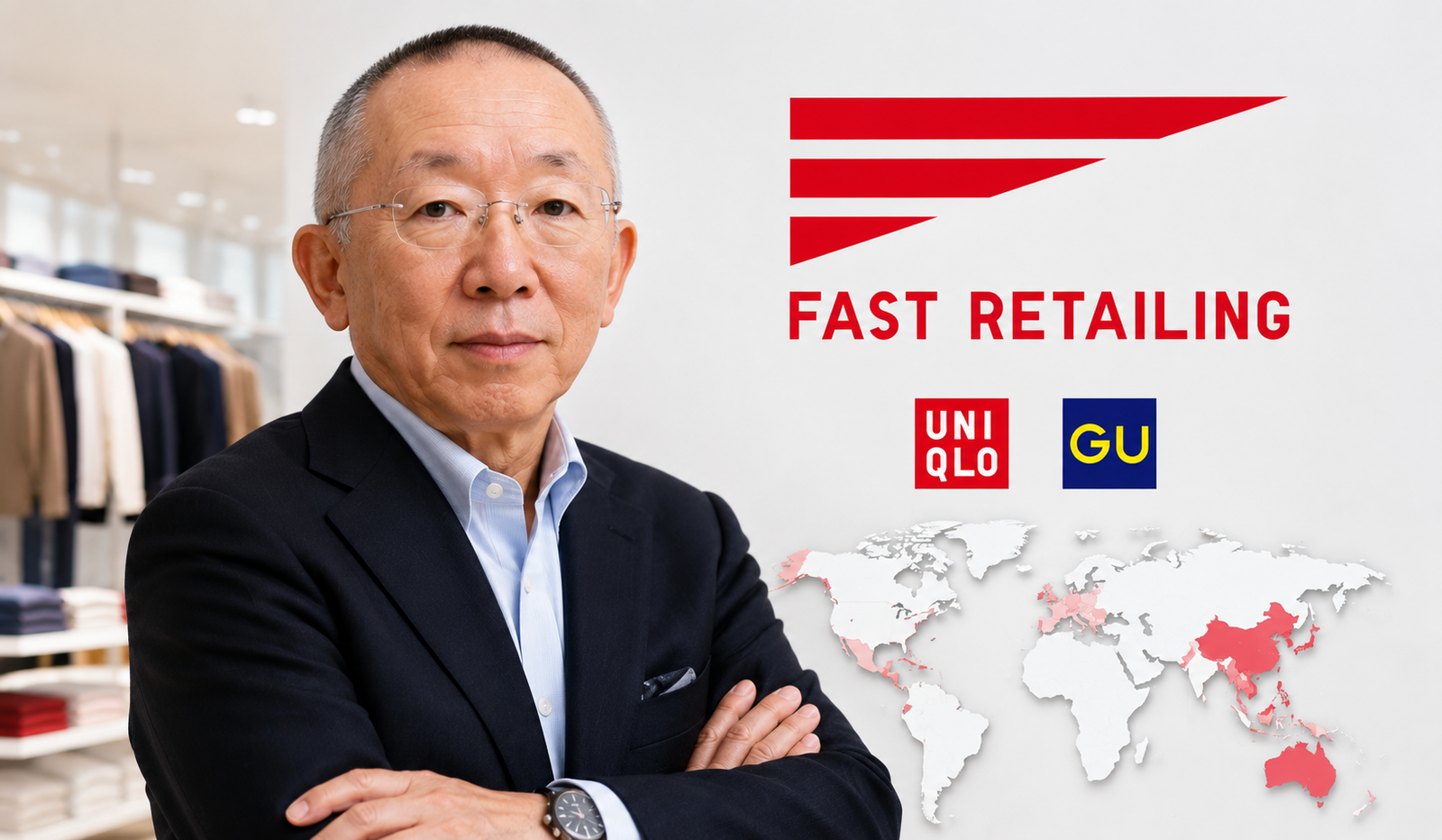
Tadashi Yanai is the founder and CEO of Fast Retailing, the Japanese retail conglomerate behind Uniqlo. Starting with a single men’s clothing store in Hiroshima in 1984, Yanai grew Fast Retailing into one of the world’s largest apparel companies, with over 3,500 stores across 25 countries and a personal net worth exceeding $40 billion USD.
Most people have worn a piece of Uniqlo without ever asking how it got there. The HeatTech base layer. The Ultra Light Down jacket. The AIRism T-shirt. These products feel almost unremarkable in their simplicity—and that’s exactly the point. Behind every deliberate design decision is a man who has spent four decades obsessing over the relationship between clothing and everyday life.
Tadashi Yanai is Japan’s richest person, a retail visionary, and one of the most consequential business leaders of the past 50 years. Yet outside of Japan and fashion industry circles, his story remains surprisingly underappreciated. He didn’t disrupt tech. He didn’t launch a social network. He built something arguably more durable: a global clothing brand rooted in function, affordability, and quiet precision.
This post traces Yanai’s journey from a small shop in Ube City, Yamaguchi Prefecture, to the helm of a company that rivals Zara and H&M on the world stage—and explores the philosophy that made it all possible.
How Did Tadashi Yanai Get His Start in the Retail Industry?
Tadashi Yanai was born on February 7, 1949, in Ube City, Yamaguchi Prefecture, Japan. His father, Hitoshi Yanai, owned a chain of men’s tailoring shops called Ogori Shoji. After graduating from Waseda University in Tokyo with a degree in economics and political science in 1971, Yanai took a job at a supermarket chain—a short-lived stint that lasted less than a year. He returned to his father’s business shortly after, eventually taking over its management.
That transition proved to be the pivot point. In 1984, Yanai opened the first Unique Clothing Warehouse store—later shortened to Uniqlo—in Hiroshima. The concept was straightforward: affordable, casual clothing with broad appeal. By 1991, he had renamed the parent company Fast Retailing Co., Ltd., signaling a shift in ambition from a regional retailer to something far larger.
The early years were characterized by rapid domestic expansion. By the late 1990s, Uniqlo had hundreds of stores across Japan. Then came a product that changed everything.
What Was the Fleece Campaign That Transformed Uniqlo’s Brand Identity?
In 1998, Uniqlo launched a fleece jacket priced at 1,900 yen—roughly $13 USD at the time. The product sold two million units. The following year, Yanai tripled down on the strategy, offering fleece in 51 colors and selling 8.5 million units in a single season (Fast Retailing, Annual Report Archive).
The fleece campaign did more than boost sales. It repositioned Uniqlo in the minds of Japanese consumers. The brand was no longer just cheap clothing—it was accessible quality. High volume, low margin, and unwavering consistency became the pillars of Yanai’s retail model.
This approach borrowed liberally from what Yanai had studied abroad. He was a known admirer of American retailers like Gap and UK brands like Marks & Spencer. But he synthesized those influences into something distinctly Japanese: meticulous attention to fabric quality, restrained aesthetics, and an emphasis on utility over trend.
How Did Tadashi Yanai Expand Uniqlo Beyond Japan to Become a Global Retailer?
International expansion was never a side project for Yanai—it was the endgame. Fast Retailing opened its first overseas Uniqlo store in London in 2001. The launch stumbled. British consumers were unfamiliar with the brand, and the company hadn’t fully adapted its product range or retail experience to local expectations. The London stores largely closed within a few years.
Yanai treated the failure as tuition. He regrouped, refined the model, and re-entered global markets more deliberately. By 2006, Uniqlo had returned to the international stage with openings in New York and Paris. This time, the reception was markedly different. The SoHo flagship in New York became a retail landmark, drawing queues on opening day and earning coverage in publications from The New York Times to Vogue.
The global strategy that followed was methodical. Uniqlo expanded across Asia first—South Korea, China, Southeast Asia—before deepening its presence in Europe and North America. As of 2024, Fast Retailing operates over 3,500 stores across more than 25 countries and regions, with Greater China representing one of its largest and fastest-growing markets (Fast Retailing, FY2023 Financial Results).
What Is the “LifeWear” Philosophy That Drives Uniqlo’s Product Development?
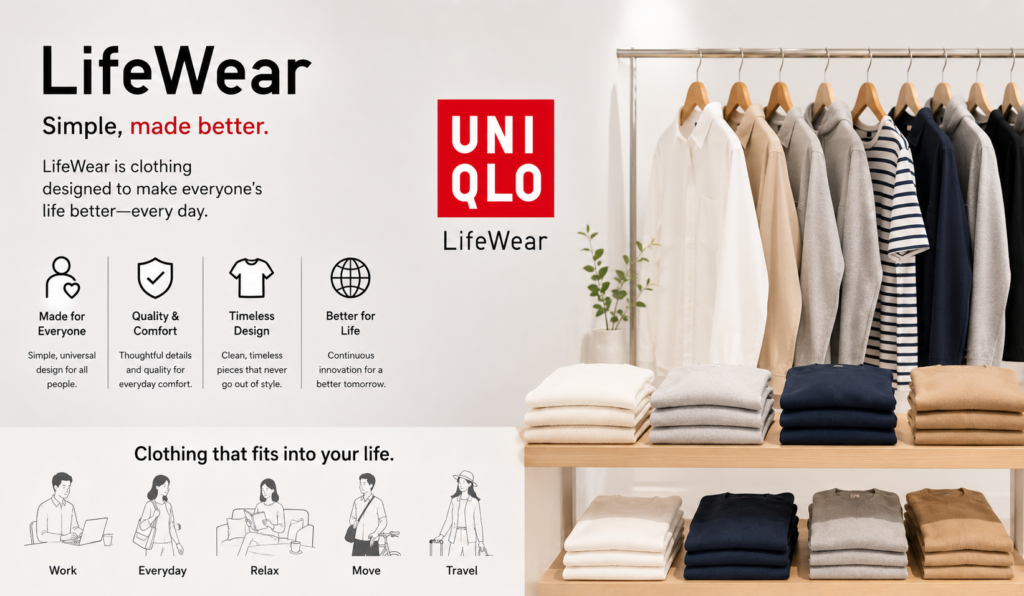
Yanai’s business philosophy can be distilled into a single word his company coined: LifeWear. It refers to clothing designed to improve everyday life—functional, comfortable, universally wearable, and built to last beyond a single season.
Where fast fashion brands refresh their collections weekly to generate impulse purchases, Uniqlo does the opposite. Its core products—HeatTech thermal wear, the Ultra Light Down jacket, the Supima cotton T-shirt—are refined and iterated over years, not abandoned each season. Yanai has described Uniqlo not as a fashion company, but as a technology company that happens to make clothes (The Business of Fashion, 2020).
That framing matters. The HeatTech line, developed in collaboration with Toray Industries—one of Japan’s leading materials science companies—uses advanced synthetic fiber technology to trap body heat. It launched in 2003 and has sold over one billion units worldwide. AIRism, the brand’s moisture-wicking fabric technology, followed a similar trajectory: born from material innovation, refined over time, and now sold across dozens of product categories.
Yanai has been clear that this model isn’t accidental. He credits a relentless focus on the supply chain, including Fast Retailing’s vertically integrated Specialty Store Retailer of Private Label Apparel (SPA) model, as the engine behind both quality control and cost efficiency.
How Has Tadashi Yanai Built One of Asia’s Largest Personal Fortunes?
Yanai’s wealth is a direct function of Fast Retailing’s stock performance. As the company’s largest individual shareholder, his net worth fluctuates with the company’s market capitalization. According to Forbes, Yanai’s net worth surpassed $40 billion USD in 2023, making him not only Japan’s richest person but also one of the wealthiest individuals in Asia (Forbes Real-Time Billionaires).
Fast Retailing is listed on the Tokyo Stock Exchange and is a component of the Nikkei 225 index. Its market capitalization has ranked it among the top three global apparel companies, alongside Inditex (parent of Zara) and H&M Group.
Yanai has spoken publicly about his ambitions to make Fast Retailing the world’s largest apparel company by revenue—a goal that would require overtaking Inditex, which generated approximately €35.9 billion in revenue in fiscal year 2023 (Inditex, FY2023 Annual Report). Fast Retailing reported revenue of approximately ¥2.77 trillion (roughly $19 billion USD) in the same period. The gap is significant, but Yanai has never been deterred by long timelines.
What Leadership Style and Business Principles Define Tadashi Yanai as a CEO?
Yanai is known for a leadership style that is demanding, direct, and deeply hands-on. He has described himself in interviews as a perpetual dissatisfier—someone who is never fully content with results, because contentment breeds stagnation. His book One Win, Nine Losses, published in Japan in 2003, documents his business philosophy through the lens of failure, arguing that most entrepreneurial attempts end in defeat and that resilience is the defining trait of successful founders.
He sets audacious numerical goals publicly, holds his organization accountable to them, and treats international expansion as a moral as well as commercial imperative. Yanai has stated that a company with no global ambition is a company without a future—a perspective shaped partly by his admiration for American business culture and partly by watching Japanese conglomerates stagnate in the 1990s.
At the same time, Yanai has faced scrutiny. Fast Retailing has been criticized for labor conditions in its supply chain, and in 2021, a BBC investigation raised concerns about cotton sourcing linked to the Xinjiang region in China (BBC News, 2021). These are not unique challenges in global apparel, but they represent real tensions between Uniqlo’s LifeWear ideals and the realities of mass production at scale. Fast Retailing has maintained that it prohibits forced labor in its supply chain and conducts regular audits of its suppliers.
What Is the Future of Fast Retailing and Uniqlo Under Tadashi Yanai’s Vision?
Now in his mid-70s, Yanai shows no signs of stepping back. He has indicated that succession planning is underway, but has been deliberately vague about timelines. In several interviews, he has suggested that the company needs a leader with global instincts and operational fluency—qualities he is actively cultivating in Fast Retailing’s next generation of executives.
The company’s near-term focus includes accelerating digital integration, expanding its direct-to-consumer online channels, and deepening its material technology partnerships. Fast Retailing has also announced plans to increase automation in its distribution infrastructure, including AI-powered warehousing systems that reduce fulfillment time and labor costs.
Sustainability is another frontier. The company has committed to reducing greenhouse gas emissions across its supply chain and has launched recycling initiatives across its store network. Whether these commitments match the scale of Fast Retailing’s environmental footprint remains a subject of ongoing debate among analysts and advocacy groups.
What Tadashi Yanai’s Story Reveals About Building an Enduring Business
Yanai’s career offers a useful counterpoint to the startup mythology that dominates business culture. He didn’t move fast and break things. He moved carefully, broke things occasionally, learned from them, and rebuilt with more precision the second time. The London expansion failed. He went back. The early international stores underperformed. He adapted.
What makes Fast Retailing durable—and what makes Yanai’s leadership distinctive—is the refusal to choose between scale and substance. Uniqlo competes on price without sacrificing material quality. It sells globally without abandoning a distinctly Japanese sensibility. It chases volume without relying on trend cycles.
For anyone building a business, studying Yanai means studying patience. It means understanding that brand identity isn’t a campaign—it’s a decade of consistent decisions. The Ultra Light Down jacket didn’t become iconic overnight. The HeatTech line didn’t sell a billion units in its first year. They earned their place through iteration, distribution, and a product philosophy clear enough to guide thousands of decisions across a global organization.
That clarity of purpose, more than any single product or market move, is the real architecture behind one of the most remarkable retail empires of the modern era.
Frequently Asked Questions About Tadashi Yanai and Fast Retailing
Who is Tadashi Yanai and what company did he found?
Tadashi Yanai is a Japanese billionaire entrepreneur and the founder and CEO of Fast Retailing Co., Ltd., the parent company of Uniqlo. He opened the first Uniqlo store in Hiroshima in 1984 and has led the company’s growth into one of the world’s largest apparel groups.
How much is Tadashi Yanai worth in 2024?
As of 2024, Tadashi Yanai’s net worth is estimated at over $40 billion USD, making him Japan’s wealthiest individual. His fortune is primarily tied to his shareholding in Fast Retailing, which is listed on the Tokyo Stock Exchange.
What is the LifeWear concept that Uniqlo is known for?
LifeWear is Uniqlo’s core product philosophy, describing clothing designed to improve everyday life through functionality, comfort, and durability. Rather than chasing seasonal trends, Uniqlo refines its core products—like HeatTech and Ultra Light Down—over multiple years.
How many Uniqlo stores are there worldwide?
As of fiscal year 2023, Fast Retailing operates over 3,500 stores across more than 25 countries and regions, with Greater China, Japan, and Southeast Asia representing its largest markets.
Did Tadashi Yanai face any business failures?
Yes. Uniqlo’s initial international expansion into the United Kingdom in 2001 failed, with most London stores closing within a few years. Yanai later used this experience to develop a more deliberate and adaptive global expansion strategy.
What book did Tadashi Yanai write about business?
Yanai authored One Win, Nine Losses, published in Japan in 2003. The book outlines his business philosophy through the lens of failure, arguing that most business attempts end in defeat and that sustained success comes from resilience and learning.
Is Fast Retailing the largest clothing company in the world?
Not yet. As of 2024, Fast Retailing ranks among the top three global apparel companies by market capitalization, behind Inditex (Zara). Yanai has stated publicly that his goal is to make Fast Retailing the world’s largest apparel company by revenue.
