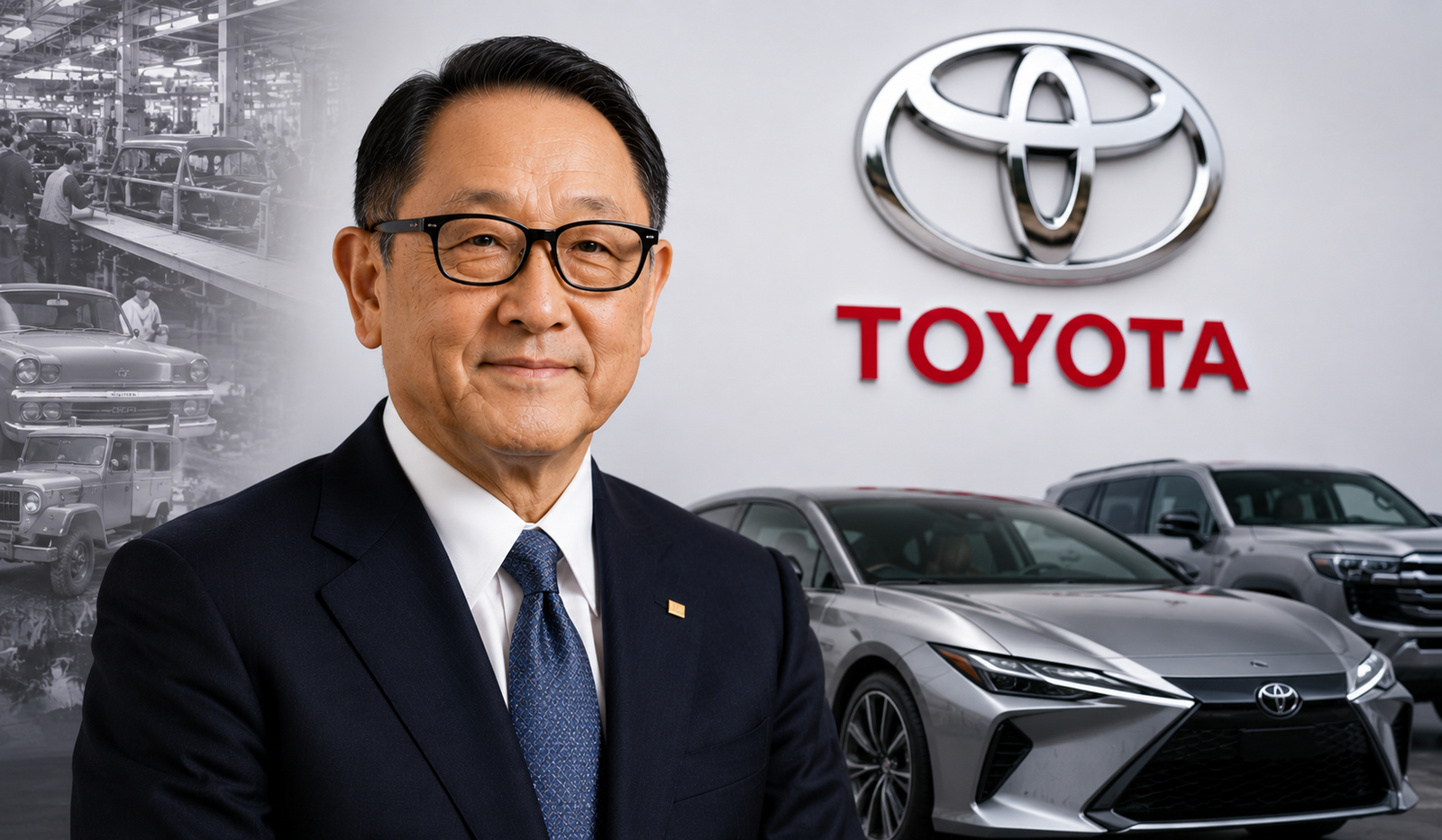
Akio Toyoda served as Toyota’s President and CEO from 2009 to 2023, steering the automaker through the 2010 recall crisis, the 2011 Tōhoku earthquake, and a historic shift toward electrification. As Executive Chairman since 2023, Akio Toyoda continues to shape Toyota’s long-term strategy, pushing the company toward carbon neutrality and next-generation mobility.
Few business leaders have left as permanent a mark on a global automaker as Akio Toyoda has on Toyota Motor Corporation. As the grandson of Toyota’s founder, Kiichiro Toyoda, Akio carried the weight of a family legacy into one of the most turbulent decades the automotive industry has ever seen. From a massive safety recall that threatened the brand’s reputation to a once-in-a-generation natural disaster, then to the seismic disruption of electric vehicles and autonomous driving—Akio faced it all, and steered Toyota through every storm.
This article takes a deep dive into the life, leadership philosophy, and lasting impact of Akio Toyoda. Whether you’re studying business leadership, tracking Toyota’s evolution, or simply curious about the man behind one of the world’s most valuable automobile brands, this profile covers the full picture: his early life, his rise to power, his most defining decisions, and where he stands today.
Who Is Akio Toyoda, and What Is His Connection to Toyota’s Founding Family?
Born on May 3, 1956, in Nagoya, Japan, Akio Toyoda is the great-grandson of Sakichi Toyoda—the inventor and industrialist who founded the Toyota Group—and the grandson of Kiichiro Toyoda, who established Toyota Motor Corporation in 1937. This lineage gave Akio a deeply personal relationship with the company long before he ever held an executive title.
Akio earned a law degree from Keio University in Tokyo in 1979, then pursued graduate studies in the United States, completing an MBA from Babson College in Massachusetts in 1982. His American education gave him an international perspective that would later prove valuable as Toyota expanded its global footprint. After joining Toyota Motor Corporation in 1984, Akio worked his way through various divisions—from manufacturing and sales to product planning—gaining hands-on experience across the company before ascending to senior leadership.
How Did Akio Toyoda Rise to Become President and CEO of Toyota?
Akio Toyoda was appointed President and CEO of Toyota Motor Corporation in June 2009, taking the helm during one of the most financially precarious periods in the company’s modern history. The 2008 global financial crisis had battered the auto industry, and Toyota posted its first operating loss in 70 years during fiscal year 2009, according to Toyota’s annual report.
His appointment was not without controversy. Some analysts questioned whether a family member was the right choice to lead a company of Toyota’s scale through such unprecedented challenges. Akio quickly silenced those doubts. One of his earliest moves was to reaffirm the Toyota Production System (TPS)—the lean manufacturing philosophy that had made Toyota a global benchmark for quality and efficiency—as the company’s operational backbone. He made clear that Toyota’s identity was rooted in craftsmanship and continuous improvement (kaizen), and that no amount of growth would compromise those principles.
What Was the 2010 Toyota Recall Crisis, and How Did Akio Toyoda Handle It?
The recall crisis of 2009–2010 stands as perhaps the most defining early test of Akio Toyoda’s leadership. Toyota recalled more than 8 million vehicles globally due to reported issues with unintended acceleration, linked to floor mat interference and, in some cases, sticky accelerator pedals. The National Highway Traffic Safety Administration (NHTSA) launched an investigation, and Toyota faced intense scrutiny from U.S. Congress, the media, and consumers worldwide.
In February 2010, Akio Toyoda testified before the U.S. House Committee on Oversight and Government Reform—a rare and publicly visible moment for a Japanese CEO. Speaking through an interpreter, he offered a direct apology to customers and acknowledged that Toyota’s rapid global expansion had outpaced its quality control systems. “We pursued growth over the speed at which we were able to develop our people and our organization,” he said during the testimony.
Rather than deflect blame, Akio took personal ownership of the crisis. He introduced a new global quality task force and restructured decision-making to give regional markets more autonomy in responding to safety concerns. The response, while costly—Toyota paid over $1.2 billion in a U.S. Department of Justice settlement in 2014—ultimately reinforced the brand’s commitment to safety and transparency, helping it recover customer trust faster than many analysts predicted.
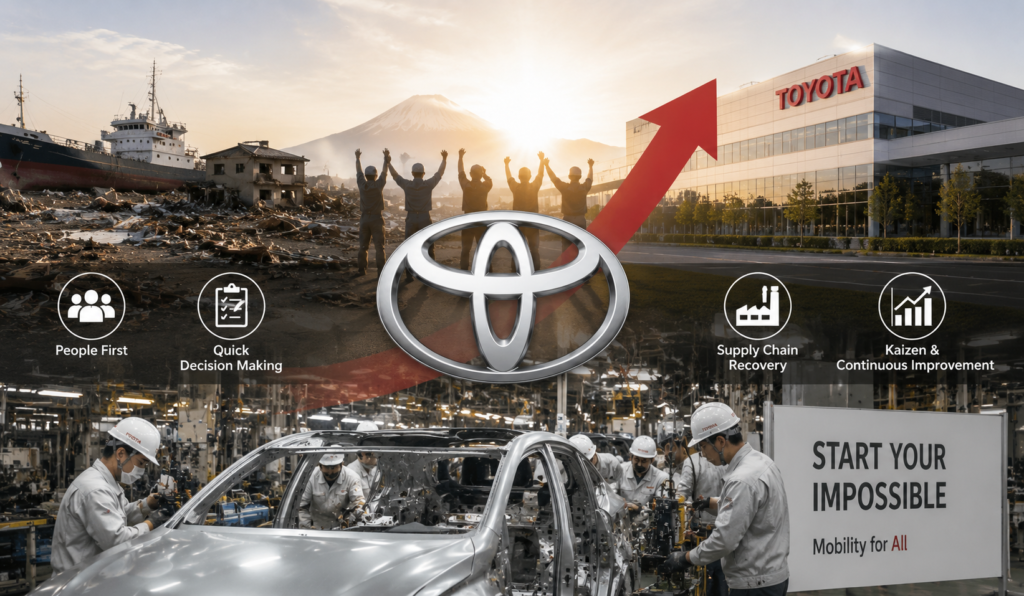
How Did Toyota Recover After the 2011 Tōhoku Earthquake and Tsunami?
On March 11, 2011, a magnitude 9.0 earthquake and subsequent tsunami devastated northeastern Japan, killing nearly 20,000 people and crippling much of the country’s manufacturing infrastructure. Toyota’s supply chain was severely disrupted, with parts shortages forcing production halts across its global network.
Akio Toyoda responded with a focus on resilience. Under his direction, Toyota undertook a systematic audit of its supply chain, mapping thousands of parts suppliers to identify single points of failure. The automaker then diversified its supplier base and increased safety stock for critical components—a strategy that has since become a model for supply chain risk management across industries. According to a report from McKinsey & Company, Toyota’s post-disaster supply chain restructuring became one of the most widely studied examples of corporate resilience planning globally.
What Is Akio Toyoda’s Approach to Electrification and the Future of Mobility?
Akio Toyoda’s most debated legacy may be his position on electric vehicles (EVs). While competitors like Tesla and Volkswagen sprinted toward full battery-electric lineups, Akio publicly argued for a more measured, multi-pathway approach to decarbonization. He has consistently advocated for hydrogen fuel cell vehicles, hybrid technology, and plug-in hybrids alongside battery EVs—insisting that a single-solution approach to carbon reduction ignores the diverse energy infrastructure realities across different global markets.
Speaking at the Japan Automobile Manufacturers Association in December 2020, Akio warned that a rapid, exclusive shift to battery EVs could result in significant job losses in Japan’s auto manufacturing sector and stressed that the electricity used to charge EVs must itself come from clean sources to deliver genuine environmental benefits. His remarks sparked global debate, drawing both criticism from EV advocates and praise from those who viewed his position as pragmatic.
Toyota has nonetheless committed to spending $35 billion on electrification through 2030, with a target of offering 30 battery-electric vehicle models globally by that year, according to a Toyota press release from December 2021. The company also remains the world’s leading producer of hybrid vehicles, with the Toyota Prius—launched in 1997—having sold more than 20 million units globally as of 2023, per Toyota’s official data.
Under Akio’s leadership, Toyota also invested heavily in hydrogen fuel cell technology, developing the Mirai—a hydrogen-powered sedan now in its second generation—and partnering with companies like Hino Motors and Kenworth to bring hydrogen fuel cell trucks to market.
What Major Leadership Changes Did Toyota Make in 2023, and What Is Akio Toyoda’s Role Today?
In January 2023, Toyota announced that Akio Toyoda would step down as President and CEO, transitioning to the role of Executive Chairman. Koji Sato, formerly the head of Toyota’s Lexus division and GR (Gazoo Racing) brand, was named as his successor, effective April 2023.
The transition was widely interpreted as a generational handoff designed to accelerate Toyota’s EV strategy under new leadership, while keeping Akio’s long-term vision and family authority anchored at the board level. As Executive Chairman, Akio Toyoda retains significant influence over the company’s strategic direction, culture, and identity.
Akio is also known for his personal passion for motorsport. Under his direction, Toyota relaunched the Gazoo Racing brand as a vehicle for performance development, competing at the 24 Hours of Le Mans and the FIA World Endurance Championship. Akio has personally participated in endurance racing events—an unusual characteristic for a global CEO that speaks to his genuine belief that racing drives engineering innovation.
What Leadership Philosophy Has Defined Akio Toyoda’s Tenure at Toyota?
At the core of Akio Toyoda’s leadership style is a concept he refers to as “ever-better cars”—a commitment to prioritizing the customer experience and the quality of the product above all else. He has repeatedly pushed back against the notion that Toyota should compete on volume alone, arguing instead that the company’s purpose is to deliver joy through mobility.
Akio has also championed the idea of “genchi genbutsu,” a Japanese principle meaning “go and see for yourself.” Rather than relying solely on reports and data, he has encouraged managers at every level to get on the factory floor, test the vehicles, and engage directly with the problems they are trying to solve. This philosophy shaped how Toyota responded to both the recall crisis and its broader quality improvement efforts.
His leadership style blends humility with conviction—qualities that have earned him strong loyalty within Toyota’s global workforce, even as his views on electrification have made him a polarizing figure in public automotive discourse.
The Lasting Impact of Akio Toyoda on the Global Automotive Industry
Akio Toyoda’s tenure at Toyota represents one of the most consequential leadership runs in modern automotive history. He inherited a company in crisis and rebuilt it into the world’s best-selling automaker—Toyota reclaimed the top global sales position in 2020 and retained it through 2023, selling approximately 10.3 million vehicles globally that year, according to Toyota’s annual sales report.
Beyond sales figures, his influence on the broader industry conversation—around electrification strategy, supply chain resilience, and the role of family-led corporate governance—has been substantial. His willingness to take an unpopular stance on EV timelines, grounded in economic and infrastructure realities, forced a more nuanced global conversation about what carbon neutrality in transportation actually requires.
Frequently Asked Questions About Akio Toyoda and His Leadership at Toyota
Who is Akio Toyoda, and is he related to Toyota’s founder?
Akio Toyoda is the grandson of Kiichiro Toyoda, who founded Toyota Motor Corporation in 1937, and the great-grandson of Sakichi Toyoda, founder of the Toyota Group. Akio served as Toyota’s President and CEO from 2009 to 2023 and currently serves as Executive Chairman.
Why did Akio Toyoda step down as Toyota’s CEO in 2023?
Akio Toyoda transitioned from CEO to Executive Chairman in April 2023 as part of a planned leadership succession. Koji Sato was appointed the new President and CEO. The change was designed to bring fresh leadership to Toyota’s accelerating EV transformation while keeping Akio involved in long-term strategy.
What is Akio Toyoda’s position on electric vehicles?
Akio Toyoda has advocated for a multi-pathway approach to carbon neutrality, supporting hydrogen fuel cells, hybrids, and battery EVs rather than an exclusive focus on battery-electric vehicles. He has argued that the viability of full EV adoption depends heavily on each country’s energy infrastructure and grid cleanliness.
What was the most significant crisis Akio Toyoda managed as CEO?
The 2009–2010 global vehicle recall, which involved more than 8 million vehicles recalled due to unintended acceleration issues, is widely considered the most serious crisis of his tenure. Akio testified before the U.S. Congress, took personal responsibility, and restructured Toyota’s global quality oversight systems in response.
What is Akio Toyoda’s role today at Toyota?
As of 2023, Akio Toyoda serves as Executive Chairman of Toyota Motor Corporation, a role in which he continues to influence corporate strategy, culture, and innovation priorities—including Toyota’s long-term vision for hydrogen technology and next-generation mobility.
What Akio Toyoda’s Legacy Means for the Next Era of Toyota
Akio Toyoda did not simply manage Toyota through a difficult period—he actively redefined what the company stands for in the 21st century. His emphasis on quality over quantity, his insistence on an honest reckoning with what carbon neutrality really demands, and his personal investment in Toyota’s identity as a maker of cars people love to drive have left a mark that will outlast his formal leadership.
The road ahead for Toyota under Koji Sato will be shaped significantly by the infrastructure, values, and strategic bets that Akio laid down. As the global automotive industry continues its transformation—with battery technology improving, hydrogen infrastructure slowly expanding, and autonomous driving edging closer to mainstream adoption—the decisions Akio made during his 14 years as CEO will be tested, debated, and ultimately judged by history.
For now, the evidence suggests that his tenure was defined not by a single bold move, but by a consistent, principled commitment to doing things the Toyota way: carefully, thoroughly, and with an eye toward the long term.
