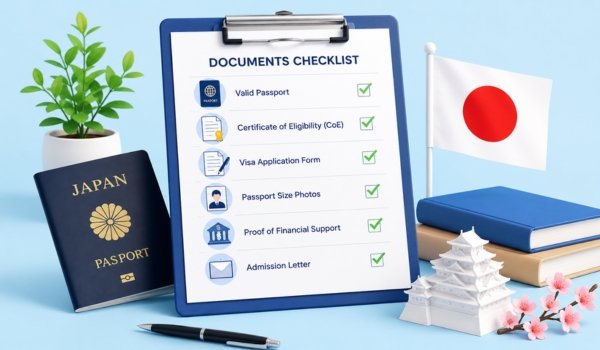
To apply for a Japan student visa, you’ll need a valid passport, Certificate of Eligibility (CoE), completed visa application form, photos, and financial proof. Requirements vary slightly by country and institution, so confirm with your nearest Japanese embassy before submitting.
Getting accepted into a Japanese university or language school is a major achievement. But before you book your flight or start packing, there’s one critical step that stands between you and your studies in Japan: securing your student visa.
The documentation process can feel overwhelming, especially if this is your first time navigating international student immigration. Miss a single required document, and your application could be delayed by weeks—or rejected entirely. That’s not a risk worth taking.
This guide walks you through every document you’re likely to need for a Japan study visa application, explains why each one matters, and highlights the common mistakes that trip up applicants. By the time you finish reading, you’ll know exactly what to prepare, in what order, and what to double-check before submitting.
Whether you’re enrolling in a Japanese language school, an undergraduate program, or a graduate research course, the core documentation requirements are largely the same. Let’s break them down.
What Exactly Is a Japan Student Visa, and Who Needs One?
A Japan student visa—officially known as a “Student” status of residence—is a long-term visa that allows foreign nationals to study in Japan for more than 90 days. It’s issued for programs at recognized educational institutions, including universities, junior colleges, professional training colleges, and accredited Japanese language schools.
If your course lasts 90 days or fewer, you may be able to enter Japan on a short-stay visa or visa waiver, depending on your nationality. However, for most degree programs and language school enrollments of three months or more, the student visa is required.
Citizens of countries with visa exemption agreements with Japan—such as the United States, Australia, the United Kingdom, and most EU member states—still need a student visa for long-term study. The exemption only applies to short tourism or business stays.
What Are the Core Documents Required for a Japan Study Visa Application?
These are the documents that virtually every applicant will need, regardless of their home country or chosen institution.
1. A Valid Passport With Sufficient Validity
Your passport must be valid for the entire duration of your intended stay in Japan. While Japan does not specify a minimum remaining validity period for student visa applications, most immigration advisors recommend having at least six months of validity beyond your planned departure date. Make sure your passport has at least one or two blank pages for visa stamps.
2. Certificate of Eligibility (CoE)
The Certificate of Eligibility is arguably the most important document in your application. Issued by a Japanese Regional Immigration Services Bureau, the CoE confirms that your planned activities in Japan comply with Japanese immigration law. In most cases, your Japanese school or university applies for the CoE on your behalf—you don’t submit this application yourself.
Once your institution secures the CoE, they’ll mail the original to you. You then submit this document to your nearest Japanese embassy or consulate along with your other materials. Processing the CoE typically takes one to three months, so your institution will usually begin this process well in advance of your enrollment date.
3. Completed Visa Application Form
The standard visa application form for Japan is available from your local Japanese embassy or consulate website. Fill it out completely in block letters or print it digitally. Errors, omissions, or inconsistencies between your application form and supporting documents are a common cause of delays.
4. Recent Passport-Size Photographs
You’ll need one or two passport-size photos (specifications vary slightly by embassy, but 4.5cm x 4.5cm is standard). Photos must be recent—typically taken within the last six months—with a plain white or light-colored background, no hats or glasses, and a neutral facial expression. Digital photos are not accepted; you must provide physical prints.
5. Proof of Financial Ability to Support Yourself
Japanese immigration authorities need to see that you can cover your tuition, accommodation, and living expenses without working illegally. Acceptable financial documents typically include:
- Bank statements from the past three to six months
- A scholarship award letter (if applicable)
- A financial guarantee letter from a sponsor, such as a parent or guardian
- Proof of employment or income if you are self-funding
The required balance varies, but many advisors recommend demonstrating access to at least ¥2,000,000 to ¥3,000,000 JPY (approximately $13,000–$20,000 USD) to cover a full year of study, tuition, and living costs.
6. Academic Records and Transcripts
You’ll generally need to provide copies of your highest completed educational qualification. For university applicants, this means your bachelor’s degree certificate and official transcripts. For language school applicants, proof of high school graduation (or equivalent) is usually sufficient. These documents may need to be officially translated into Japanese if they’re in another language.
7. Admission Letter or Enrollment Confirmation
A formal letter from your Japanese educational institution confirming your acceptance into their program is required. This document should include your course name, start date, duration, and tuition fee details.
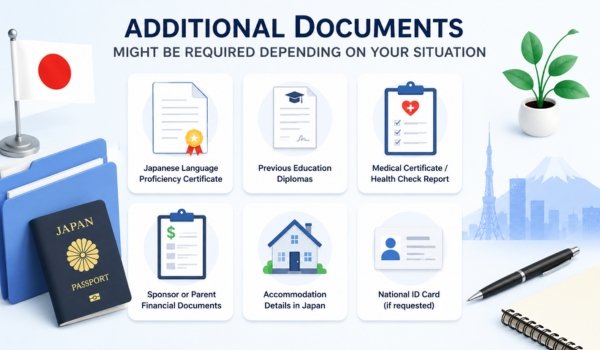
What Additional Documents Might Be Required Depending on Your Situation?
Beyond the core checklist, some applicants will need to provide supplementary materials. Here’s what may apply to you.
What if a Sponsor Is Covering Your Expenses?
If someone else—such as a parent, relative, or employer—is funding your study in Japan, you’ll need to submit documents on their behalf as well. These typically include:
- The sponsor’s bank statements
- A notarized letter of financial support
- Proof of their income (e.g., employment certificate or tax returns)
- Their relationship to you (e.g., birth certificate or family registration document)
What if You’re Applying for a Research or Graduate Program?
Graduate students and research scholars may need to provide additional academic documentation, including a research proposal, letters of recommendation from academic supervisors, and a letter of acceptance from a specific Japanese professor or research laboratory.
What if Your Documents Are in a Language Other Than Japanese or English?
Japanese embassies generally accept supporting documents in Japanese or English. Documents in any other language must be accompanied by a certified translation. Your institution or a professional translation service can assist with this.
How Do You Submit Your Japan Student Visa Application Correctly?
Once you have all your documents in order, submit your complete application in person at the Japanese embassy or consulate with jurisdiction over your area of residence. Walk-in applications are accepted at most embassies, but some require appointments—check your local embassy’s website before you go.
Processing times generally range from five to seven business days after submission, though this can vary depending on the embassy’s workload and the time of year. Avoid submitting your application too close to your intended departure date; aim for at least four to six weeks before your program start date.
According to the Japan Ministry of Foreign Affairs, applicants must appear in person to collect their visa once it has been approved. You cannot authorize a third party to collect it on your behalf in most cases.
For a broader overview of what to expect when preparing for life in Japan as a student — including housing, language requirements, and cost of living—visit the GoGoNihon student guide for practical, experience-based resources.
What Are the Most Common Reasons Japan Student Visa Applications Get Rejected?
Understanding why applications fail is just as important as knowing what to submit. According to immigration practitioners, the most frequent issues include:
- Incomplete or inconsistent documentation: Discrepancies between your application form and supporting documents raise red flags.
- Insufficient financial proof: Providing bank statements that don’t clearly demonstrate adequate funds is one of the top rejection causes.
- Expired or invalid passport: Submitting a passport that expires too close to your study period.
- Missing certified translations: Submitting documents in languages other than Japanese or English without translation.
- CoE not yet received: Applying before your Certificate of Eligibility has been issued.
If your application is rejected, the embassy will typically provide a reason. You may be able to reapply with corrected documentation, but this takes additional time—so getting it right the first time is essential.
For a detailed breakdown of Japanese language school options and how to choose the right one for your goals, the GoGoNihon school search tool is a helpful starting point for prospective students.
Start Your Japan Study Visa Application Early—Here’s Why It Pays Off
The single most actionable piece of advice for prospective students? Start early. The Certificate of Eligibility alone can take up to three months to process. Add the time needed to gather financial documents, arrange certified translations, and schedule an embassy appointment, and you’re looking at a four- to five-month lead time at minimum.
Create a checklist based on your specific situation—whether you’re self-funded or sponsored, enrolling in a language school or a university—and work through it systematically. Contact your Japanese institution early to confirm their CoE application timeline, and reach out to your local Japanese embassy to verify any country-specific requirements that may apply to you.
The paperwork involved in a Japan student visa application is detailed, but it’s entirely manageable with the right preparation. Thousands of international students successfully complete this process every year. With this checklist in hand, you’re well-equipped to do the same.
Frequently Asked Questions About Japan Study Visa Documents
How long does it take to get a Japan student visa after submitting all documents?
After submitting a complete application to your local Japanese embassy or consulate, processing typically takes five to seven business days. However, this doesn’t account for the time required to obtain the Certificate of Eligibility from Japan, which can take one to three months. Plan for a total lead time of at least four to five months from the start of your application process.
Can I apply for a Japan student visa without a Certificate of Eligibility?
In most cases, no. The Certificate of Eligibility is a mandatory component of the Japan student visa application. Without it, embassies will not process your visa request. Your educational institution in Japan is responsible for applying for the CoE on your behalf through the local Regional Immigration Services Bureau.
Do I need to translate my academic documents into Japanese for the visa application?
Documents in Japanese or English are generally accepted as-is. Documents in any other language must be accompanied by a certified translation. Check with your specific Japanese embassy for their exact requirements, as policies can vary slightly by location.
What is the minimum bank balance required to qualify for a Japan student visa?
There is no universally fixed minimum, but immigration advisors generally recommend demonstrating access to ¥2,000,000–¥3,000,000 JPY (roughly $13,000–$20,000 USD) to cover a full year of tuition and living expenses. The exact amount will depend on your school’s tuition fees, your accommodation arrangements, and your expected living costs.
Can a family member sponsor my Japan student visa application?
Yes. A parent, sibling, or other close relative can act as your financial sponsor. You will need to provide their bank statements, a signed letter of financial support, proof of their income, and documentation confirming your relationship (such as a birth certificate or family register).
What happens if my Japan student visa application is rejected?
The embassy will typically indicate the reason for rejection. You may reapply after addressing the issue—whether that’s providing additional financial documentation, obtaining a certified translation, or waiting for your CoE to be issued. There is no standard waiting period between applications, but reapplication takes time, so resolving issues promptly is important.
