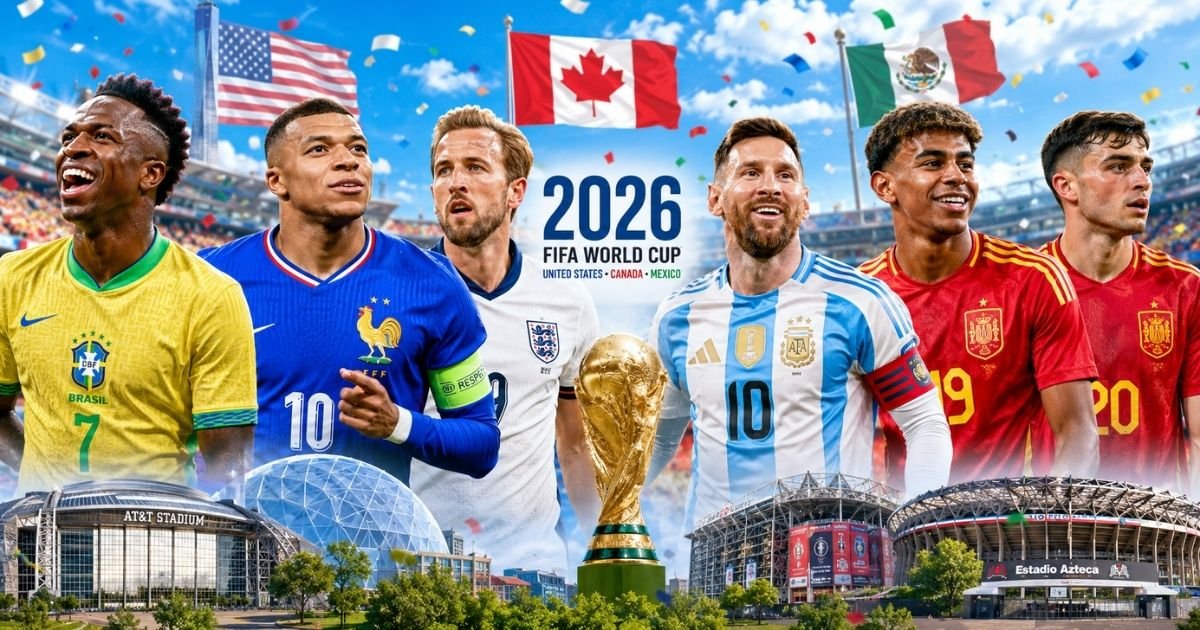
Brazil, France, and England are among the strongest contenders for the 2026 FIFA World Cup, based on squad depth, recent tournament form, and the expanded 48-team format that rewards consistent quality across multiple rounds. Argentina, as defending champions, remain a serious threat despite Lionel Messi’s advancing age.
The 2026 FIFA World Cup is shaping up to be the most anticipated tournament in the competition’s history. For the first time ever, the event will be jointly hosted by the United States, Canada, and Mexico—spanning 16 cities across three countries. The expanded 48-team format means more matches, more upsets, and a longer road to glory. For the favorites, that’s both an opportunity and a risk.
Predicting a World Cup winner is never straightforward. History is littered with teams that looked unbeatable on paper only to crumble under tournament pressure, and with dark horses that came from nowhere to lift the trophy. But form, squad depth, and coaching quality do matter—and when you examine those factors carefully, a few names consistently rise to the top. That’s why the question of Who Will Win 2026 FIFA World Cup is already generating intense debate among football fans, analysts, and former players around the world.
This post breaks down the most credible contenders for the 2026 title, analyzing their strengths, weaknesses, and realistic chances of going all the way. Whether you follow international football obsessively or just want a confident pick before the tournament kicks off, here’s what the evidence points to.
Table of Contents
Which Teams Are the Strongest Contenders for the 2026 World Cup?
Brazil: The Perennial Favorites With a Point to Prove
Brazil hasn’t won a World Cup since 2002—the longest drought in the nation’s modern football history. That fact alone gives the 2026 squad significant motivation. With a generation of elite attacking talent now in their prime, including Vinicius Jr., Rodrygo, and Endrick, Brazil’s offensive firepower is arguably the deepest it has been in two decades.
The key question for Brazil heading into 2026 is stability. The Seleção cycled through managerial changes and inconsistent qualifying performances in the lead-up to the tournament, which has historically been a warning sign. But with the right tactical setup and a full squad of fit players, Brazil has the individual quality to beat anyone on any given day.
Strong favorite, particularly if their defensive structure holds under pressure in the knockout rounds.
France: The Most Complete Squad in the World?
France enters 2026 as the team with arguably the most balanced squad across all positions. Kylian Mbappé, now leading the line as one of the most complete forwards in the world, will be 27 years old—right in his peak years. Behind him, France boasts depth in midfield and defense that few nations can match.
Les Bleus won the World Cup in 2018 and reached the final in 2022, losing to Argentina on penalties after an extraordinary comeback. That near-miss will sharpen their focus. France also benefits from a rich pool of domestic talent emerging from Ligue 1 and Europe’s top clubs, meaning injuries are less likely to derail their campaign.
France is the most consistently dangerous team in world football and the single most likely winner heading into 2026.
England: Decades of Hurt, One Final Chance for This Generation
England’s 2024 European Championship final appearance—their second consecutive major final—confirmed that this generation of players has broken through the psychological barriers that plagued previous squads. Under a tactically astute manager, England has developed a defensive resilience that complements their attacking talent.
Jude Bellingham, who will be 22 at the time of the 2026 tournament, represents the kind of generational midfielder who can single-handedly change games at the highest level. Combined with Harry Kane’s goalscoring record and a talented supporting cast, England’s squad has genuine depth for the first time in years.
The concern for England is their tendency to underperform in the early knockout rounds under pressure. However, tournament experience is accumulating rapidly, and 2026 could be the year the pattern finally breaks.
A genuine contender, with the squad quality to go all the way if the pieces fall into place.
Argentina: Can the World Champions Defend Without Messi?
Argentina’s 2022 World Cup triumph in Qatar was one of the most emotionally charged title wins in tournament history. Lionel Messi, widely regarded as the greatest player of all time, finally claimed the one trophy that had eluded him. The question for 2026 is stark: how much does Messi have left, and can Argentina compete at the highest level if he isn’t at his best—or isn’t there at all?
Messi will be 38 years old during the 2026 tournament. While he has defied age expectations consistently, tournament football at that intensity is a different demand. Argentina’s squad beyond Messi—Lautaro Martínez, Enzo Fernández, and Alexis Mac Allister among them—is genuinely strong. But the psychological and tactical reliance on Messi remains a real structural question.
Dangerous in any tournament, but defending the title without peak Messi is a significant challenge.
Spain: The Silent Threat With a Tactical Edge
Spain’s 2024 European Championship victory—their fourth, a record—announced the arrival of a new golden generation. Built on the same positional play principles that made the 2010 World Cup-winning squad so dominant, this version of Spain is faster, more direct, and harder to press.
Pedri, Lamine Yamal, and Nico Williams give Spain a midfield and wide combination that can unlock any defensive structure. Head coach Luis de la Fuente has crafted a tactical system that is simultaneously difficult to play against and genuinely exciting to watch. Spain will enter 2026 as tournament-hardened, confident, and deeply organized.
Spain is the most underrated favorite. Do not sleep on them.
What Does the New 48-Team Format Mean for Favorite Nations?
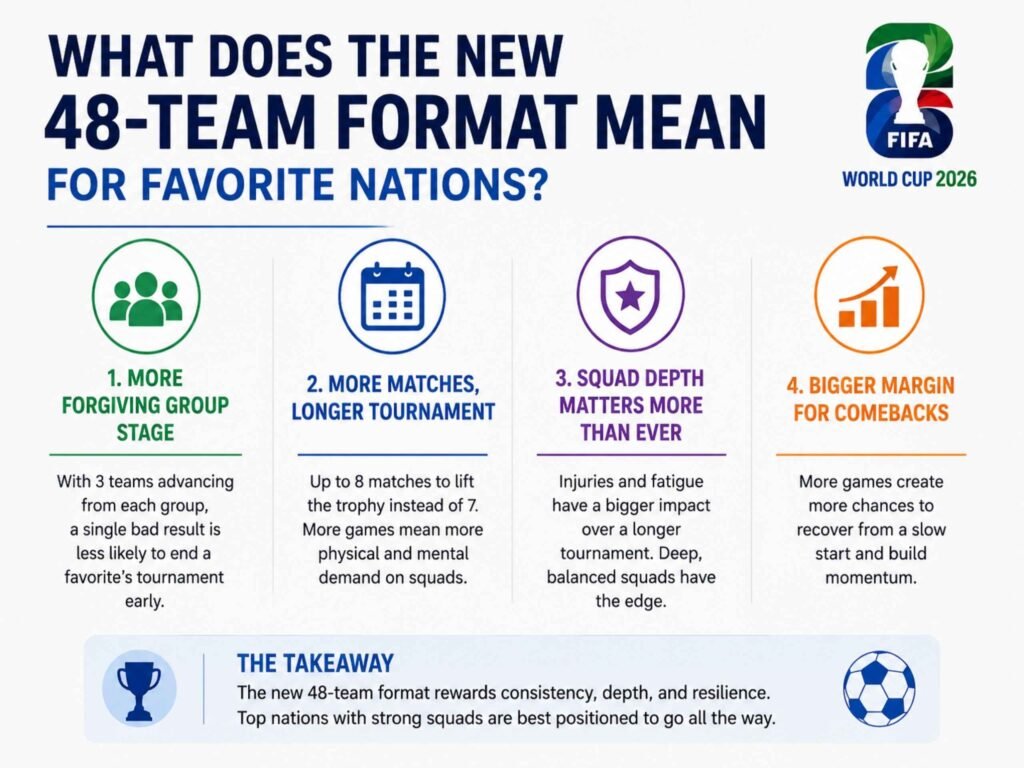
The 2026 World Cup expands from 32 to 48 teams for the first time in the tournament’s history. That means three additional rounds of matches for the teams that go deepest, and a new league-style group stage where three teams per group advance.
For the major favorites, this creates two dynamics. First, the group stage is more forgiving—a single bad result is less likely to eliminate a quality team early. Second, the path to the final is longer, meaning squad depth and physical resilience matter more than ever. Teams that rely heavily on one or two star players face a compounded injury risk across more matches.
France and Spain, both of whom have exceptional depth across their squads, benefit most from this format. Smaller favorites like Portugal, whose ceiling is closely tied to Cristiano Ronaldo’s performance, may face more exposure as the tournament extends.
Which Dark Horses Could Surprise at the 2026 World Cup?
No World Cup prediction piece would be complete without acknowledging the teams that could disrupt the established order. A few names deserve serious attention:
- Germany: A nation with five World Cup titles and a rebuilt squad hungry to end a cycle of early exits. If their generational talent—Florian Wirtz chief among them—delivers on potential, Germany can challenge the very best.
- Portugal: Likely playing in what would be Cristiano Ronaldo’s final World Cup, Portugal has a supporting cast that is genuinely world-class. Rafael Leão, Bernardo Silva, and Vitinha can carry a campaign even if Ronaldo’s role evolves.
- United States (host nation): The USA enters 2026 with home advantage and an exciting generation of players, including Christian Pulisic, gaining senior experience at Europe’s top clubs. Host nations historically outperform expectations—the USA reached the knockout stages in 2002 and could do so again, potentially deeper.
- Morocco: Their semifinal run in 2022 was the furthest an African nation has ever gone at a World Cup. The squad’s defensive organization and tournament mentality make them a credible threat to upset European and South American giants.
What Are the Best Predictions for the 2026 World Cup Winner?
Based on squad quality, recent form, tactical development, and tournament experience, the current evidence points to the following hierarchy:
- France — Most complete squad, peak players at prime age, motivated by 2022 final heartbreak
- Brazil — Devastating attacking depth, strong motivation to end a 24-year drought
- Spain — Reigning European champions with a cohesive system and young talent at peak confidence
- England — Improving trajectory, experienced knockout players, Bellingham as a difference-maker
- Argentina — Tournament DNA is unquestionable, but Messi’s age is the central uncertainty
Read our complete FIFA World Cup 2026 Predictions for a deeper analysis of every contender. The eventual champion could also produce the next World Cup Golden Ball winner. A title-winning campaign often includes a serious Golden Boot challenger. The expanded format could make this the most historic World Cup ever staged.
Frequently Asked Questions About the 2026 World Cup
Where will the 2026 FIFA World Cup be held?
The 2026 FIFA World Cup will be jointly hosted by the United States, Canada, and Mexico across 16 cities. It will be the first World Cup hosted by three nations simultaneously.
How many teams will compete in the 2026 World Cup?
48 teams will compete in the 2026 World Cup, up from 32 at the 2022 tournament in Qatar. The expanded format introduces a new group stage structure where 16 groups of three teams each play a round-robin, with the top two from each group—plus eight best third-place finishers—advancing.
Who are the top favorites to win the 2026 World Cup?
France, Brazil, and Spain are considered the top favorites based on squad depth, recent tournament performance, and tactical organization. England and Argentina are close behind as credible contenders.
Will Lionel Messi play at the 2026 World Cup?
Messi has not officially confirmed his participation as of early 2025, and he will be 38 years old during the tournament. His involvement remains uncertain, though he has not ruled it out.
Has the United States ever won the FIFA World Cup?
No. The United States has never won the FIFA World Cup. Their best result remains a third-place finish at the inaugural 1930 tournament. As co-hosts in 2026, they will be expected to advance further than in recent editions.
Which nation has won the most World Cup titles?
Brazil holds the record for the most FIFA World Cup titles, having won the tournament five times (1958, 1962, 1970, 1994, 2002). Germany and Italy follow with four titles each.
The Verdict: France, Brazil, or Spain Will Lift the Trophy
The 2026 FIFA World Cup is still months away, and tournaments have a way of humbling even the most considered predictions. But if the current evidence holds—squad depth, age profiles, recent form, and coaching quality—France enters as the team most likely to be holding the trophy at the end of it all.
Brazil and Spain are not far behind, and both have realistic paths to the final. England and Argentina carry the kind of talent and tournament pedigree to complicate anyone’s prediction. What’s certain is that 2026 will be the biggest, most expansive World Cup in history. With 48 teams, three host nations, and a generation of world-class players at or near their peaks, the race for football’s greatest prize has never been more wide open.
Mark your calendars. This one is going to be special.
