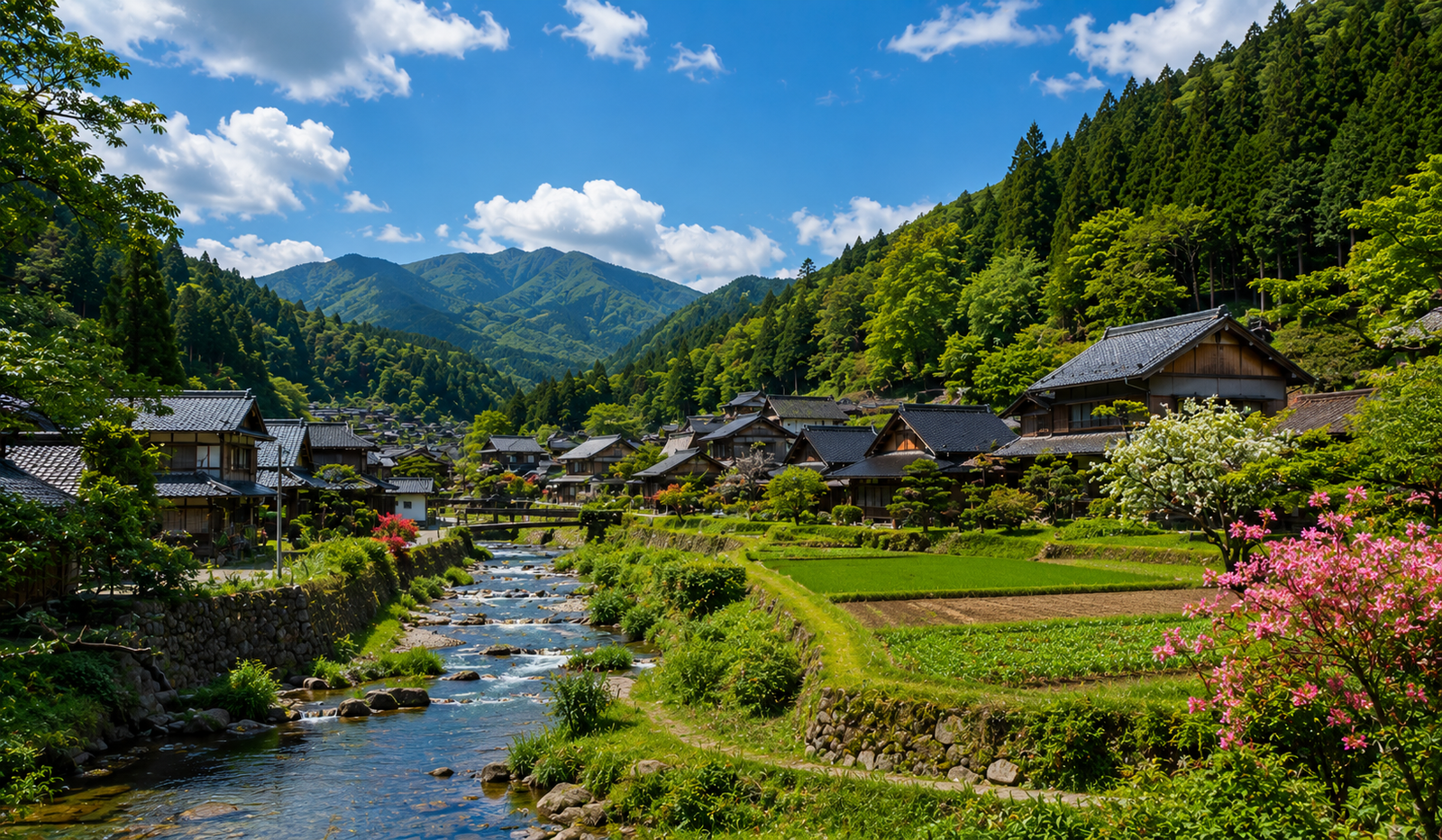
Rural Japan Travel and the Best Countryside Places to Explore
Rural Japan offers a quieter, more authentic side of the country—think mountain villages, ancient temples, rice terraces, and traditional inns (ryokan) that Tokyo simply can’t replicate. This guide covers where to go, when to visit, how to get around, and what to expect when you venture beyond Japan’s major cities.
Japan’s most famous destinations—Tokyo, Osaka, Kyoto—draw millions of visitors every year, and for good reason. But millions of travelers pass through those cities and never see the other Japan. The one where elderly farmers tend rice terraces by hand. Where you can soak in an outdoor hot spring with no one around for miles. Where a family-run ryokan serves you a 12-course kaiseki dinner, then lays out your futon while you’re not looking.
That Japan exists, and it’s hiding in plain sight. Rural Japan—known locally as inaka—covers roughly 90% of the country’s land area but receives a fraction of its tourist traffic. That’s not a deterrent. That’s exactly the point.
This guide will walk you through the best rural regions to explore, the logistics of getting there, what to eat and where to stay, and the cultural nuances that will make or break your experience. Whether you have five days or five weeks, rural Japan rewards the traveler who slows down.
Why Is Rural Japan Worth Visiting Instead of Staying in the Cities?
The short answer: because the cities are already well-covered, and rural Japan offers something most modern travel simply doesn’t—genuine stillness.
Japan’s countryside is the product of centuries of agricultural tradition, religious practice, and deeply local identity. Villages like Shirakawa-go (a UNESCO World Heritage Site in Gifu Prefecture) have preserved their distinctive gassho-zukuri farmhouses—steep, thatched-roof structures designed to withstand heavy snowfall—since the Edo period. Walking through the village in winter, surrounded by snow-capped rooftops and lantern light, feels like stepping into a woodblock print.
Beyond the aesthetics, rural Japan offers something increasingly rare: access. You can walk into a 400-year-old temple without a crowd. You can strike up a conversation with a local artisan in a pottery town like Mashiko. You can hike the Nakasendo trail—an ancient highway that once connected Kyoto and Edo—through post towns that have barely changed in two centuries.
It’s also, counterintuitively, more affordable. Accommodation, food, and transport in rural areas often cost significantly less than their urban counterparts, and the quality of the experience tends to be higher.
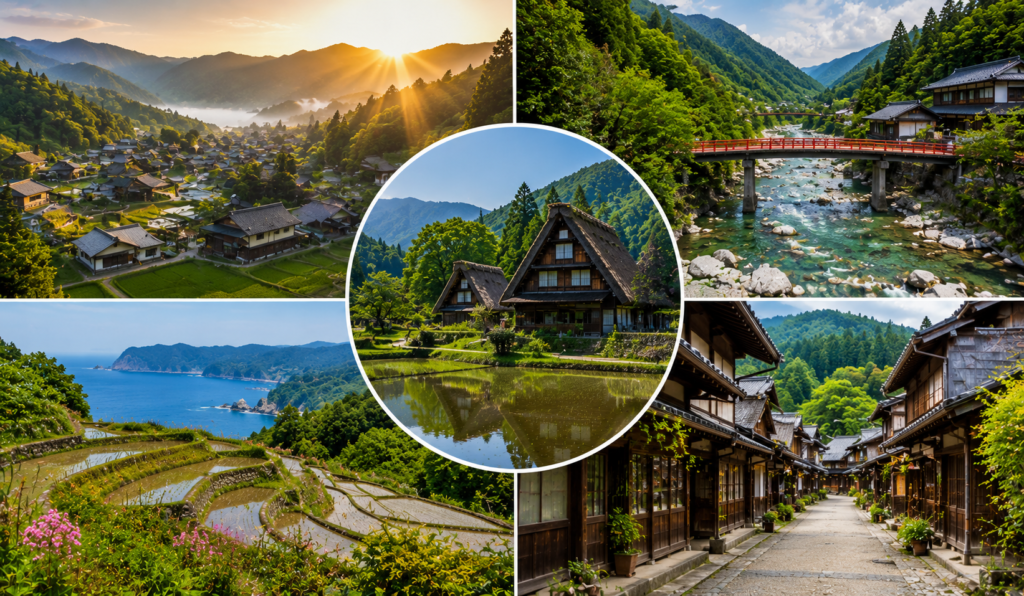
What Are the Best Rural Regions to Visit in Japan?
Japan’s rural landscape is extraordinarily diverse—from the subtropical forests of Yakushima Island to the volcanic highlands of Hokkaido. Here are the regions that consistently deliver the most rewarding experiences for travelers.
Tohoku: Japan’s Overlooked North
Tohoku, the northeastern region of Honshu, remains one of the most undervisited parts of Japan among international travelers. That oversight is a genuine gift for those who make the trip. The region encompasses six prefectures—Aomori, Iwate, Miyagi, Akita, Yamagata, and Fukushima—each with its own distinct landscape and culture.
Aomori Prefecture is home to Lake Towada, a caldera lake of striking clarity, as well as the Oirase Gorge—a 14-kilometer forested river trail that is arguably one of Japan’s most beautiful autumn walks. Akita Prefecture offers the remote Oga Peninsula, where the Namahage Festival (held every New Year’s Eve) features villagers dressed as demons visiting homes to frighten children into good behavior. It’s unusual, deeply local, and not remotely curated for tourists.
Yamagata Prefecture contains Yamadera, a mountain temple complex (formally called Risshakuji) that requires climbing 1,015 stone steps to reach the main hall. The views from the top, over a valley of cedar and maple, justify every step.
Gifu and the Japanese Alps
Gifu Prefecture sits at the heart of the Japanese Alps and is the gateway to several of Japan’s most photogenic rural destinations. Shirakawa-go, as mentioned, is the headline attraction—but the surrounding Hida region offers just as much.
Takayama, a small city in the mountains, functions as the ideal rural base camp. Its preserved Edo-period merchant district, Sanmachi Suji, is lined with sake breweries, craft shops, and traditional townhouses. The twice-yearly Takayama Festival (held in April and October) is listed among Japan’s three most beautiful festivals, featuring elaborate floats with mechanical puppet performances.
Deeper into the mountains, the village of Ogimachi in Shirakawa-go and the nearby Gokayama region (also a UNESCO site) offer ryokan stays inside actual gassho-zukuri farmhouses—a genuinely rare accommodation experience.
Kyushu’s Rural Interior
Most travelers to Kyushu limit themselves to Fukuoka and Nagasaki. The island’s interior, however, contains some of Japan’s most dramatic landscapes. The Aso-Kuju National Park centers on Mount Aso, one of the world’s largest active volcanic calderas, with a rim road that cuts through open grasslands managed by controlled burns since ancient times.
The Yufuin and Kurokawa Onsen areas in Oita Prefecture are rural hot spring towns—the latter particularly beloved for its network of open-air baths cut into a wooded river valley. Unlike the more commercial Beppu nearby, Kurokawa Onsen has deliberately limited development to preserve its atmosphere.
Shikoku: The Pilgrimage Island
Shikoku, the smallest of Japan’s four main islands, is the home of one of Buddhism’s most significant pilgrimage routes: the 88-temple Shikoku Pilgrimage, associated with the monk Kukai (Kobo Daishi). Walking the full circuit covers approximately 1,200 kilometers and takes 30 to 60 days. Many travelers walk sections rather than the whole route.
Even without the pilgrimage, Shikoku rewards rural travel. The Iya Valley in Tokushima Prefecture is one of Japan’s most isolated regions—a deep mountain gorge with vine bridges, terraced hamlets, and a landscape that inspired the term kakuriyo (hidden world). Kochi Prefecture’s Cape Ashizuri is the island’s southernmost point and home to Kongofukuji Temple, a remote coastal complex that marks the route’s end.
When Is the Best Time to Visit Rural Japan?
Timing matters more in rural Japan than in the cities, because many rural experiences are seasonal by nature.
Spring (late March to May) is cherry blossom season, and rural Japan’s sakura often outlasts the cities’ by a week or two, since mountain temperatures rise more slowly. Villages like Kakunodate in Akita Prefecture are known for their shidarezakura (weeping cherry trees).
Autumn (mid-October to late November) brings koyo—fall foliage—which is genuinely spectacular in forested mountain regions. Tohoku and the Japanese Alps are particularly vivid.
Winter (December to February) suits travelers heading to Shirakawa-go, where the farmhouses under snow are at their most dramatic. The region’s tourism authority hosts special nighttime illumination events on select weekends, during which the village is lit from within. Tickets are released months in advance and sell out quickly.
Summer (June to August) is humid and occasionally typhoon-prone, but the Japanese mountain regions offer cooler temperatures than the cities. Festivals are concentrated in summer—including the famous Nebuta Festival in Aomori and Awa Odori in Tokushima.
How Do You Get Around Rural Japan Without Getting Lost?
This is the practical question most travelers struggle with, and the honest answer is: it takes planning, but it’s very manageable.
The Japan Rail Pass covers the Shinkansen and most JR local lines, making it the essential starting point for rural travel. From the Shinkansen network, rural regions are typically reached by a combination of local JR trains and bus services. The Jorudan route planner is the most reliable tool for mapping multi-modal journeys, including rural bus routes that Google Maps occasionally misses.
In areas like the Iya Valley or the more remote parts of Tohoku, a rental car is genuinely the best option. Japan’s rural roads are well-maintained and signposted (with increasing amounts of English signage), and driving gives you access to villages and viewpoints that public transport simply doesn’t reach. International travelers can drive in Japan using an International Driving Permit (IDP) alongside their home country license.
For the Shikoku Pilgrimage, many travelers use a combination of walking, cycling, and local bus, depending on time and physical ability. Organized tour operators also offer self-guided packages with accommodation pre-booked along the route—a practical option for travelers who want the experience without the full logistical burden.
Where Should You Stay and What Should You Eat in Rural Japan?
Accommodation in rural Japan centers on the ryokan—a traditional inn where the room, bedding, and meals are all part of a single experience. A well-run ryokan offers futon bedding on tatami floors, a private or shared onsen (hot spring bath), and a multi-course kaiseki dinner using local, seasonal ingredients.
Prices vary considerably. Budget ryokan can run from ¥8,000 to ¥15,000 per person per night including dinner and breakfast. Higher-end properties—particularly in Kurokawa Onsen and around the Kyoto countryside—can exceed ¥50,000 per person. The Japanese Inn Group is a good starting point for finding mid-range, English-friendly ryokan options across rural regions.
Food in rural Japan is hyperlocal in the best possible sense. In Takayama, look for Hida beef (a wagyu variety less internationally marketed than Kobe but comparably rich), mitarashi dango (grilled rice dumplings), and sake produced from Hida’s snowmelt water. In Tohoku, kiritanpo (grilled rice skewers in hot pot) is Akita’s most celebrated dish. In Shikoku, Kochi’s katsuo no tataki—bonito seared over rice straw and served with ginger and garlic—is one of Japan’s most distinctive regional preparations.
Convenience stores (konbini)—particularly 7-Eleven and Lawson—are ubiquitous even in rural towns and serve as reliable backup for meals, snacks, and supplies. Don’t dismiss them: Japan’s konbini food quality is genuinely high.
What Cultural Norms Should You Know Before Visiting Rural Japan?
Rural Japan is generally more conservative and less accustomed to international visitors than Tokyo or Osaka. A few practices go a long way.
Learn a handful of Japanese phrases before you arrive. “Sumimasen” (excuse me), “arigatou gozaimasu” (thank you), and “eigo no menyu wa arimasu ka?” (do you have an English menu?) will serve you well. Google Translate’s camera function, which translates text in real time, is invaluable for navigating menus and signage.
Respect onsen etiquette: shower thoroughly before entering the communal bath, don’t bring towels into the water, and be aware that most onsen prohibit entry for guests with visible tattoos (though policies vary, and some rural onsen are more flexible than urban ones).
In temples and shrines, follow the posted rules. Photography is often restricted inside main halls. Remove shoes when entering any tatami-floored space. At Shinto shrines, the established practice is two bows, two claps, one bow at the main hall—locals will notice if you follow it, and it signals respect.
Finally, carry cash. Rural Japan remains largely cash-dependent, and many ryokan, small restaurants, and market stalls don’t accept cards.
Is Rural Japan Safe for Solo Travelers and First-Time Visitors?
Rural Japan is among the safest travel destinations in the world. Japan’s overall crime rate is exceptionally low, and rural areas are generally safer than cities by every available measure. Solo travelers—including solo female travelers—consistently rank Japan as one of the most comfortable countries to navigate alone.
The primary challenge for first-time visitors is the language barrier, which is more pronounced in rural areas than in major cities. English signage is improving, particularly on transport routes, but restaurant menus, inn communications, and local interactions will frequently require either a translation app or a patient host. Many rural ryokan now offer basic English communication, particularly those that have listed on international booking platforms.
The second consideration is physical accessibility. Several of Japan’s most compelling rural destinations—Yamadera’s 1,015 steps, the Iya Valley’s vine bridges, the Nakasendo trail—involve significant walking on uneven terrain. This isn’t a barrier so much as a planning consideration.
Frequently Asked Questions About Traveling to Rural Japan
Do I need to speak Japanese to travel in rural Japan?
You don’t need to be fluent, but basic phrases and a reliable translation app (Google Translate with downloaded offline Japanese language files) make a substantial difference. Many rural guesthouses and restaurants have limited English-speaking staff, so patience and non-verbal communication are genuinely useful skills.
How much does a rural Japan trip cost compared to visiting Tokyo?
Rural Japan is generally less expensive for accommodation and food. A mid-range ryokan with dinner and breakfast costs roughly ¥12,000–¥20,000 per person per night. Budget guesthouses and minshuku (family-run inns) can be ¥6,000–¥10,000. Transport costs depend heavily on how much ground you cover; the JR Pass is cost-effective for multi-region rural trips.
What is the best rural Japan itinerary for two weeks?
A strong two-week itinerary might include: Tokyo (2 nights) → Nikko (1 night) → Tohoku highlights including Yamadera and Kakunodate (3 nights) → Takayama and Shirakawa-go (3 nights) → Kyoto countryside including Kinosaki Onsen (2 nights) → Shikoku/Iya Valley (2 nights) → Osaka for departure (1 night). This covers four distinct rural regions without feeling rushed.
Are there rural Japan destinations accessible without a car?
Yes. Takayama, Shirakawa-go (by seasonal bus), Kakunodate, Yamadera, and most onsen towns are accessible by public transport. The Iya Valley, parts of Tohoku, and Kyushu’s interior are significantly easier with a rental car.
When should I book rural ryokan accommodation?
For peak seasons—cherry blossom (late March to early May), autumn foliage (October to November), and winter illumination events—book three to six months in advance. Rural ryokan have limited rooms and fill quickly during these periods, particularly on weekends.
Start Planning Your Rural Japan Trip the Right Way
Rural Japan doesn’t require a special kind of traveler. It requires a traveler who’s willing to slow down, accept a little ambiguity, and trust that the detour will be worth it. In almost every case, it is.
The logistics are more manageable than they appear from the outside. The language barrier is navigable. The rewards—a farmhouse dinner by the light of paper lanterns, a mountain temple at dawn, a hot spring in the snow—are not available anywhere else on earth.
Start by picking one region rather than trying to cover everything. Read the Japan National Tourism Organization’s regional travel resources for current entry requirements and transportation updates. Book your ryokan early. And give yourself more time than you think you need—because rural Japan has a way of making you want to stay.
