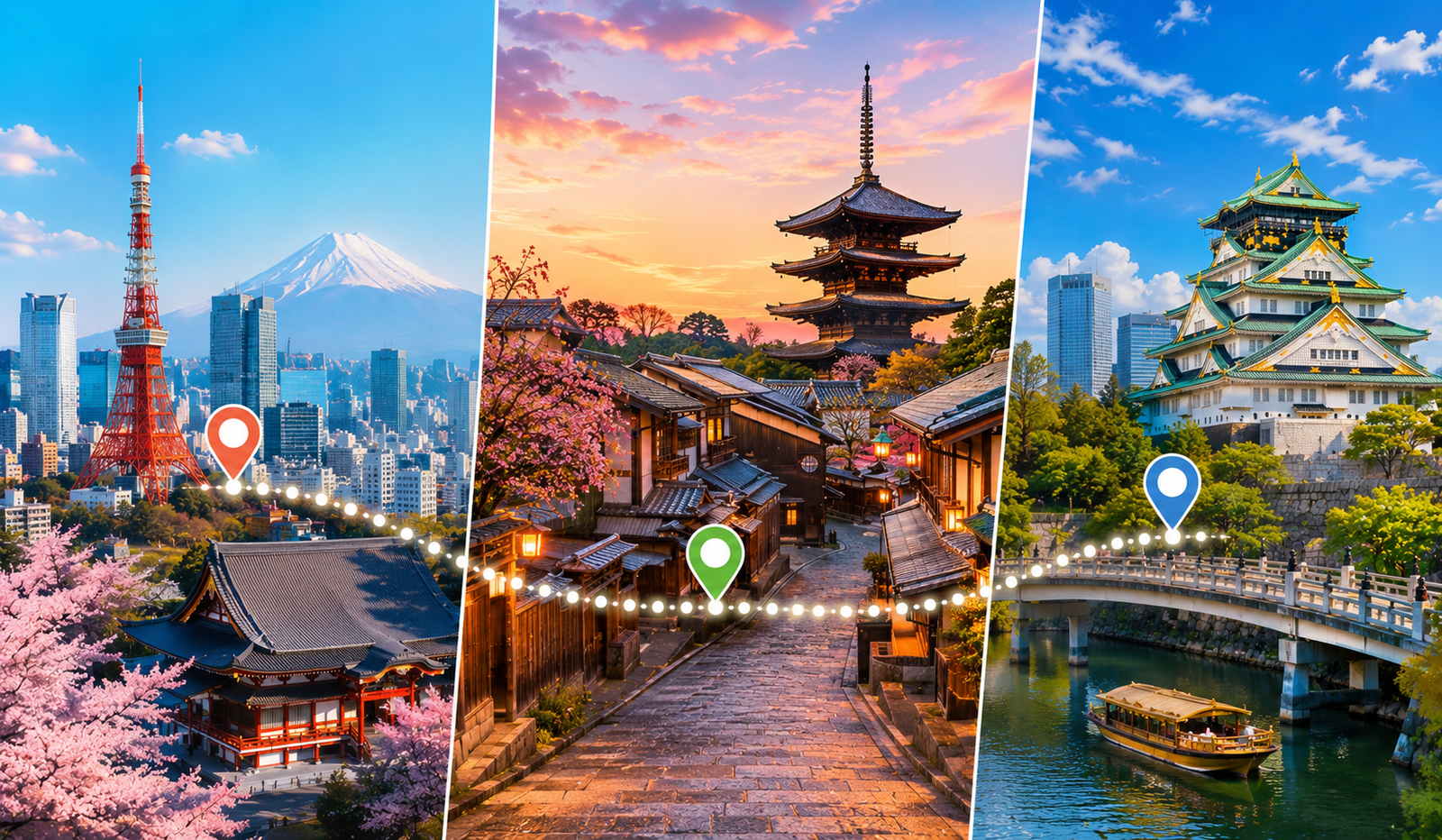
The Best Tokyo Kyoto Osaka Itinerary for First-Time Visitors
A Tokyo-Kyoto-Osaka itinerary is Japan’s most popular travel route for good reason. Covering modern city life, ancient temples, and world-class food, this classic circuit can be done comfortably in 10–14 days. This guide walks you through exactly how to plan it, day by day.
Japan has a way of surprising even the most seasoned travelers. You think you know what to expect—sushi, bullet trains, cherry blossoms—and then you step off the Shinkansen and realize the country is somehow more layered, more alive, and more extraordinary than anything you’d read about. The Tokyo-Kyoto-Osaka route is the most traveled path through Japan for a reason. These three cities don’t just sit next to each other on a map; they each represent a different dimension of Japanese life.
Tokyo is electric. It’s one of the largest cities on earth by population, yet remarkably orderly, clean, and efficient. Kyoto is its philosophical opposite—a city of wooden temples, zen gardens, and geisha districts that moves at a slower, more deliberate pace. Osaka sits between them in more ways than one: looser, louder, and arguably the best place in Japan to eat your way through an evening.
Planning a trip that does justice to all three takes some thought. How many days should you spend in each city? What’s the best order to visit them? How do you get around without overspending on transport? This guide answers all of those questions with a practical, day-by-day itinerary built for first-time visitors who want depth, not just highlights.
Whether you’re planning a 10-day trip or stretching it to two weeks, what follows is a framework you can adapt to your pace, budget, and interests.
How Many Days Do You Actually Need for Tokyo, Kyoto, and Osaka?
The honest answer: more than you think. Most travel guides suggest a minimum of 10 days for the full circuit, with 12–14 days being the sweet spot for a first visit. Here’s a rough breakdown of how to split your time:
- Tokyo: 4–5 days
- Kyoto: 3–4 days
- Osaka: 2–3 days
This gives you enough time to explore each city without the anxiety of constantly rushing to the next attraction. If your trip is shorter, lean toward cutting time from Osaka rather than Tokyo or Kyoto—Osaka’s key sights can realistically be covered in a single full day if needed.
What Is the Best Order to Visit Tokyo, Kyoto, and Osaka?
The most logical sequence is Tokyo → Kyoto → Osaka, and for good reason. Geographically, this route flows west along the Shinkansen (bullet train) line, allowing you to travel efficiently without backtracking. It also creates a satisfying narrative arc: you arrive in Japan’s most contemporary city, decompress into its most traditional one, then finish with a food-forward, energetic send-off in Osaka before flying home from Kansai International Airport.
Arriving into Tokyo (Narita or Haneda) and departing from Osaka (KIX) is a common strategy that avoids the need to double back—worth considering when booking flights.
How to Get Between Tokyo, Kyoto, and Osaka Affordably
The Japan Rail Pass is the most discussed transport option for international visitors, but it’s not always the cheapest. Whether it’s worth purchasing depends entirely on how many long-distance journeys you plan to make.
A single Tokyo–Kyoto Shinkansen ticket costs around ¥13,850 (approximately $95 USD) each way. If you’re making two or three long-distance trips during your visit, a 7-day JR Pass (currently priced at ¥50,000 for adults, as of 2024) can deliver real savings. For shorter trips or those sticking close to the Kansai region, individual tickets or an IC card (like Suica or Pasmo) may work out cheaper.
For getting around within each city, the subway systems in Tokyo, Kyoto, and Osaka are world-class. Kyoto also has an excellent bus network that connects most of the major temples and shrines. Loading your IC card before leaving Tokyo will save you time at ticket machines throughout the trip. Learn more about how the JR Pass works and whether it’s right for your itinerary here.
What Should You Do in Tokyo? A 4-Day Breakdown
Tokyo rewards slow exploration far more than a rushed tick-list approach. Here’s how to structure four full days:
Day 1: Shinjuku and Shibuya — Where Modern Tokyo Lives
Start in Shinjuku, one of Tokyo’s busiest entertainment and shopping districts. Spend the morning wandering Shinjuku Gyoen National Garden—particularly stunning during cherry blossom season (late March to early April) and autumn foliage (mid-November). In the afternoon, head to Shibuya to see the famous scramble crossing in person. It’s even more impressive than the photos suggest. End the evening in the backstreets of Shimokitazawa, a bohemian neighborhood known for vintage shops and live music.
Day 2: Asakusa and Ueno — Tokyo’s Historical Core
Senso-ji Temple in Asakusa is Tokyo’s oldest temple, dating back to 628 AD. Arrive early—before 8:00 AM if possible—to experience the grounds before the crowds arrive. From Asakusa, walk or take a short subway ride to Ueno, home to several of Japan’s top museums and Ueno Park. The Tokyo National Museum is the largest art museum in Japan and houses an extraordinary collection of Japanese art spanning thousands of years.
Day 3: Harajuku, Omotesando, and Akihabara
Harajuku and its famous Takeshita Street offer a window into Japanese youth culture—colorful, chaotic, and unlike anything else. A short walk brings you to Omotesando, sometimes called Tokyo’s Champs-Élysées, lined with high-end boutiques and striking architectural flagship stores. In the evening, take the subway to Akihabara, Tokyo’s legendary electronics and anime district. Even if you’re not a gamer, the sensory overload is worth experiencing.
Day 4: Tsukiji Outer Market and Tokyo Bay
Start early at the Tsukiji Outer Market (the inner wholesale market relocated to Toyosu, but the outer market remains) for an exceptional breakfast of sushi, tamago, and fresh seafood. Spend the afternoon exploring Odaiba, the artificial island in Tokyo Bay, or take a water bus along the Sumida River for a different perspective of the city skyline.
What Are the Must-See Sites in Kyoto on a 3-Day Itinerary?
Kyoto served as Japan’s imperial capital for over 1,000 years, and the city wears that history openly. With more than 1,600 Buddhist temples and 400 Shinto shrines, being selective is essential.
Day 5: Fushimi Inari and the Higashiyama District
Fushimi Inari Taisha is one of Japan’s most photographed sites—a seemingly endless tunnel of vermilion torii gates climbing Mount Inari. The full hike to the summit takes about two hours each way. Arrive before 7:00 AM to have the lower gates largely to yourself. In the afternoon, wander through the Higashiyama District, a well-preserved historic neighborhood with stone-paved lanes, craft shops, and the iconic Kiyomizudera Temple, which sits on a wooden stage overlooking the city.
Day 6: Arashiyama and the Bamboo Grove
The Arashiyama district sits on Kyoto’s western edge and feels genuinely removed from urban life. The Bamboo Grove is the obvious draw—a short but surreal walk through towering stalks that filter light in extraordinary ways. Nearby, Tenryu-ji Temple is a UNESCO World Heritage Site with a stunning traditional garden. After the temple, take a short hike to the Okochi Sanso Villa, a former actor’s hilltop estate with sweeping views over the Arashiyama valley.
Day 7: Nijo Castle, Kinkaku-ji, and Gion
Nijo Castle is one of Kyoto’s most underrated sites. Built in 1603 as the residence of the Tokugawa Shogunate, it features “nightingale floors” designed to chirp underfoot as a security measure—a genuinely fascinating piece of architectural history. From there, head to Kinkaku-ji, the famous Golden Pavilion, which genuinely glitters in person. Finish the day in Gion, Kyoto’s geisha district, best explored on foot after dark when the wooden machiya townhouses are lit from within. This Kyoto travel resource from the official Kyoto tourism board is useful for checking seasonal events and temple hours before you go.
Why Is Osaka the Perfect Place to End a Japan Trip?
Osaka has a well-earned reputation as Japan’s most fun city. The local saying “kuidaore”—roughly translated as “eat until you drop”—tells you everything you need to know about the city’s priorities. After the formality and refinement of Kyoto, Osaka’s energy feels liberating.
Day 8: Dotonbori, Shinsekai, and Osaka Castle
Dotonbori is Osaka’s neon-drenched entertainment strip, best experienced at night when the canal reflections amplify the lights. During the day, head to Osaka Castle, a striking 16th-century structure surrounded by a large park. In the afternoon, explore Shinsekai, an old-school neighborhood that feels like a retro theme park with its retro signage, kushikatsu restaurants, and Tsutenkaku Tower.
Day 9: Day Trip to Nara or Himeji
With Osaka as your base, two excellent day trips are within easy reach. Nara, accessible in about 45 minutes by train, is home to hundreds of freely roaming deer and the magnificent Todai-ji Temple, which houses Japan’s largest bronze Buddha statue. Himeji, about 50 minutes west of Osaka by Shinkansen, contains what many consider Japan’s finest surviving castle. Both are manageable in a day and add significant depth to a Japan itinerary.
Frequently Asked Questions About Planning a Tokyo Kyoto Osaka Trip
What is the best time of year to visit Tokyo, Kyoto, and Osaka?
Spring (late March to early April) and autumn (mid-November to early December) are widely considered the best seasons. Cherry blossom season and autumn foliage both transform the cities—particularly Kyoto—into something extraordinary. That said, these periods attract the heaviest tourist traffic. Traveling in early November or mid-March can offer similar scenery with slightly thinner crowds.
How much does a Tokyo Kyoto Osaka trip cost per day?
Budget travelers can get by on approximately $80–$100 USD per day, covering accommodation in hostels or budget hotels, meals at convenience stores and ramen shops, and public transport. Mid-range travelers should plan for $150–$250 USD per day, which allows for better hotels, sit-down restaurants, and entry fees. Japan is more affordable than many Western travelers expect, particularly for food.
Is it safe to travel solo in Japan?
Japan consistently ranks as one of the safest countries in the world for solo travelers. Violent crime is extremely rare, public transport runs on time and is clearly signposted in English, and locals are generally helpful—even with a language barrier. Solo travel through Tokyo, Kyoto, and Osaka is straightforward and highly recommended.
Do you need to speak Japanese to travel in Japan?
No—though learning a handful of phrases (thank you: arigatou gozaimasu; excuse me: sumimasen) goes a long way in terms of goodwill. Major tourist sites, train stations, and most restaurants in tourist areas have English signage. Google Translate’s camera feature is also remarkably useful for menus and signs.
Is the Japan Rail Pass worth buying for a Tokyo Kyoto Osaka itinerary?
For a 10–14 day trip that includes at least two long-distance Shinkansen journeys (e.g., Tokyo–Kyoto and Kyoto–Osaka), a 7-day JR Pass is likely worth the investment. Run the numbers based on your specific itinerary before purchasing. The JR Pass must be bought before arriving in Japan. You can compare options and purchase through the official JR Pass site.
Start Planning Your Japan Trip the Right Way
A Tokyo-Kyoto-Osaka itinerary is one of travel’s genuine classics—not because it’s easy or obvious, but because these three cities genuinely deliver at every level. The logistics are manageable, the food is exceptional at every price point, and the cultural depth is unlike anywhere else on earth.
The biggest mistake first-time visitors make is overpacking the schedule. Japan rewards slowness. A morning spent sitting in a temple garden, or an hour getting lost in a neighborhood you didn’t plan to visit, will often become the memory you carry home. Build in space. Leave room for the unexpected. And then book the flight.
