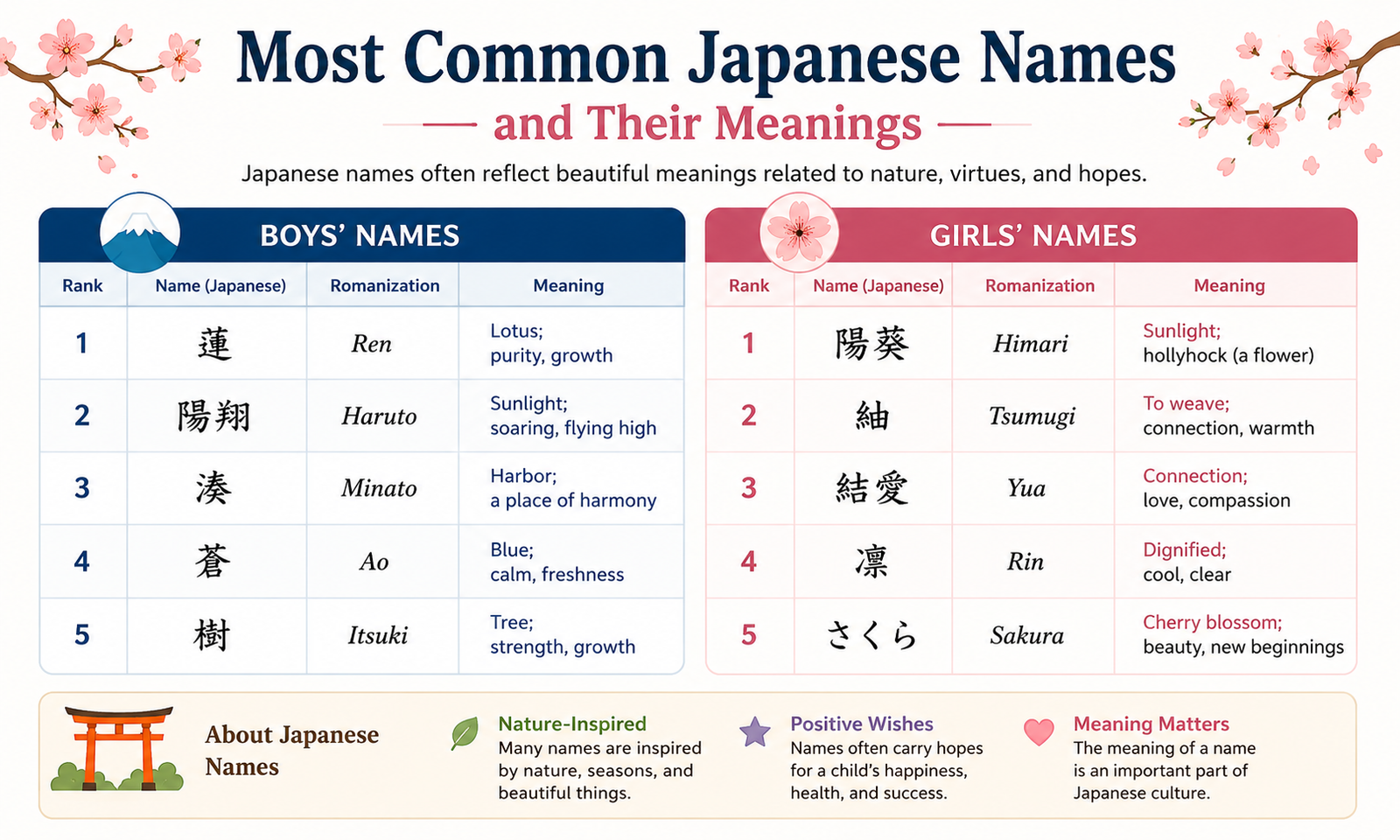
Naming a child is a deeply significant process in Japanese culture. Parents spend weeks, sometimes months, selecting the perfect name to reflect their hopes for their baby’s future. Unlike many Western names that have fixed definitions, Japanese names derive their meanings from the specific writing system used to spell them.
The primary writing system for names is kanji, a set of characters adopted from Chinese. A single spoken name can be written using dozens of different kanji combinations. Each combination entirely changes the underlying message of the name. If you are researching names for a character, looking for baby name inspiration, or simply learning about Japanese culture, understanding these characters is essential.
You will learn about the structure of Japanese names, the most popular choices for boys and girls, and the beautiful meanings hidden within their kanji.
The Unique Structure of Japanese Names
In Japan, the family name comes first, followed by the given name. There are no middle names. When you see a Japanese name written in English, it is often flipped to match Western conventions, putting the given name first.
The beauty of these names lies heavily in the kanji. Japan uses thousands of these characters, and many have multiple pronunciations. Parents can choose a kanji for its meaning and assign a non-standard pronunciation, or they can choose a pronunciation they like and find kanji that match the sound. This flexibility means that even native Japanese speakers sometimes need to ask how to read a person’s name correctly.
Let’s look at some of the most popular names in Japan today and explore the characters that bring them to life.
Popular Japanese Girl Names and Their Meanings
Japanese girl names often draw inspiration from nature, beauty, and virtues. Flowers, light, and gentleness are common themes.
Sakura
The name Sakura is famous worldwide. It translates to “cherry blossom.” The most traditional way to write it is with the single kanji 桜. The cherry blossom represents spring, renewal, and the fleeting nature of life. Some parents choose to write Sakura using two characters, such as 咲良, which combines “bloom” (咲) and “good” (良).
Hina
Hina is a bright and cheerful name that consistently ranks at the top of baby name charts. It is frequently written as 陽菜. The first character (陽) means “sun” or “sunlight.” The second character (菜) means “greens” or “vegetables.” Together, they evoke the image of fresh green plants growing warmly in the spring sun.
Yui
Yui is a short, elegant name with a beautiful meaning. The most common kanji pairing is 結衣. The character 結 means “to tie” or “to bind,” representing strong connections with family and friends. The character 衣 means “clothing” or “garment.” This name conveys a wish for the child to be surrounded by loving relationships and gentle comfort.
Aoi
Aoi means “hollyhock” flower, represented by the single kanji 葵. It is a gender-neutral name, though it is currently very popular for girls. The hollyhock flower grows tall and faces the sun, symbolizing ambition, growth, and a bright future.
Mio
Mio is a gentle, flowing name. It is often written as 澪, which refers to a water route or a channel for ships. Another popular combination is 美桜, blending “beautiful” (美) with “cherry blossom” (桜). This creates a highly visual, deeply poetic name.
Popular Japanese Boy Names and Their Meanings
Boy names in Japan frequently emphasize strength, nature, flight, and grand scales. Parents often choose characters that represent soaring through the sky or navigating the vast ocean.
Haruto
Haruto has been one of the most popular boy names in Japan for over a decade. It is commonly written as 陽翔. The first kanji (陽) means “sun,” while the second (翔) means “to soar” or “to fly.” Parents give this name hoping their son will soar brightly toward a successful future. Another popular writing is 大翔, meaning “great flight.”
Minato
Minato is written with the kanji 湊, which means “harbor” or “port.” A harbor is a place where people and ships gather. Parents choose this name to wish that their son will be sociable, attracting good friends and bringing people together.
Riku
Riku is a strong, grounded name. It is typically written as 陸, meaning “land” or “continent.” This kanji represents stability, vastness, and a solid foundation. It suggests a person who is reliable and down-to-earth.
Yuto
Yuto is a classic name with an optimistic ring. It can be written as 悠人. The character 悠 implies “leisurely,” “calm,” or “permanence,” and 人 means “person.” Together, they describe a relaxed, thoughtful individual. Another variation is 優斗, which blends “gentleness” or “excellence” (優) with “the Big Dipper” or “soaring” (斗).
Haru
Haru is a lively, short name that directly translates to “spring” when written as 春. It signifies warmth, new beginnings, and vibrant energy. It can also be written with the kanji 陽 (sun/sunlight) to emphasize brightness and warmth.
The Most Common Japanese Surnames
While parents have endless creativity with given names, family names are deeply historical. The vast majority of Japanese surnames consist of two kanji characters, often describing geographical features.
Sato (佐藤)
Sato is the most common surname in Japan. The first character (佐) means “to assist” or “to help.” The second character (藤) means “wisteria,” a beautiful purple climbing plant. This surname is historically linked to the powerful Fujiwara clan of ancient Japan.
Suzuki (鈴木)
Suzuki is the second most common family name. It is written with the characters 鈴, meaning “bell,” and 木, meaning “tree” or “wood.”
Takahashi (高橋)
Takahashi translates quite literally to a geographical feature. The first kanji (高) means “high” or “tall.” The second kanji (橋) means “bridge.” Hundreds of years ago, families who lived near a high bridge likely adopted this surname to describe their location.
Finding Meaning in the Characters
Understanding Japanese names requires looking closely at the written characters. The spoken sounds are musical and pleasant, but the kanji reveal the true intentions behind the name. A single sound like “Haru” can mean spring, sunlight, or clear weather depending on the stroke of a pen.
Learning these characters gives you a profound glimpse into Japanese culture. You uncover how much the society values nature, family connections, and bright, hopeful futures. The next time you hear a Japanese name, remember that there is an entire story waiting to be read in its kanji.
