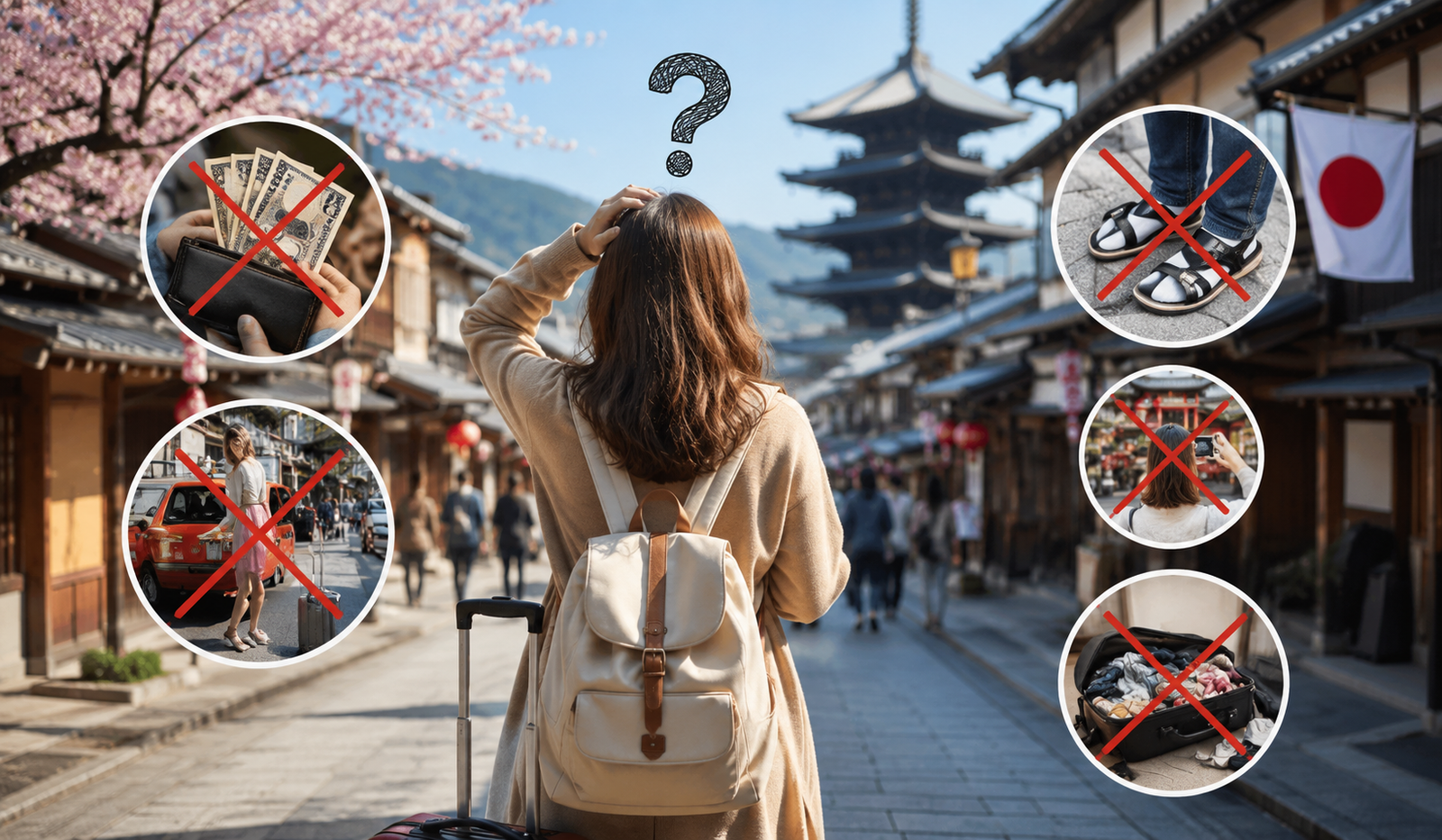
The Most Common Japan Travel Mistakes and How to Avoid Them
Many first-time visitors to Japan make avoidable mistakes—from misreading transportation systems to ignoring cultural etiquette—that lead to wasted money, missed experiences, and awkward moments. This guide covers the most common Japan travel mistakes and exactly how to avoid them before you board your flight.
Japan has a way of humbling even the most experienced traveler. The country runs with extraordinary precision, operates on deep cultural codes, and rewards those who take the time to prepare. Those who don’t? They often spend their first few days confused, overpaying for things, and accidentally offending locals without realizing it.
This isn’t meant to scare you off. Japan is one of the most rewarding travel destinations on the planet -its food, its cities, its temples, its countryside. But the difference between a good Japan trip and an unforgettable one often comes down to preparation. Knowing what not to do matters just as much as knowing where to go.
Whether you’re a first-timer planning a two-week itinerary or a repeat visitor looking to go deeper, this guide walks you through the most common Japan travel mistakes—and, more importantly, how to sidestep every single one of them.
Why Do So Many Travelers Struggle During Their First Trip to Japan?
The honest answer: Japan is unlike anywhere else. Its systems, customs, and social expectations are deeply specific. Most Western travel instincts—tipping to show appreciation, speaking loudly in public spaces, winging it with transportation—don’t translate.
Japan rewards research. It rewards quiet observation. And it especially rewards those who understand that “doing things your way” isn’t always welcome in a culture built on collective harmony and respect.
The good news is that the Japanese people are extraordinarily kind and patient with tourists. But the more you understand the cultural context, the more doors open to you—literally and figuratively.
What Are the Biggest Japan Travel Mistakes First-Time Visitors Make?
Not Getting an IC Card or Planning Transportation in Advance
Japan’s public transportation system is world-class. It is also deeply complex. Tokyo alone has 13 metro lines operated by multiple companies. Add the Shinkansen bullet train network, regional JR lines, and local buses, and you have a system that can paralyze an unprepared traveler.
One of the most common mistakes is arriving without an IC card—a rechargeable smart card like Suica or Pasmo that works across most trains, subways, and buses in Japan. You can tap in, tap out, and even pay at convenience stores, without fumbling with exact change or decoding fare machines.
Pick up a Suica card at the airport upon arrival and load it with at least ¥3,000–¥5,000 to cover your first few days. If you’re planning to travel between cities, research whether a JR Pass makes financial sense for your itinerary. According to the Japan National Tourism Organization, the JR Pass is only cost-effective if you plan to travel on multiple long-distance Shinkansen routes—for a trip confined to Tokyo or Osaka, it’s often not worth the upfront investment.
You can learn more about planning rail travel in Japan through the Hyperdia route planner, which is one of the most reliable tools for mapping train routes and estimating fares.
Underestimating How Much Cash Japan Still Requires
Japan has a reputation as a cashless innovator in some respects—vending machines, convenience stores, and metro systems are all seamlessly efficient. But many restaurants, temples, and smaller shops remain strictly cash-only. Arriving in Japan without sufficient yen in hand is a surprisingly common mistake that catches visitors off-guard.
ATMs at 7-Eleven and Japan Post offices reliably accept international cards. Convenience store ATMs are your best friends here. Exchange rates at these ATMs tend to be more competitive than airport currency exchange counters, so resist the urge to exchange everything at the airport.
A practical rule: carry at least ¥10,000–¥20,000 in cash at all times, especially when heading to rural areas, smaller towns, or traditional restaurants that don’t post signage about payment methods.
Ignoring Japanese Dining and Food Etiquette
Food is one of Japan’s greatest joys. Ramen, sushi, izakaya grills, kaiseki dinners, conveyor-belt sushi—the variety is staggering. But dining in Japan carries its own set of unwritten rules, and breaking them, while unlikely to cause a scene, can mark you as an oblivious tourist.
A few of the most important things to know:
- Tipping is not practiced in Japan. Leaving money on the table after a meal is considered rude, not generous. It can even cause confusion or offense.
- Eating and walking simultaneously is frowned upon in most parts of Japan. Street food stalls typically expect you to stop and eat before moving on.
- Talking loudly in restaurants, especially smaller or more traditional ones, disrupts the calm atmosphere most Japanese diners expect.
- Chopstick etiquette matters. Never stick chopsticks vertically into a bowl of rice—this resembles a funeral ritual. Passing food chopstick to chopstick is also associated with cremation ceremonies.
These aren’t obscure rules. They’re everyday norms. Understanding them shows respect, and locals notice.
How Does the Shoe Rule Work, and Why Does It Matter So Much?
Removing your shoes before entering certain spaces—traditional ryokan accommodations, many restaurants with tatami flooring, some temples and shrines, and private homes—is non-negotiable in Japan.
The mistake most tourists make isn’t the removal itself; it’s the footwear they choose to wear. Shoes with complex lacing systems, boots that take minutes to remove, or worn socks with holes in them all create slow, awkward moments at entryways called genkan. Choose slip-on shoes or simple sneakers, and make sure your socks are in good shape.
When you do remove your shoes, place them neatly, pointing toward the exit. This is standard practice and signals attentiveness to those around you.
What Are the Most Common Mistakes People Make When Visiting Temples and Shrines?
Japan has over 80,000 shrines and 77,000 temples. Many are living religious sites—not just tourist attractions. Treating them as photo backdrops without understanding their purpose is one of the more disrespectful mistakes travelers make.
At Shinto shrines, the standard approach includes bowing twice, clapping twice, offering a silent prayer, and bowing once more. At Buddhist temples, the customs differ slightly—typically a single bow and a moment of quiet reflection.
Photography is welcome in many outdoor areas but restricted or prohibited inside main halls. Look for signage, and when in doubt, observe what locals are doing and follow their lead.
Dressing modestly matters too, particularly at more conservative religious sites. Many major temples like Senso-ji in Asakusa, Tokyo, or Fushimi Inari Taisha in Kyoto are open to all, but covering your shoulders and knees is a sign of respect.
You can find comprehensive etiquette guidance at Japan-Guide.com, one of the most comprehensive English-language resources for visitors.
Why Is Overpacking Your Japan Itinerary One of the Biggest Travel Mistakes?
Japan offers so much that it’s tempting to build a schedule with five cities in ten days. This approach leads to travel fatigue, missed depth, and an itinerary that starts to feel like a checklist rather than an experience.
The Shinkansen makes it easy to zip between Tokyo and Kyoto in about 2.5 hours, but “easy to reach” doesn’t mean it belongs in every trip. Rushing through a city means you’ll miss the hidden ramen shops tucked into narrow alleys, the local neighborhoods that aren’t in any guidebook, and the kind of slow, wandering discovery that makes Japan genuinely memorable.
A more effective approach: choose three or four anchor locations and build your days around depth rather than distance. Tokyo alone can comfortably absorb five to seven days. Kyoto rewards multiple visits. Hiroshima, Kanazawa, and Hakone each offer distinct experiences that deserve at least two nights.
For a well-structured sample itinerary, Lonely Planet’s Japan travel guide offers detailed regional breakdowns that help with realistic pacing.
What Should You Know About Luggage and Getting Around Between Cities?
Japan’s trains are immaculate—and compact. Rolling a large suitcase through a crowded Tokyo metro during rush hour is genuinely difficult, and stowing oversized bags on Shinkansen trains can be a logistical challenge, especially on older carriages without dedicated luggage space.
The solution most seasoned Japan travelers use is luggage forwarding, known as takkyubin. Services like Yamato Transport allow you to send your bags from hotel to hotel overnight for a modest fee—usually ¥1,500–¥2,500 per bag. You travel light, your bags arrive at your next destination before you do, and the whole experience becomes significantly more comfortable.
Plan your packing accordingly. A smaller backpack or carry-on for daily items paired with forwarded luggage is a far more practical approach than dragging everything with you on every journey.
What Cultural Misunderstandings Should Travelers Be Aware of Beyond the Basics?
Beyond the well-documented rules, a few subtler things trip up even culturally aware travelers.
Queue etiquette is sacred in Japan. Lines form for trains, taxis, escalators, and popular food stalls—and cutting in, even accidentally, causes genuine discomfort. Always locate the queue markers (usually marked on the ground near train platforms) and wait your turn.
Volume in public spaces is a social signal. On trains and buses, phone calls are generally avoided, voices are kept low, and headphone audio is kept inaudible to others. This isn’t a strict law—it’s a deeply ingrained norm.
Pointing at people or objects is considered impolite. If you need to gesture toward something, use an open hand rather than a single finger.
Making the Most of Your Japan Trip Starts Before You Land
The travelers who enjoy Japan most aren’t necessarily those with the biggest budgets or the most ambitious plans. They’re the ones who did their homework—who learned a handful of Japanese phrases (sumimasen for excuse me, arigatou gozaimasu for thank you), who downloaded an offline translation app, and who approached the country on its own terms rather than forcing it to conform to theirs.
Japan will challenge you in the best possible way. Its systems will occasionally confuse you. Its social codes will occasionally make you second-guess yourself. But every moment of genuine connection—a local who goes out of their way to help you find a train platform, a chef who lights up when you show real appreciation for their food—will remind you exactly why this country captures so many hearts.
Prepare well, stay curious, and leave room for the unexpected. That’s the formula that turns a good Japan trip into one you’ll spend years describing to anyone who will listen.
Frequently Asked Questions About Japan Travel Mistakes and How to Avoid Them
Is it rude to tip in Japan?
Yes. Tipping is not part of Japanese culture and can cause confusion or offense. Service staff take pride in doing their job well without expecting additional compensation. Leave your gratuity habits at the airport.
What is the best way to get around Japan as a tourist?
For most visitors, a combination of an IC card (like Suica or Pasmo) for daily urban travel and a researched Shinkansen ticket or JR Pass for intercity trips is the most efficient approach. The JR Pass is only cost-effective for travelers covering multiple long-distance routes.
Do I need to know Japanese to travel in Japan?
Not fluently, but learning a handful of basic phrases—sumimasen (excuse me), arigatou gozaimasu (thank you), and eigo ga hanasemasu ka? (do you speak English?)—goes a long way. Most major cities have English signage, and Google Translate’s camera feature works well for menus and signs.
What should I wear when visiting temples and shrines in Japan?
Modest clothing is recommended—covered shoulders and knees are appropriate for more conservative sites. Comfortable shoes that are easy to slip on and off are essential since many traditional spaces require removing footwear.
How much cash should I carry daily in Japan?
A daily cash budget of ¥10,000–¥20,000 is a practical starting point, depending on your spending habits. Rural areas and traditional restaurants are more likely to be cash-only, so carry more on days involving travel outside major cities.
Is it safe to drink tap water in Japan?
Yes. Japan has some of the safest tap water in the world. You can refill a reusable bottle from any tap, which saves money and reduces plastic waste.
