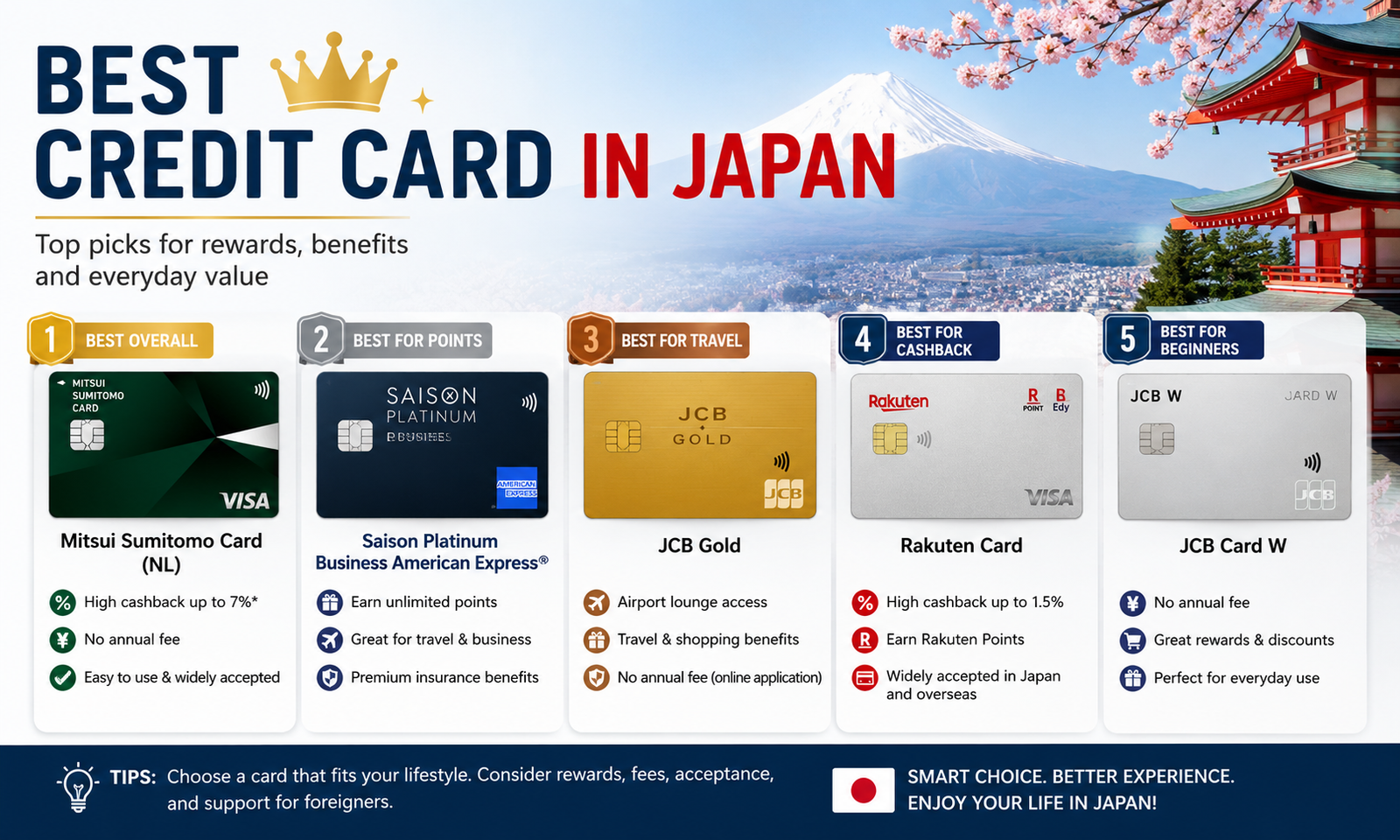
The Rakuten Card is widely considered the best credit card in Japan for foreign residents due to its high approval rate, lack of an annual fee, and excellent points program. Choose the Rakuten Card if you want everyday value, but opt for the SMBC Prestia Visa if English-language customer support matters more than earning points.
Japan is famous for its cash-based culture, with paper money and coins dominating daily transactions for decades. However, the financial landscape is shifting rapidly. The Japanese government and private sectors have pushed aggressively toward a cashless society. Mobile payment apps, smart transit cards, and credit cards are now standard across major cities like Tokyo, Osaka, and Fukuoka.
Living in Japan without a local credit card quickly becomes a frustrating experience. You will encounter difficulties paying for basic utilities, setting up a mobile phone plan, or booking domestic travel. Using a foreign credit card often triggers high foreign transaction fees, which drain your bank account over time.
Securing a Japanese credit card presents a unique challenge for foreign residents. Local financial institutions employ strict screening processes. They often reject applicants who lack a long credit history in Japan, lack permanent residency, or struggle with the Japanese language. Knowing which banks offer the highest approval odds can save you weeks of frustrating rejections.
This guide explores the top financial products available to foreign residents. You will learn the specific benefits of each option, the documentation required to secure approval, and the strategies that maximize your chances of getting the best credit card in Japan.
Table of Contents
What are the top credit cards in Japan for foreign residents?
Selecting a financial product depends entirely on your spending habits and language proficiency. Different cards serve different needs, from maximizing online shopping points to providing comprehensive travel insurance.
Rakuten Card: The best credit card in Japan for points and easy approval
The Rakuten Card remains the undisputed champion for foreign residents living in Japan. Rakuten Group, a massive Japanese e-commerce and digital services company, issues this card. The company actively seeks to expand its user base, resulting in a significantly lower barrier to entry compared to traditional Japanese banks.
The primary draw of the Rakuten Card is the Rakuten Super Points program. You earn one point for every 100 yen spent anywhere. When you shop on the Rakuten Ichiba e-commerce platform, your point accumulation multiplies rapidly. You can use these points to pay your credit card bill, purchase items online, or pay for groceries at affiliated stores like FamilyMart and McDonald’s.
Choose the Rakuten Card if your primary goal is building credit in Japan while earning versatile rewards. The application process occurs entirely online, though the interface is exclusively in Japanese. Using a browser translation tool allows most applicants to navigate the forms successfully.
EPOS Card: The top choice for no annual fee and retail discounts
Marui Department Stores issues the EPOS Card. It stands out as a highly accessible option for students and young professionals working in Japan. Like the Rakuten Card, the EPOS Card carries no annual fee, making it a risk-free addition to your wallet.
The EPOS Card shines in its physical retail partnerships. Cardholders receive automatic discounts at thousands of affiliated restaurants, karaoke parlors, and amusement parks across Japan. Additionally, Marui Department Stores host “Marco and Maruo’s Seven Days” sales events several times a year, where EPOS Card users receive a flat 10% discount on all purchases.
This card also includes automatic overseas travel insurance, a rare feature for a card with no annual fee. Apply for the EPOS Card if you frequently shop in physical retail stores and want a reliable backup card with solid travel protections.
Amazon Mastercard: The ideal credit card for online shoppers in Japan
Sumitomo Mitsui Card Company (SMCC) partners with Amazon Japan to issue the Amazon Mastercard. Foreign residents who rely heavily on Amazon for groceries, household goods, and electronics find massive value in this specific financial product.
Cardholders earn 1.5% back on all Amazon Japan purchases with the standard card, and 2% back if they hold an Amazon Prime membership. Purchases made at major convenience stores like 7-Eleven, FamilyMart, and Lawson earn 1.5% back. All other purchases earn a standard 1% return.
Choose the Amazon Mastercard if you already spend a significant portion of your monthly budget on Amazon Japan. The points apply automatically to your Amazon account, eliminating the need to navigate complex point transfer portals.
SMBC Prestia Visa: The best credit card in Japan for English support
SMBC Trust Bank operates the Prestia division, which specifically caters to expatriates and high-net-worth individuals living in Japan. The SMBC Prestia Visa is unique because the institution provides full English-language support, from the initial application process to ongoing customer service inquiries.
This card integrates seamlessly with a Prestia multi-currency bank account. You can manage your finances, pay your credit card bills, and transfer funds internationally using their English online banking portal. The points program is less lucrative than the Rakuten Card, and the screening process requires a higher minimum income.
Choose the SMBC Prestia Visa if comprehensive English support matters more to you than maximizing retail points, or if you regularly move money between multiple international currencies.
How do you apply for a credit card in Japan?
The application process in Japan differs significantly from North America or Europe. Financial institutions prioritize stability and verifiable identity over your credit score in your home country, which does not transfer across borders.
What documents are required for a Japanese credit card application?
Japanese credit card companies mandate strict identity verification. You must prepare several specific documents before initiating an application.
First, you need a valid Residence Card (Zairyu Card). This card proves your legal status in Japan. Your period of stay must be valid for at least several months beyond your application date.
Second, you need a Japanese bank account. The credit card company will automatically deduct your monthly bill directly from this bank account. You cannot pay a Japanese credit card bill manually each month; auto-draft is a mandatory requirement.
Third, you must provide a Japanese phone number. Credit card companies often conduct a verification call to confirm your identity and employment details. A voice-capable mobile number is essential.
Finally, you need verifiable employment information. This includes the exact registered name of your employer, the corporate phone number, and your gross annual salary.
How can foreign residents increase their chances of approval?
Rejections happen frequently, even for applicants with high salaries. You can implement several strategies to improve your approval odds.
Apply for a Japanese credit card only after you have lived in the country for at least six months. Banks view brand-new arrivals as high-risk applicants. Securing a mobile phone contract and paying your utility bills on time for half a year establishes a baseline of financial reliability.
Ensure that your name matches exactly across all documents. Your Residence Card, bank account, and credit card application must display your name in the exact same format, order, and alphabet. Even a minor discrepancy, such as an omitted middle name on your bank account, will trigger an automatic rejection from the credit card issuer.
Do not apply for multiple credit cards simultaneously. In Japan, credit bureaus record every application. Submitting three applications in one week signals financial distress to the automated screening algorithms. Apply for one card, such as the Rakuten Card, and wait at least six months before attempting another application if rejected.
Why should you get a local Japanese credit card instead of using a foreign card?
Many expats initially rely on credit cards issued in their home countries. While this strategy works for short tourist visits, it creates severe financial and logistical disadvantages for long-term residents.
Avoiding high foreign transaction fees
Foreign credit cards typically charge a foreign transaction fee ranging from 1% to 3% on every purchase made in Japanese yen. Furthermore, the currency exchange rate applied by foreign banks is rarely favorable. Over the course of a year, paying for groceries, train tickets, and internet bills with a foreign card will cost you hundreds of dollars in hidden fees. A Japanese credit card completely eliminates these international surcharges.
Earning domestic points and rewards
Japan possesses a highly developed loyalty point ecosystem. Programs like T-Point, d-Point, and Rakuten Super Points function almost like secondary currencies. When you use a local Japanese credit card, you accumulate points that translate directly into free groceries, discounted flights, or reduced utility bills. Foreign credit cards do not integrate into this domestic ecosystem, meaning you forfeit significant financial value every time you swipe.
Take charge of your finances in Japan
Securing a Japanese credit card represents a major milestone in establishing your life abroad. It frees you from the burden of carrying large amounts of cash, protects you from predatory exchange rates, and opens the door to lucrative domestic rewards programs.
Begin your journey by opening a local bank account and setting up your basic utilities. Once you have established a few months of residency, apply for a beginner-friendly option like the Rakuten Card or the EPOS Card. Pay your bills strictly on time to build your local credit file. With patience and careful preparation, you will integrate fully into Japan’s modern financial ecosystem.
For further reading, visit the official websites of the Rakuten Card or SMBC Prestia to review their current sign-up campaigns, which frequently offer thousands of yen in bonus points for new applicants.
Frequently asked questions about credit cards in Japan
Can a tourist get a Japanese credit card?
No, tourists cannot get a Japanese credit card. Financial institutions require a valid Residence Card (Zairyu Card) and a Japanese bank account, which are only issued to individuals holding long-term visas, such as work visas or student visas.
What is the easiest credit card to get in Japan for a student?
The EPOS Card and the Rakuten Card are widely considered the easiest credit cards to get for international students. Both companies utilize flexible screening criteria that account for part-time income and lack of credit history, making them highly accessible for university students.
Do Japanese credit cards support contactless payments?
Yes, modern Japanese credit cards support contactless payments. Most cards feature the Visa payWave or Mastercard Contactless chips. Additionally, you can link almost any Japanese credit card to Apple Pay or Google Pay, allowing you to use your smartphone to tap and pay at convenience stores and transit gates through the iD or QUICPay networks.
How long does it take to get a credit card in Japan?
It typically takes one to two weeks to receive a Japanese credit card. Once you submit the online application, the screening process takes a few days. If approved, the physical card is mailed to your registered address via registered mail, which requires an in-person signature upon delivery.
