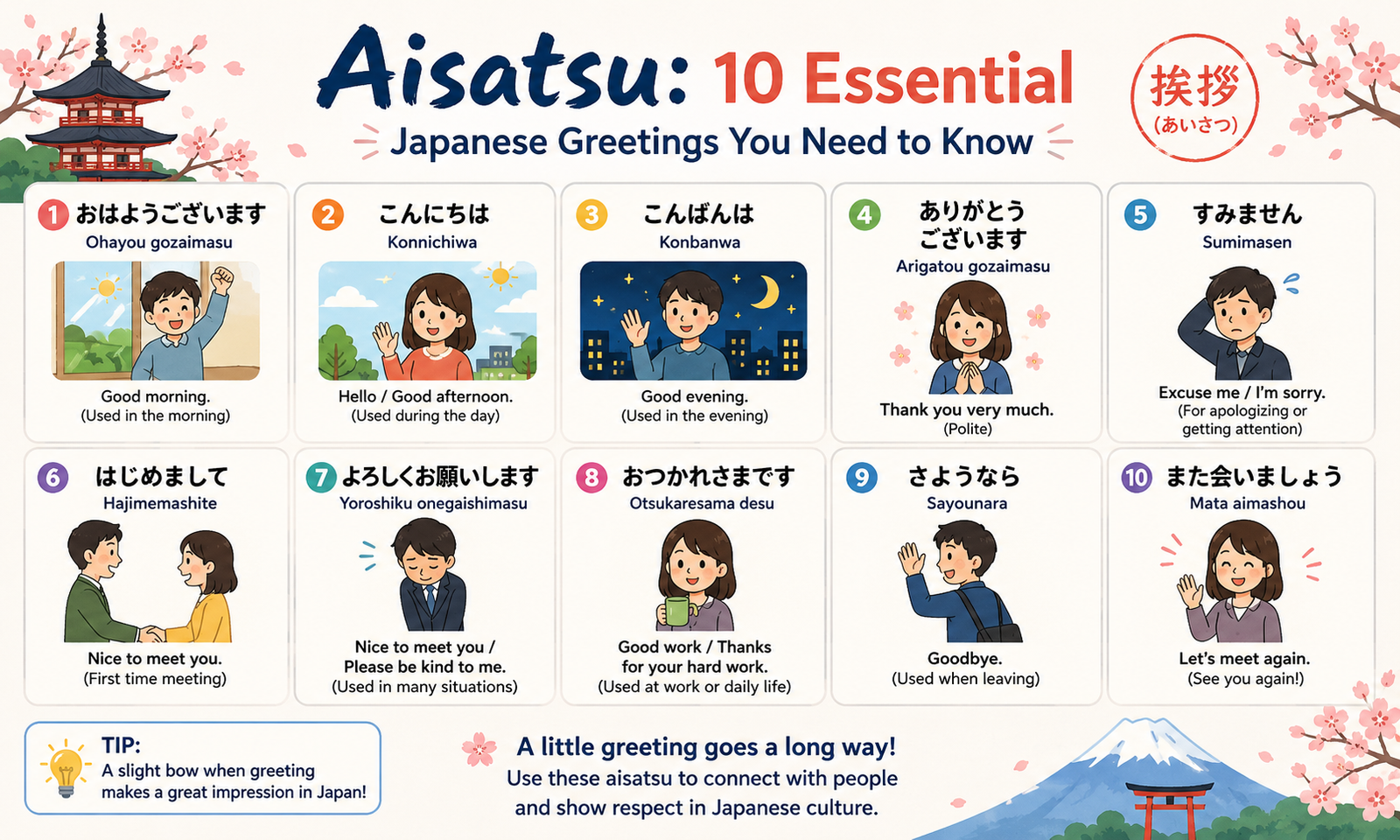
Language is the key to understanding any culture. If you are planning a trip to Japan, studying the language, or working with Japanese colleagues, mastering basic greetings is your best starting point. In Japanese, these daily greetings are known as aisatsu (挨拶).
The concept of aisatsu goes far beyond a simple “hello” or “goodbye.” In Japanese society, these phrases form the foundation of polite communication, mutual respect, and social harmony. From classrooms to corporate offices, actively participating in aisatsu shows that you acknowledge the people around you and respect the shared environment.
Learning the right greeting for the right situation will completely change how you interact with Japanese speakers. Locals deeply appreciate foreigners who make an effort to use these phrases correctly. To help you build meaningful connections, we have compiled a list of the 10 most common Japanese greetings you need to know.
The Importance of Aisatsu
Aisatsu is taught to children from a very young age as a critical social skill. In workplaces, morning meetings often begin with energetic aisatsu to set a positive tone for the day. Using these phrases demonstrates politeness and helps smooth out social interactions. Neglecting them can accidentally come across as rude or aloof. By memorizing these core expressions, you will navigate daily interactions with confidence and respect.
10 Common Japanese Greetings
Here are the 10 essential Japanese greetings to practice, complete with their Japanese script and proper usage contexts.
1. Ohayou Gozaimasu (おはようございます)
Meaning: Good morning
This is the standard way to greet people before 11:00 AM. If you are speaking to close friends or family members, you can drop the formal ending and simply say “Ohayou.” However, when addressing teachers, strangers, or superiors at work, always use the full “Ohayou gozaimasu” to maintain politeness. Interestingly, in some work environments like the entertainment industry, people use this phrase at any time of day when they see their colleagues for the first time.
2. Konnichiwa (こんにちは)
Meaning: Hello / Good afternoon
Konnichiwa is perhaps the most famous Japanese greeting worldwide. It is generally used between 11:00 AM and 5:00 PM. While it serves as a standard “hello,” it is rarely used with family members or close friends, as it can sound a bit formal. Save it for acquaintances, coworkers, and people you meet while out and about.
3. Konbanwa (こんばんは)
Meaning: Good evening
As the sun sets and evening approaches, shift your greeting to konbanwa. You will use this phrase when meeting people for dinner, attending evening events, or simply passing neighbors after dark. Like konnichiwa, it is a slightly formal greeting, so you do not need to use it with your closest friends or immediate family.
4. Oyasuminasai (おやすみなさい)
Meaning: Good night
When it is time to go to bed or part ways at the end of a late night, use oyasuminasai. If you are saying good night to a roommate, partner, or close friend, you can shorten it to just “Oyasumi.”
5. Arigatou Gozaimasu (ありがとうございます)
Meaning: Thank you
Expressing gratitude is a massive part of Japanese culture. “Arigatou gozaimasu” is the polite, standard way to say thank you to shop staff, colleagues, and strangers. For a casual “thanks” to friends, you can use “Arigatou.” If you want to express deep appreciation for something someone did in the past, you change the ending to “Arigatou gozaimashita.”
6. Sumimasen (すみません)
Meaning: Excuse me / I’m sorry
If you only learn one word on this list, make it sumimasen. This incredibly versatile phrase acts as an apology, a way to get someone’s attention, and even a form of gratitude. You can use it to call out to a waiter in a restaurant, apologize for bumping into someone on the train, or thank someone who held the door open for you.
7. Sayounara (さようなら)
Meaning: Goodbye
While often taught as the primary word for goodbye, sayounara carries a sense of finality. It implies that you will not see the person for a long time, or possibly ever again. Because of this, Japanese speakers rarely use it in daily life. Instead, coworkers usually say “Otsukaresama desu” (thank you for your hard work), and friends use casual phrases like “Mata ne” (see you later). Use sayounara sparingly and only when appropriate.
8. Itadakimasu (いただきます)
Meaning: Let’s eat (literally: I humbly receive)
Food culture in Japan is deeply respected. Before starting a meal, everyone puts their hands together and says “Itadakimasu.” This phrase expresses gratitude to the people who prepared the food, the farmers who grew the ingredients, and the plants and animals that provided the nourishment.
9. Gochisousama Deshita (ごちそうさまでした)
Meaning: Thank you for the meal
Just as you express gratitude before eating, you must also give thanks after finishing your food. You say this phrase to your host, the chef, or the restaurant staff as you pay your bill. If you are speaking casually with friends after a shared meal, you can shorten it to “Gochisousama.”
10. Yoroshiku Onegaishimasu (よろしくお願いします)
Meaning: Please treat me well / I look forward to working with you
This unique phrase has no direct translation in English, but it is essential for social interactions. You use it when introducing yourself to someone new, when asking a favor, or before starting a collaborative project. It sets a cooperative, polite tone and shows that you value the relationship moving forward.
Take Your Japanese Communication Further
Mastering these 10 phrases will instantly make your interactions with Japanese speakers smoother and more enjoyable. Aisatsu is all about showing respect and acknowledging the people around you.
Your next step is to put these greetings into practice. Try listening for them in Japanese movies or anime to understand their timing and pronunciation. If you have the opportunity, test them out with a language partner or a local Japanese speaker. Even a simple “konnichiwa” paired with a polite bow will go a long way in showing your appreciation for the culture.
