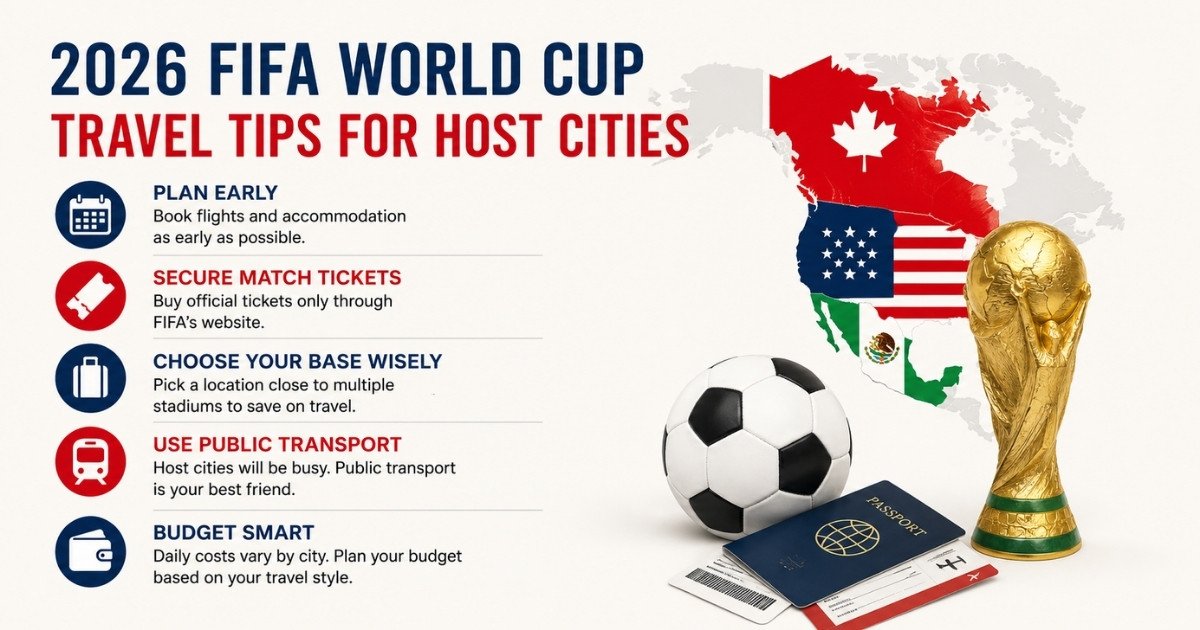
The 2026 FIFA World Cup takes place across 16 host cities in the United States, Canada, and Mexico from June 11 to July 19, 2026. Planning early is critical—accommodation near stadiums is already filling up fast. Budget travelers can expect to spend from $150–$200 per day, while mid-range travelers should plan for $300–$500 per day depending on the host city.
The 2026 FIFA World Cup is the biggest sporting event in history—at least on paper. For the first time ever, three nations are co-hosting the tournament: the United States, Canada, and Mexico. With 48 teams competing across 16 host cities, the scale of this World Cup dwarfs anything the sport has seen before.
That’s exciting news for fans. But it also makes planning more complex. Whether you plan to stay in one host city or follow your national team across multiple countries, 2026 FIFA World Cup travel comes with important decisions. How much should you budget for flights, hotels, and match tickets?
This guide cuts through the noise. Whether you’re a first-time World Cup attendee or a seasoned tournament traveler, here’s everything you need to know to plan your trip to the 2026 FIFA World Cup—from stadium locations to realistic daily budgets.
Table of Contents
Where Is the 2026 FIFA World Cup Being Held?
The 2026 World Cup spans 16 cities across three countries. Here’s a breakdown by host nation:
United States host cities (11 venues)
- New York/New Jersey – MetLife Stadium (capacity: ~82,500) — hosting the Final
- Los Angeles — SoFi Stadium (~70,240)
- Dallas — AT&T Stadium (~80,000)
- San Francisco Bay Area — Levi’s Stadium (~68,500)
- Miami — Hard Rock Stadium (~65,000)
- Atlanta — Mercedes-Benz Stadium (~71,000)
- Seattle — Lumen Field (~68,740)
- Boston — Gillette Stadium (~65,878)
- Kansas City — Arrowhead Stadium (~76,416)
- Houston — NRG Stadium (~72,220)
- Philadelphia — Lincoln Financial Field (~69,176)
Canada host cities (2 venues)
- Toronto — BMO Field (~45,736, with temporary expansion)
- Vancouver — BC Place (~54,500)
Mexico host cities (3 venues)
- Mexico City — Estadio Azteca (~87,000) — hosting Opening Match
- Guadalajara — Estadio Akron (~49,850)
- Monterrey — Estadio BBVA (~53,500)
The sheer geographic spread means fans traveling to multiple matches will need to budget for significant domestic travel costs. Choosing a home base close to two or more venues—like Dallas and Houston in Texas—can help reduce transit expenses.
What Is the 2026 World Cup Schedule?
The tournament runs from June 11 to July 19, 2026. The group stage takes place from June 11 to June 27. The knockout rounds begin June 29, with the Final scheduled for July 19 at MetLife Stadium in New Jersey.
Mexico City’s Estadio Azteca will host the opening match—a historic nod to Mexico’s storied football culture and the stadium’s legendary status in World Cup history (it hosted the 1970 and 1986 finals).
How Much Will It Cost to Attend the 2026 World Cup?
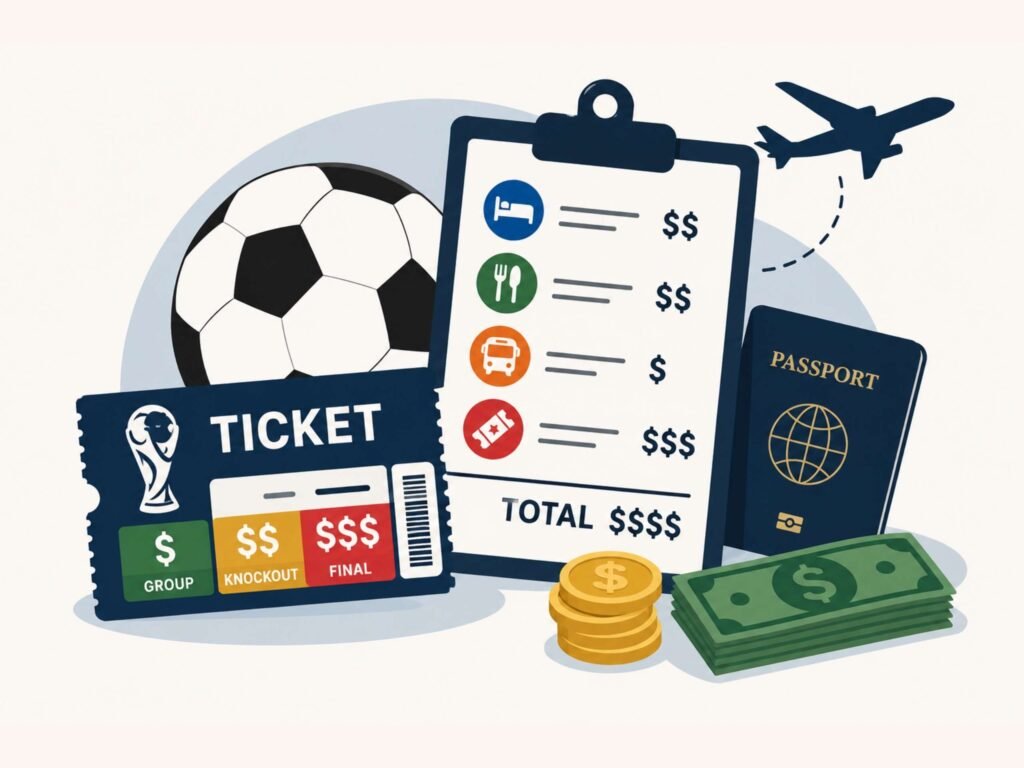
Budget planning for the 2026 World Cup depends heavily on which cities you visit, how far in advance you book, and your travel style. Here’s a realistic breakdown:
Match tickets: what to expect
FIFA has not yet published the full 2026 ticket pricing structure, but based on 2022 Qatar World Cup pricing, fans should expect:
- Group stage tickets: $80–$500+ USD
- Knockout round tickets: $150–$800+ USD
- Final tickets: $500–$2,000+ USD (face value; resale prices will be significantly higher)
Official tickets are sold exclusively through FIFA’s ticketing portal. Avoid third-party resellers where possible to reduce the risk of fraudulent tickets.
Daily budget by travel style
| Travel style | Estimated daily spend (USD) |
|---|---|
| Budget | $150–$200 |
| Mid-range | $300–$500 |
| Premium | $700+ |
These estimates cover accommodation, meals, local transport, and entertainment—excluding match tickets and flights.
Flights: book early
Transatlantic flights to U.S. gateway cities like New York, Miami, and Los Angeles are likely to surge in price as the tournament approaches. Booking 6–12 months in advance is strongly recommended. Domestic U.S. flights between host cities can be cost-effective, but flying into border regions and crossing by road (e.g., San Diego to Tijuana, or Buffalo to Toronto) is often cheaper and surprisingly efficient.
Which 2026 World Cup Host City Should You Visit?
Each host city offers a distinct atmosphere, and the right choice depends on your priorities—nightlife, culture, climate, or stadium experience.
New York/New Jersey — best for the biggest match
MetLife Stadium is hosting the Final, making the New York metro area the tournament’s most coveted destination. New York City itself is one of the world’s great football cities, with a passionate immigrant fan culture that makes watching matches in bars and public viewing areas an experience in itself. Accommodation in New York is expensive—expect to pay $250–$600 per night for a hotel close to Manhattan. Book as early as possible; rooms in the tri-state area for July 2026 are already selling out.
Dallas — best for multiple matches
AT&T Stadium in Arlington is one of the largest in the U.S., and Dallas’s central location makes it a practical hub. The city is well-connected by air to other host cities, and hotel rates are more affordable than coastal markets. Dallas is also set to host several high-profile knockout matches, making it one of the stronger choices for fans attending multiple games.
Mexico City — best for atmosphere
Estadio Azteca is the only stadium in history to have hosted two World Cup finals (1970 and 1986). Attending a match here is a bucket-list football experience. Mexico City is also one of the most affordable host cities for accommodation and dining, making it a smart choice for budget-conscious travelers. The city sits at 2,240 meters above sea level, so factor in altitude acclimatization if you’re not used to high elevations.
Miami — best for beach and football
Hard Rock Stadium is surrounded by one of the most vibrant cities in the Western Hemisphere. Miami’s diverse, football-mad Latin American community means the fan atmosphere extends well beyond the stadium. Hotel rates in Miami Beach are steep in summer, but staying in neighborhoods like Brickell or Wynwood offers better value with easy transit access.
Toronto and Vancouver — best for Canadian fans
Both Canadian cities offer world-class urban experiences at a relatively lower cost than major U.S. markets. Vancouver’s BC Place is a spectacular enclosed stadium with a retractable roof, while Toronto’s BMO Field will be expanded significantly to meet FIFA standards. Summer in both cities is excellent—warm, with long daylight hours.
Where to Stay During the 2026 World Cup
Book accommodation now—seriously
Hotels near host stadiums in major U.S. cities are already being snapped up. If you haven’t started looking, start today. Use platforms like Booking.com, Expedia, and Hotels.com for traditional hotels, but also consider Airbnb and Vrbo for apartments and houses that accommodate larger groups at a lower per-person cost.
Consider staying outside the city center
In cities like New York and Los Angeles, accommodation within the city core is expensive. Staying in suburban areas with strong public transit connections can cut costs significantly without adding much travel time. For example, staying in Newark, NJ puts you within 20 minutes of MetLife Stadium and a short train ride from Manhattan.
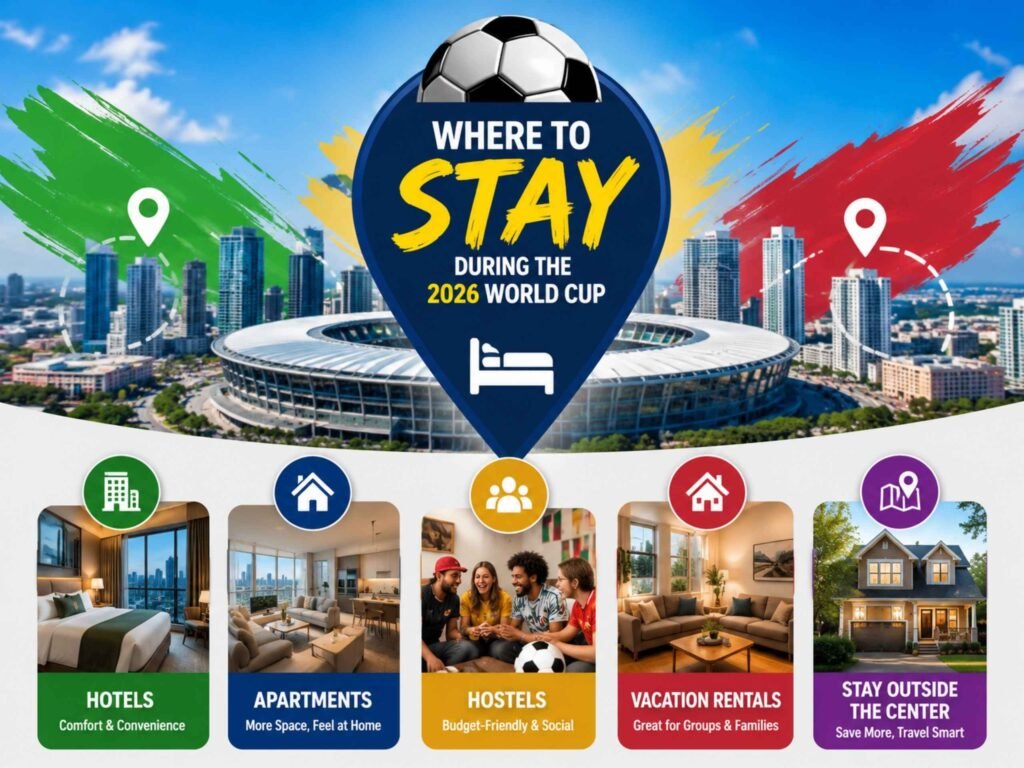
Types of accommodation to consider
- Hotels near stadiums: Convenient but premium-priced during tournament weeks
- Vacation rentals: Best for groups of 4+; often include kitchens to reduce food costs
- Hostels: Available in most U.S. cities; ideal for solo budget travelers
- Extended-stay hotels: Good value for fans planning a multi-week trip
Tips for Getting the Most Out of Your World Cup Trip
Plan your match itinerary first, then book accommodation. Once you know which games you’re attending and where, build the rest of your trip around those anchor dates.
Look into travel packages. FIFA and its official hospitality partners offer bundled ticket-and-hotel packages. They’re not cheap, but they remove the stress of coordinating bookings across multiple cities.
Use public transit wherever possible. U.S. cities vary widely in transit quality—New York and Chicago are excellent, while Los Angeles and Dallas are more car-dependent. Factor in rideshare costs if you’re visiting cities without robust public transport.
Get travel insurance. With three countries, multiple currencies, and a packed 39-day schedule, the logistical complexity of this World Cup is high. Travel insurance covering cancellations, medical emergencies, and ticket disputes is worth every dollar.
Keep an eye on fan festivals. FIFA typically organizes free public viewing events in host cities. These are great ways to experience the tournament atmosphere without spending money on tickets.
Start Planning Your World Cup 2026 Trip Today
The 2026 FIFA World Cup is a once-in-a-generation event. Spanning three nations and 16 cities, with 48 teams competing over 39 days, it will generate moments that football fans talk about for decades.
The fans who have the best experiences will be the ones who plan early, book smart, and stay flexible. Lock in your accommodation now, monitor FIFA’s official channels for ticket sale windows, and decide which host cities align with your budget and travel style.
Wherever you end up—roaring inside the Azteca, watching the Final at MetLife, or soaking up the summer sun in Vancouver—2026 is going to be worth every dollar.
Start by exploring all official FIFA World Cup 2026 Host Cities. Secure your FIFA World Cup 2026 Tickets before finalizing travel plans. Venue size can influence accommodation demand around matchdays. Understanding ticket costs early can help you build a realistic travel budget.
FAQs About the 2026 FIFA World Cup Travel
When does the 2026 FIFA World Cup start and end?
The 2026 FIFA World Cup runs from June 11 to July 19, 2026. The opening match is held at Estadio Azteca in Mexico City, and the Final takes place at MetLife Stadium in New York/New Jersey.
How many cities are hosting the 2026 World Cup?
16 cities across three countries are hosting the 2026 World Cup: 11 in the United States, 2 in Canada (Toronto and Vancouver), and 3 in Mexico (Mexico City, Guadalajara, and Monterrey).
How much does it cost to attend the 2026 World Cup?
Budget travelers should plan for approximately $150–$200 USD per day, excluding match tickets and flights. Mid-range travelers should budget $300–$500 per day. Match tickets are expected to range from $80 for group stage games to $2,000+ for the Final on the resale market.
Where can I buy official 2026 World Cup tickets?
Official tickets are sold exclusively through FIFA’s official ticketing portal at FIFA.com. FIFA has not yet announced all ticket sale dates, so checking the portal regularly is recommended.
Which 2026 World Cup host city is the cheapest to visit?
Mexico City is generally the most affordable host city, offering lower hotel rates, cheaper food, and lower transportation costs compared to U.S. cities like New York and Los Angeles. Dallas and Houston are among the more budget-friendly U.S. host cities.
How far in advance should I book a hotel for the 2026 World Cup?
As early as possible. Accommodation near major stadiums—especially in New York/New Jersey and Los Angeles—is already in high demand for the tournament period. Booking 12+ months in advance is strongly recommended for the best selection and pricing.
