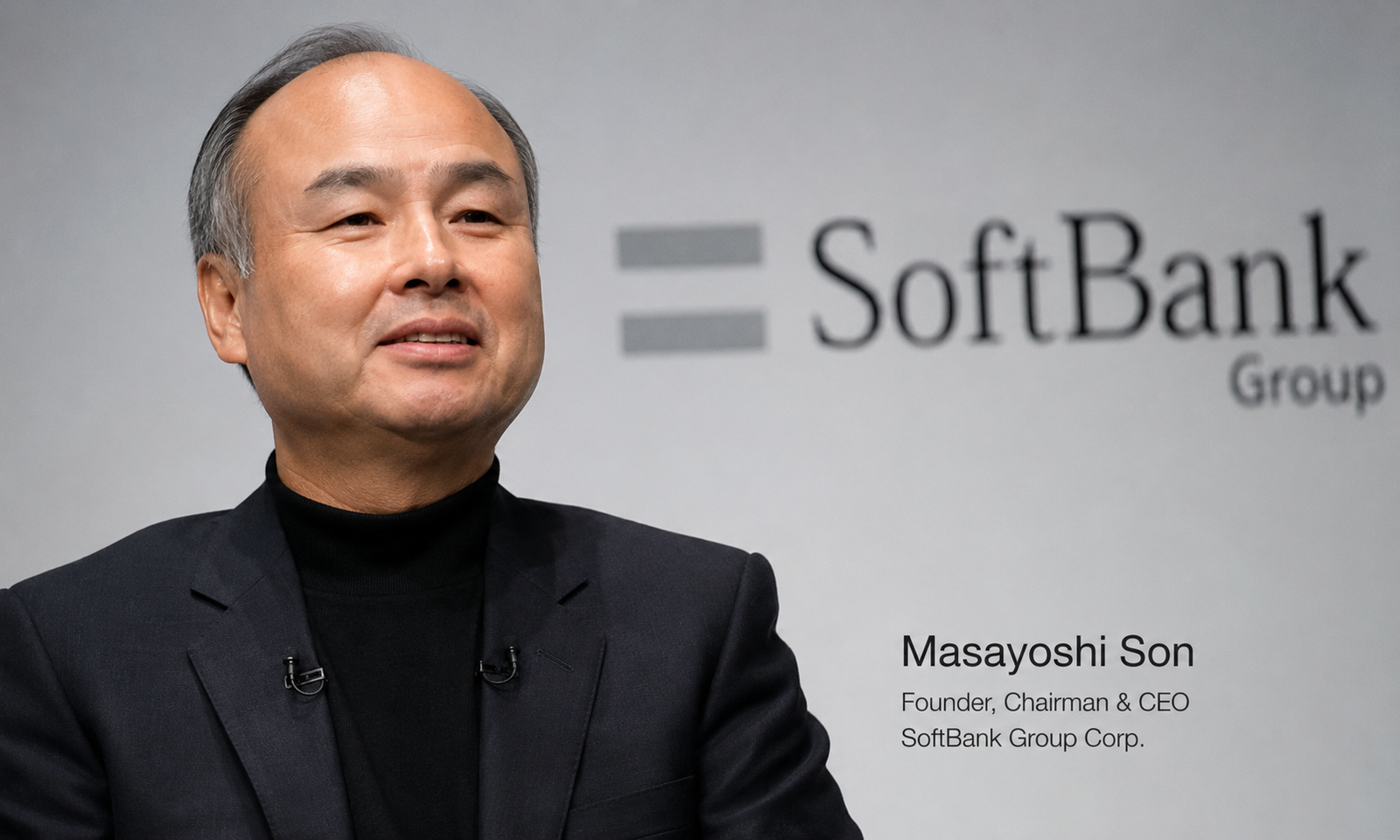
Quick answer: Masayoshi Son is the founder and CEO of SoftBank Group, holding an estimated net worth of around $30 billion. His wealth originates from aggressive tech investments—most notably a highly lucrative early stake in Alibaba—and the management of the $100 billion SoftBank Vision Fund.
Masayoshi Son stands out as one of the most ambitious technology investors in modern history. Taking bold risks has defined his career, transforming a small software distributor into a global powerhouse. His financial journey is a rollercoaster of record-breaking gains and staggering losses, reflecting the volatile nature of the technology sector he champions.
Understanding Masayoshi Son requires looking past the sheer size of his bank account. His portfolio touches almost every aspect of the digital economy, from e-commerce and ride-sharing to artificial intelligence and robotics.
This post explores the exact mechanisms behind the Masayoshi Son net worth. You will discover how the SoftBank Group CEO built his business empire, the specifics of his high-profile investment strategy, and the details of his billionaire lifestyle.
Table of Contents
How did Masayoshi Son build his billion-dollar net worth?
Masayoshi Son founded SoftBank Group in Tokyo in 1981. Initially, the company operated as a software distributor, capitalizing on the emerging personal computer market in Japan. Son quickly expanded operations, launching computer magazines and building broadband infrastructure.
The strategy was simple: dominate the Japanese tech ecosystem early. This foundational success provided the capital required for Son to pivot into venture capital and private equity on a global scale.
What was the impact of the Alibaba investment?
The most defining moment of Masayoshi Son’s career occurred in the year 2000. Son met with Jack Ma, a former English teacher attempting to build a Chinese e-commerce platform called Alibaba. After a brief presentation, Son invested $20 million into Alibaba.
When Alibaba went public in 2014, that initial $20 million investment ballooned to a valuation of roughly $60 billion. This massive return on investment cemented Masayoshi Son’s reputation as a visionary investor. The Alibaba windfall provided SoftBank Group with the immense financial leverage needed to launch even larger investment vehicles in the subsequent decades.
What is the SoftBank Vision Fund?
In 2017, Masayoshi Son launched the SoftBank Vision Fund. Backed heavily by the Public Investment Fund of Saudi Arabia and Mubadala Investment Company, the fund debuted with an unprecedented $100 billion in capital. The objective was to aggressively fund technology companies focused on artificial intelligence, robotics, and the internet of things.
How does the Vision Fund influence global markets?
The SoftBank Vision Fund disrupted traditional venture capital by injecting massive amounts of money into late-stage startups. This strategy allowed companies like Uber, DoorDash, and ByteDance to rapidly scale their operations and dominate market share.
However, the strategy also introduced severe risks. SoftBank Group faced heavy scrutiny following the dramatic valuation collapse of the co-working startup WeWork. Masayoshi Son publicly acknowledged the mistakes made during the WeWork investment, leading to a more cautious approach for the subsequent Vision Fund 2.
Masayoshi Son’s Wealth and Key Investments
To understand the scale of his empire, reviewing the foundational investments is necessary. The table below outlines key financial milestones and stakes held by SoftBank Group under Masayoshi Son’s leadership.
| Investment / Asset | Year of Initial Investment | Estimated Initial Capital | Peak Valuation Impact | Sector Focus |
|---|---|---|---|---|
| Alibaba Group | 2000 | $20 Million | >$60 Billion | E-commerce |
| Yahoo! Japan | 1996 | $100 Million | Dominant Market Share | Internet Services |
| Sprint / T-Mobile | 2013 | $21.6 Billion | Successful Merger | Telecommunications |
| ARM Holdings | 2016 | $32 Billion | IPO in 2023 | Semiconductor / AI |
| WeWork | 2017 | $4.4 Billion | Heavy Losses | Real Estate Tech |
Data reflects historical investment milestones and peak valuations associated with SoftBank Group.
How does Masayoshi Son spend his billionaire fortune?
While Masayoshi Son spends much of his time managing SoftBank Group, he maintains a lifestyle consistent with his status as one of Japan’s wealthiest individuals. His wealth affords him access to exclusive real estate, private aviation, and high-end philanthropy.
What real estate does Masayoshi Son own?
Masayoshi Son owns a sprawling property portfolio spanning multiple continents. His primary residence is a three-story mansion located in the upscale Azabu neighborhood of Tokyo. The Tokyo property reportedly features a golf simulator and climate-controlled rooms for his personal art collection.
In the United States, Son made headlines in 2012 when he purchased a massive estate in Woodside, California, for $117.5 million. The Woodside property sits in the heart of Silicon Valley, featuring a sprawling mansion, a swimming pool, a tennis court, and formal gardens. This strategic location allows him to remain close to the center of the American technology industry.
What are the key lessons from Masayoshi Son’s business strategy?
Entrepreneurs and investors can draw several practical lessons from the rise of SoftBank Group.
First, long-term vision is critical. Masayoshi Son frequently speaks about his “300-year plan” for SoftBank Group, emphasizing investments that will shape the distant future rather than just quarterly earnings.
Second, conviction drives massive returns. The Alibaba investment was highly speculative in 2000. Son trusted his evaluation of the founder over the immediate financial metrics, leading to historic returns. Choose high-conviction investments if capturing exponential market growth matters more to you than safe, incremental gains.
Third, resilience is a requirement. During the dot-com crash, Masayoshi Son reportedly lost over $70 billion of his net worth. Rather than retreating, he pivoted his strategy, acquired broadband assets, and rebuilt his empire.
Navigating the Future of SoftBank
Masayoshi Son continues to shift his focus toward the future of artificial intelligence. With the successful public listing of the semiconductor designer ARM Holdings, SoftBank Group is positioning itself as a central player in the global AI infrastructure supply chain.
For investors monitoring the Masayoshi Son net worth, the performance of these AI assets will dictate his financial trajectory for the next decade. His willingness to adapt, take staggering risks, and invest aggressively ensures that SoftBank Group will remain a powerful force in global technology.
Frequently Asked Questions
What is Masayoshi Son’s current net worth?
Masayoshi Son’s net worth fluctuates based on the stock price of SoftBank Group and the valuation of the Vision Fund portfolio. As of late 2023 and early 2024, financial publications estimate his net worth to be between $20 billion and $30 billion.
Did Masayoshi Son really lose $70 billion?
Yes. During the dot-com bubble burst in the early 2000s, SoftBank Group’s stock price plummeted by 99%. Masayoshi Son lost an estimated $70 billion in personal wealth during this period, though he eventually rebuilt his fortune through the success of Yahoo! Japan and Alibaba.
Who owns the SoftBank Vision Fund?
The SoftBank Vision Fund is managed by SoftBank Group. However, the capital comes from a mix of sources. The primary investors in the first $100 billion Vision Fund were the Public Investment Fund of Saudi Arabia, Mubadala Investment Company, Apple, Foxconn, Qualcomm, and SoftBank Group itself.
Does Masayoshi Son still own Alibaba?
SoftBank Group historically held a massive stake in Alibaba. However, in recent years, Masayoshi Son has orchestrated the sale of the vast majority of SoftBank’s Alibaba shares to raise capital and stabilize the company’s balance sheet following tech market downturns.
What is Masayoshi Son’s educational background?
Masayoshi Son moved from Japan to the United States for his education. He attended the University of California, Berkeley, where he studied economics and computer science. During his time at Berkeley, he invented a multi-lingual translator device that he sold to Sharp Corporation for $1 million.
