
Curious about what sets successful companies apart during fast-moving digital shifts? It’s not just who adopts the newest technology first. It’s who crafts digital transformation strategies that connect people, purpose, and progress. This guide shares practical insights, expert voices, and honest answers—so you can rethink how your business adapts and thrives.
Table of Contents
Unlocking the Power of Digital Transformation Strategies
A digital transformation strategy is more than upgrading your software or launching a new app. It’s a clear, company-wide plan to rethink how you create value—aligning your technology moves with your customer needs, your team’s skills, and your big-picture goals.
Why does this matter? Because the pace of change isn’t slowing down. From automation and data to sustainability challenges like climate change, businesses are being called to go deeper than surface-level fixes.
Key Insight: Companies that treat digital transformation as an ongoing, human-centered strategy—not just a tech project—are the ones making lasting impact.
The Essential Framework: Mapping Change with Confidence
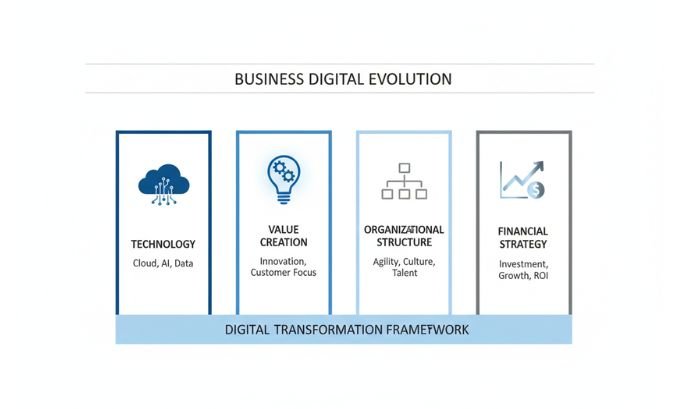
Great digital transformation strategies are built on structure, not guesswork.
Enter the Digital Transformation Framework (DTF). This isn’t a checklist—it’s a holistic map that interlocks four big areas:
- Use of Technologies: Are you leading with innovation, or are you strategically following?
- Changes in Value Creation: How does digital let you reimagine your products, services, or even entire business models?
- Structural Changes: Do you need a new organizational chart? Maybe a Chief Digital Officer (CDO) or skilling up for brand-new roles?
- Financial Aspects: What’s your investment story? How can you balance the costs of change with returns, urgency, and sustainable growth?
Neglect even one pillar, and your transformation may stumble—regardless of how impressive your tech spending looks.
The Human Experience: When Transformation Gets Real

Nothing illustrates digital transformation like a lived example.
Gareth Walsh’s Turning Point
Imagine Gareth, heading up a mid-sized engineering company. After years of making custom parts for others, Gareth saw opportunity calling. Like many, his first instinct was classic Industry 4.0: invest in automation tech, upgrade machines, speed up production.
But here’s the twist: nothing fundamental changed. Business improved at the edges. But big dreams, and bigger pains, went unmet. This is a common trap—modernizing, not transforming.
Finding the Heart of the Problem
Gareth’s breakthrough came when his team shifted focus. No longer was the question, “How can we do what we’ve always done, just faster?” Instead, it became, “What’s keeping our clients up at night—and how could we solve that, differently?”
Using tools and approaches like the Seven Principles of Digital Business Strategy Framework, a pattern emerged: rising flood risks stoked by climate change were urgent for their municipal customers. Yet solutions were outdated or impractical.
Fast Learning With AI-Driven Testing

Armed with Generative AI and Large Language Models (LLMs) (think: rapid prototyping and feedback loops that used to take months), Gareth’s team:
- Spotted real customer pain points, not just assumed needs.
- Built and revised marketing pitches, prototypes, and pricing models in record time.
- Spoke with actual customers—uncovering roadblocks and unexpected opportunities.
A big pivot followed. Attempting to sell its flood defense solutions to government was slow, so Gareth’s team built a way for communities themselves to organize and pay for protection kits—flexible, affordable, and app-powered.
Result: A transformation in both business model and mindset—as customer success became the organizing star, not just technology for tech’s sake.
What Sets Great Digital Transformation Strategies Apart

What Works Well
- Human-First Focus: Customers (and their pain points) drive meaningful innovation.
- Agile Experimentation: Generative AI and LLMs allow for faster, smarter idea testing.
- Strategic Leadership: Roles like the Chief Digital Officer (CDO) bridge departments, break silos, and keep everyone rowing in the same direction.
- Frameworks Ground Change: Both the DTF and the Seven Principles provide a compass, not just a roadmap.
What to Watch For
- Tech Tunnel Vision: Don’t let shiny tools distract from market realities or real human needs.
- New Complexity: Subscription models, digital services, and platform plays require new skillsets. Invest in people as much as tech.
- Cultural Headwinds: Even the right plan can falter without buy-in and support at every level.
For a real-world look at how digital strategies drive growth, explore LinkLuminous.com for expert marketing insights and TokyoMart.store for a thriving example of e-commerce success in Japan.
Making Sense of the Entities: A Playbook for Transformation
How do all the moving parts click together? Here’s a quick guide:
| Concept/Entity | Role in Transformation |
|---|---|
| Digital Transformation Strategy | Your organization’s north star for all digital moves |
| Digital Transformation Framework (DTF) | The structure guiding what, how, and where to prioritize |
| Chief Digital Officer (CDO) | Change champion who aligns vision and execution |
| Generative AI / LLMs | Fast-trackers for idea generation and market testing |
| Industry 4.0 | The environment: automation, smart tech, IoT |
| Customer Pain Points | The starting point for meaningful product/service changes |
| Climate Change | External force driving urgency and innovation |
| Seven Principles of Digital Business Strategy Framework | Framework to align strategy and reality |
| Gareth Walsh | The real-world case bringing the theory to life |
Quick-Reference FAQ: Digital Transformation Strategies
1. What’s the difference between having digital tools and a real digital transformation strategy?
Tools are steps; a strategy is a connected, intentional journey that links technology, business model, and long-term value.
2. Is a Chief Digital Officer (CDO) essential?
If your teams are stuck or your digital projects lack momentum, a CDO (or equivalent leader) often helps break the inertia and align priorities.
3. How do Large Language Models (LLMs) help my business?
They let you prototype offers, test copy, model scenarios—and gather insights—faster and cheaper than ever, especially when paired with real-world data.
4. Does Industry 4.0 mean we’re transforming?
Only if those upgrades reimagine the value you deliver and how you deliver it. Otherwise, it’s just modernization.
5. What about climate change—why is it relevant?
It reshapes customer needs (think flood risk, resource efficiency) and opens up new paths for innovation, often best tackled through smart digital approaches.
6. What if we have a tight budget or lack digital experience?
Start by mapping the biggest customer pain points. Use bite-sized, rapid tests (powered by AI) to prove what works before rolling out at scale.
If you want to learn more about digital transformation strategies, you can visit mindjournal.co or techbullion.in
Summing Up: Practical Steps for Lasting Transformation
True digital transformation strategies rely on much more than new hardware or software contracts. They ask tough, human questions. They empower teams to adapt amid uncertainty. They treat frameworks and AI tools as guides, not substitutes for real listening and real learning.
Get started by:
- Focusing relentlessly on genuine customer pain.
- Aligning stakeholders behind a vision, not just a budget request.
- Using frameworks like DTF as a safety rail, so nothing crucial slips through the cracks.
- Testing, learning, and staying humble—because the digital world always has another surprise in store.
Meet the Authors
This guide draws on decades of combined experience in business consulting, digital leadership, and hands-on transformation projects. Our team includes strategists who’ve walked factory floors, advised start-ups, and navigated the complexities of turning buzzwords into game-changing results. Every insight is rooted in real stories, current research, and a passion for making change approachable—and achievable—for all.
