

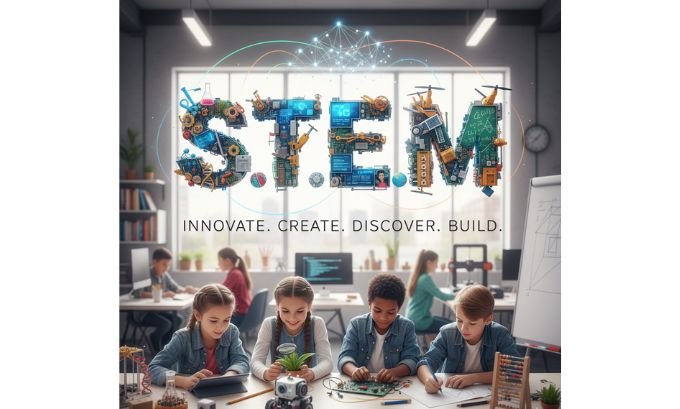
The true STEM education meaning isn’t just about teaching four separate subjects; it’s about weaving them together to create a new way of learning. It stands for an integrated approach to Science, Technology, Engineering, and Mathematics that focuses on hands-on experience and real-world problem-solving. This method helps students develop the critical thinking and time management skills needed to thrive in a rapidly changing world.
Table of Contents
Let’s Unpack the Meaning of STEM Education
At its core, the STEM education meaning is about learning through application. It’s a philosophy that breaks down the traditional barriers between Science, Technology, Engineering, and Mathematics. An Integrated STEM Education framework encourages students to see how these fields connect in the real world. Instead of just reading about scientific theories, they use them to build something. Instead of solving abstract math problems, they use calculations to design a solution.
This isn’t just a fleeting educational fad. It’s a strategic movement backed by leading institutions. For decades, organizations like the National Science Foundation (NSF) and the American Association for the Advancement of Science (AAAS) have called for an overhaul of how these vital subjects are taught. They understood that to foster true innovation, learning had to be active, not passive, especially within the crucial years of K-12 Education.
Where Did the Term “STEM” Come From?
While the concept of improving science and math education is decades old, the acronym STEM itself gained traction in the early 2000s. Credit for popularizing the term is often given to Judith A. Ramaley, a biologist and former director at the National Science Foundation (NSF). Around 2001, she championed its use to describe this integrated educational model.
Before the term STEM (Science, Technology, Engineering, and Mathematics) became common, many similar initiatives lacked a unifying identity. The NSF’s adoption of the acronym provided a much-needed banner under which educators, policymakers, and industry leaders could rally. This simple, powerful term helped focus national attention and resources, transforming a collection of ideas into a cohesive movement aimed at boosting America’s global competitiveness.
The National Push for STEM
The drive for STEM became a national priority after a series of influential reports sounded the alarm. Perhaps the most famous was Rising Above the Gathering Storm, a 2007 report from a committee under the umbrella of the National Research Council (NRC). The report made a compelling case that America’s economic future and innovative leadership were at risk without a significant improvement in science and technology education.
This and other similar reports created a powerful sense of urgency. It became clear that to solve the complex challenges of the 21st century, the country needed a workforce with strong STEM skills. This led to a surge in federal support and policy initiatives aimed at reinventing K-12 education. Long-standing programs like Project 2061, an initiative by the AAAS to promote science literacy for all Americans, found renewed purpose within this broader STEM movement.

My Journey with STEM: From Theory to Practice
As an educational consultant who has spent fifteen years in the field, I’ve seen many teaching strategies come and go. But the shift to STEM was different. I remember working with a high school where the science and math departments were completely siloed. Students in physics couldn’t see how it connected to the calculus they were learning down the hall. Engagement was low because the learning felt disconnected from their lives.
The school decided to pilot an Integrated STEM Education program for 10th graders. I was brought in to help the teaching team design a cross-curricular project: design and build a functional, small-scale wind turbine capable of charging a phone.
It was a challenge, but the integration was beautiful to watch:
- Science: Students delved into the principles of aerodynamics and electromagnetism to understand how wind energy is converted into electrical power.
- Technology: They used 3D printing software to design and create custom turbine blades, and they used sensors to gather performance data.
- Engineering: They applied the engineering design process—ideate, prototype, test, and iterate—to troubleshoot and optimize their turbines for maximum efficiency.
- Mathematics: They used trigonometry to calculate optimal blade angles and algebra to analyze the power output data, making the numbers meaningful.
The results were astonishing. Students who were once bored in class were now working through lunch, collaborating on designs, and passionately debating the merits of different blade shapes. They were not just learning the material; they were living it. This project perfectly captured the STEM education meaning for me. It’s about turning students into creators and innovators.
The Power of the STEM Approach: What I Value Most
- It Cultivates True Problem-Solvers: Students learn to tackle messy, open-ended problems that don’t have a simple answer in the back of the book.
- It Teaches Resilience: In STEM, failure is just a data point. Students learn that the first attempt is rarely perfect and that iteration is key to success.
- It Fosters Essential Soft Skills: Collaboration, communication, and teamwork are at the heart of every successful STEM project.
- It Bridges the Gap to Real Careers: It provides a tangible glimpse into what engineers, data scientists, and technicians actually do, making career paths feel more accessible.
- It Sparks Authentic Curiosity: When learning is hands-on and relevant, it naturally inspires students to ask deeper questions and explore their own ideas.
The Challenges We Still Face
- Investing in Our Educators: Shifting to an integrated curriculum is a major undertaking. Teachers need consistent, high-quality training and support to do it well.
- Closing the Resource Gap: Meaningful STEM projects often require technology and materials that not all schools can afford, creating significant equity concerns.
- Navigating Standardized Testing: The intense focus on standardized tests can make it difficult for teachers to justify spending time on deep, project-based learning.
- Maintaining Disciplinary Rigor: It’s crucial to ensure that the “fun” part of a project doesn’t overshadow the fundamental science and math principles that students need to learn.
If you’d like to explore this topic further, feel free to visit the following sites for more in-depth resources and insights
ponta.in
mumbaitimes.net
mindjournal.co
How Integrated STEM Differs from Traditional Learning

The STEM education meaning is best understood by comparing it to the traditional, siloed model of teaching.
| Feature | Traditional Classroom | Integrated STEM Classroom |
|---|---|---|
| Structure | Subjects are taught in isolation. | Disciplines are interconnected around a central challenge. |
| Learning Process | Teacher-centered, with a focus on lectures and memorization. | Student-centered, with a focus on inquiry and hands-on projects. |
| Student’s Role | To absorb information and repeat it on a test. | To investigate, design, create, and solve problems. |
| Teacher’s Role | The expert who provides answers. | The facilitator who guides discovery and asks probing questions. |
| Assessment | Typically based on multiple-choice tests and worksheets. | Based on project portfolios, presentations, and skill application. |
| Real-World Link | Often abstract or non-existent. | Directly tied to solving real-world problems and exploring careers. |
The Big Picture: STEM and the Global Stage

The national focus on STEM education is fundamentally a strategy for securing our future global competitiveness. The nations that lead the world in innovation are those that produce a steady stream of scientists, technologists, and engineers. The skills that a quality STEM program develops—analytical reasoning, data-driven decision-making, and creative problem-solving—are the currency of the modern global economy.
This link is not just theoretical. Reports from institutions like the National Research Council (NRC) have consistently shown a direct correlation between a country’s STEM workforce and its economic prosperity and national security. As technology continues to evolve at an exponential rate, the demand for these skills will only increase. By investing in K-12 Education with a strong STEM focus, we are making a down payment on a future driven by American innovation. The visionary work of organizations like the AAAS through initiatives such as Project 2061 helped set this course, aiming for a future where every citizen is empowered to participate in our technological world.
Frequently Asked Questions (FAQ)
1. What does the acronym STEM actually mean?
STEM stands for Science, Technology, Engineering, and Mathematics. It represents an educational model that integrates these disciplines rather than teaching them in isolation.
2. What is the main goal of STEM education?
The primary goal is to equip students with practical problem-solving, critical thinking, and collaborative skills. It connects classroom learning to real-world applications, preparing students for future careers and challenges.
3. Is a STEM education only for students who want to become scientists or engineers?
No, not at all. The core skills learned through STEM—such as analytical thinking, creativity, and resilience—are valuable in virtually any career. The real STEM education meaning is about developing a versatile and adaptable mindset.
4. How is an Integrated STEM project different from a regular science fair project?
A traditional science fair project often follows the scientific method to test a single hypothesis. An Integrated STEM Education project is typically more complex, requiring students to design, build, and test a solution to a problem by applying principles from all four STEM disciplines.
5. Who first coined the term STEM?
The acronym was popularized in the early 2000s by biologist Judith A. Ramaley during her tenure as a director at the National Science Foundation (NSF). She used it to give a common name to this growing educational movement.
6. Why is there so much focus on STEM in elementary and high school?
Introducing STEM concepts early in K-12 Education helps build confidence and curiosity. It makes challenging subjects more engaging and can inspire a lifelong passion for learning and discovery.
7. How does STEM education affect a country’s global competitiveness?
A nation’s capacity for innovation is directly tied to its global competitiveness. By fostering a strong STEM-skilled workforce, a country can lead in technological development, fuel economic growth, and solve complex global issues, a point strongly made in reports like Rising Above the Gathering Storm.
Conclusion: STEM is a Verb, Not Just a Noun
The STEM education meaning is about action, creation, and discovery. It is a dynamic and evolving philosophy that transforms students from passive observers into active participants in their own education. It’s about building a generation of thinkers and doers who are unafraid to tackle the world’s biggest problems.
By embracing an Integrated STEM Education model, we provide students with the skills they need to not only find success in their careers but also to build a more innovative and prosperous future for everyone. The groundwork laid by organizations like the NSF and AAAS has given us the blueprint. Now, it’s up to us to build on it.
Curious to learn more? Look for opportunities to support a local robotics team or volunteer for an Hour of Code event at a nearby school. Every action helps bring the power of STEM to life.
