


Many successful startups today didn’t start with million-dollar budgets — they started with a clear marketing strategy, creativity, and a deep understanding of their target audience.
This article explores proven, low-cost marketing ideas for startups that work in the real world. It’s not theory — it’s what smart founders actually do when they can’t afford to waste a single dollar.
We’ll walk through frameworks inspired by marketing strategist Adam Erhart, explore low-budget marketing techniques, and learn how to connect every effort to your marketing funnel and customer journey for maximum impact.
Table of Contents
1. Start With a Clear Marketing Strategy (Before You Spend Anything)
The most powerful marketing doesn’t start with money — it starts with clarity.
Before you launch ads or social campaigns, step back and define your marketing strategy. This is your roadmap — outlining your goals, audience, messaging, and metrics for success.
The Four Core Questions Every Startup Must Answer
| Question | Why It Matters | Example |
|---|---|---|
| Who is your Target Audience? | Determines what message resonates. | Freelancers, small business owners, Gen Z shoppers, etc. |
| What problem do you solve? | Clarifies your offer’s value. | “We help freelancers manage invoices faster.” |
| How do you want your brand to be perceived? | Ties to brand positioning. | Affordable, reliable, eco-friendly, or premium? |
| What does success look like? | Connects to Marketing ROI. | Leads, website traffic, or sales conversions. |
Marketing strategist Adam Erhart often says, “Your strategy is the filter that prevents wasted marketing spend.”
And he’s right — without direction, even a $10,000 campaign can fail, while a $100 one can soar.
2. Content Marketing: The Foundation of Low-Budget Growth
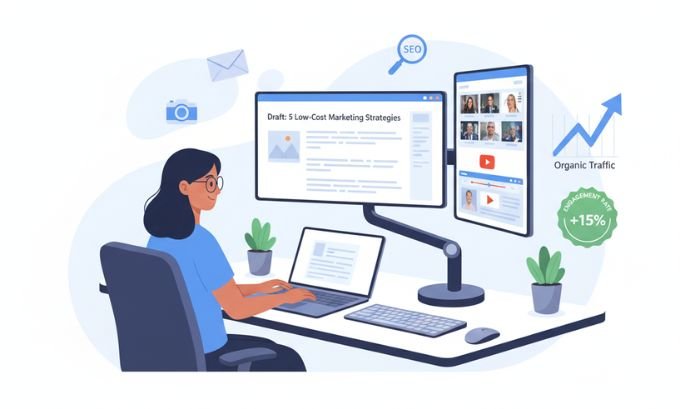
If you want long-term, low-cost visibility, invest in content marketing. It’s your 24/7 salesperson.
Instead of shouting for attention, content marketing earns it — by educating, entertaining, and solving your audience’s problems.
Practical Ways to Start
- Write blog posts around real customer pain points.
- Create “behind the scenes” videos or tutorials.
- Share customer success stories on LinkedIn or Medium.
- Repurpose one blog post into 3–4 short-form videos or carousel posts.
Real-Life Example
A small fintech startup couldn’t afford Google Ads. Instead, they published weekly articles like “How to Save on Taxes as a Freelancer.”
Within 6 months, they ranked on Google for 20+ keywords and tripled their inbound leads — all through consistent, SEO-optimized content marketing.
What I Like About This Approach:
- Builds authority and trust (EEAT).
- Improves organic traffic steadily.
- Supports every stage of the marketing funnel.
Areas to Improve:
- Results take time.
- Needs consistent content creation.
3. Use Social Media Marketing to Build Authentic Connections

You don’t need paid ads to win on social media — you need personality, consistency, and value
Social media marketing is one of the best low-cost marketing ideas for startups because it amplifies your story to a global audience for free.
Simple Yet Effective Tactics
- Focus on 1–2 platforms where your audience actually spends time.
- Use short-form videos (Reels, TikToks, Shorts) to show your human side.
- Share customer wins and behind-the-scenes stories.
- Respond to comments — it signals authenticity and builds trust.
Mini Case Study
A new handmade candle brand started posting weekly “scent stories” on Instagram — short videos explaining how each scent was made and what inspired it.
They gained 10K followers in 3 months and sold out their first collection — without a single paid ad. That’s low-budget marketing done right.
4. Optimize Your Marketing Funnel and Customer Journey
Even small startups need a marketing funnel — a system that turns attention into sales.
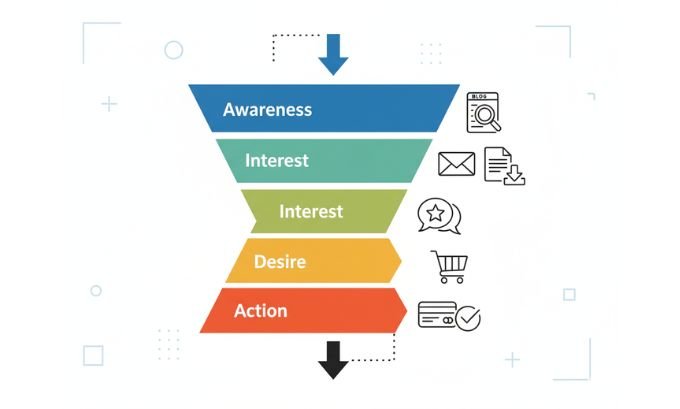
The customer journey usually follows this path:
Awareness → Interest → Desire → Action.
Here’s how to map yours:
| Funnel Stage | What Happens | Low-Cost Actions |
|---|---|---|
| Awareness | People discover you | Blog posts, podcasts, social videos |
| Interest | They learn more | Free guides, webinars, mini-courses |
| Desire | They want your solution | Testimonials, case studies, product demos |
| Action | They buy or subscribe | Email sequences, discount offers |
Pro Tip
Connect each piece of content to one funnel stage.
A blog post attracts awareness.
A newsletter nurtures interest.
A case study builds desire.
A checkout page drives action.
This ensures every dollar (and every hour) works harder — improving your Marketing ROI over time.
5. Collaborate and Co-Market With Other Startups
Partnerships multiply reach and credibility without multiplying costs.
Co-marketing means teaming up with other brands targeting the same audience — and it’s one of the smartest low-cost marketing ideas for startups today.
Collaboration Ideas
- Joint webinars or Instagram Lives.
- Guest blog exchanges.
- Cross-promotions or bundle discounts.
- Community-driven events.
Example:
A local coffee brand and a coworking space partnered for a “Monday Productivity Challenge.” They co-promoted the event across both audiences — doubling their email subscribers in 10 days, all at zero cost.
Startups looking to scale in international markets can explore Japan’s thriving e-commerce scene through TokyoMart.store or boost their digital presence with expert help from LinkLuminous.com, a results-driven marketing agency.
6. Track Performance and Improve Marketing ROI
If you don’t track it, you can’t improve it.
Even with limited resources, startups must monitor Marketing ROI — the return on each campaign or initiative.
Metrics That Matter
| Metric | Meaning | Why It’s Important |
|---|---|---|
| CAC (Customer Acquisition Cost) | How much you spend to get one customer. | Helps optimize ad and content spending. |
| LTV (Lifetime Value) | How much a customer is worth over time. | Shows profitability of retention. |
| CTR (Click-Through Rate) | % of people who click your links. | Measures engagement effectiveness. |
| Conversion Rate | % of visitors who take action. | Evaluates funnel performance. |
Expert Tip from Adam Erhart:
“Your analytics are the heartbeat of your business. When you track what matters, you spend smarter, not harder.”
Use free tools like Google Analytics, Meta Insights, or Notion dashboards to keep tabs on performance.
7. Real-World Example: Growing on a Budget
Let’s look at how one startup applied all this.
A small digital design agency started with $300/month in marketing funds.
They:
- Defined a marketing strategy focused on SaaS startups.
- Created weekly content marketing posts about UI/UX mistakes.
- Used social media marketing (LinkedIn + Instagram) to share design tips.
- Mapped a marketing funnel with a free resource → email nurture → consultation offer.
- Partnered with a software developer for a webinar series.
Within 6 months, they generated $25,000 in new contracts — proof that low-budget marketing can deliver high-impact results when planned strategically.
If you want more information about low-cost marketing ideas for startups, you can visit these sites Mind Journal or Mumbai Times
FAQ: Low-Cost Marketing Ideas for Startups
Q1. What’s the best free marketing strategy for startups?
Start with content marketing — it builds credibility, SEO visibility, and trust with your target audience.
Q2. How can I promote my startup with zero budget?
Use social media, community engagement, and strategic collaborations to grow organically.
Q3. What’s the difference between a marketing funnel and a customer journey?
The funnel is your internal structure; the journey is your customer’s experience moving through it.
Q4. Why is brand positioning so important for startups?
It defines how people perceive your brand and differentiates you from competitors — even if your products are similar.
Q5. Who is Adam Erhart, and why is he mentioned here?
Adam Erhart is a respected marketing expert known for simplifying digital strategy and helping startups market smarter on small budgets.
Q6. How do I measure Marketing ROI effectively?
Track conversion rates, customer acquisition costs, and lead quality using free tools like Google Analytics.
Conclusion: You Don’t Need a Big Budget — Just a Smart Plan
Success in marketing isn’t about how much you spend — it’s about how well you plan.
When your marketing strategy, target audience, and marketing funnel align, even the smallest budget can yield powerful results.
The secret? Stay consistent, track performance, and focus on adding value at every touchpoint. That’s how startups turn limited resources into lasting growth.
Author Bio
Written by: Marketing Strategy Editorial Team
Reviewed by Adam Erhart, Marketing Strategist and Digital Educator.
This article is part of our Startup Growth Series — delivering actionable, evidence-based insights to help entrepreneurs grow smarter.
