


The most significant story in education technology news today is not about a new gadget or software update. It’s about a profound shift in the classroom, driven by Generative AI in Education. Tools like ChatGPT have moved from the headlines into students’ homework, forcing educators to ask a critical question: Are we witnessing a threat to learning or its next evolution?
This article moves beyond the initial panic to explore the nuanced reality of AI in schools. We’ll look at how innovative teachers are using these tools, the complex issue of academic integrity, and how this technological wave is fundamentally redefining learning itself.
Table of Contents
Today’s AI in Education: A Tale of Two Realities

The current landscape of AI in schools is split. For some, it’s a powerful new instrument for teaching and learning. For others, it’s a source of anxiety, raising alarms about cheating and the erosion of fundamental skills. The truth is, it’s both.
This complexity is pushing the conversation forward. Simple bans are being recognized as shortsighted. Instead, districts like Metro Nashville Public Schools are working on thoughtful implementation plans. At the same time, individual educators are becoming pioneers, experimenting in their own classrooms to find a productive balance. This isn’t a story of technology; it’s a story of human adaptation.
From Brainstorming Buddy to Critical Thinking Coach
Many educators are discovering that AI’s greatest strength isn’t providing answers, but helping students learn to ask better questions. It can serve as a catalyst for creativity and a scaffold for complex thinking.
A Practical Use Case for Writing
Secondary English teacher Amanda Muffler offers a glimpse into this balanced approach. She and her team have decided to treat AI as a tool, not a taboo. Her students are permitted to use ChatGPT for initial brainstorming—to generate ideas for an essay or to explore different ways to phrase a thesis statement.
This doesn’t finish the assignment; it just gets it started. The students are still responsible for the heavy lifting: finding and analyzing evidence, structuring their own arguments, and, most importantly, writing in their own distinct voice.
What I find compelling about this model:
- It tackles writer’s block: AI helps overcome the initial inertia of a blank page, making writing less intimidating.
- It encourages active engagement: Students must act as editors, critically assessing the AI’s suggestions rather than passively accepting them.
- It keeps students in the driver’s seat: The core intellectual work remains the student’s responsibility.
Pushing a Step Further: AI as an Intellectual Sparring Partner
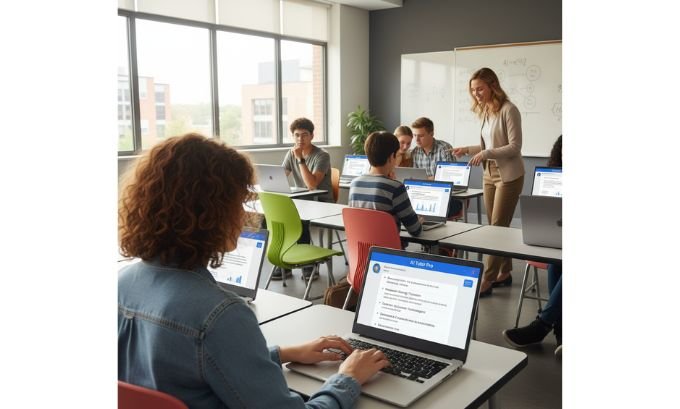
The potential of Generative AI in Education goes far beyond essay support. Danielle Macias, an English teacher with a deep background in Instructional Technology in Schools, advocates for using AI to create dynamic learning scenarios. She reframes ChatGPT as an interactive “discussion partner.”
Imagine a student’s experience with these methods:
- Debate Simulation: A student can challenge the AI to defend an opposing viewpoint, forcing them to anticipate counterarguments and refine their own logic.
- Literary Analysis: A student could ask the AI for an unconventional interpretation of a novel, prompting them to dig deeper into the text to support their own reading.
- Socratic Inquiry: With teacher guidance, students can learn to use the AI to pose probing questions that challenge their own assumptions, fostering a deeper level of self-reflection.
This approach transforms the AI from a simple information retriever into a tool that actively sharpens a student’s mind.
The Unavoidable Question of Cheating and the Tech Response
With such a powerful tool at their fingertips, it’s no surprise that students are using it. A poll from Common Sense Media confirmed that a large portion of teens have already used ChatGPT for school assignments. This has created an urgent need for tools that can help uphold academic integrity.
Can Technology Police Itself? The Case of GPTZero
This need gave rise to AI detection tools like GPTZero. Its co-creator, Edward Tien, developed it to identify the statistical fingerprints that AI models often leave behind. The tool analyzes text for qualities like “burstiness”—the natural variation in sentence length and complexity that characterizes human writing. AI-generated text is often more uniform.
Strengths of AI Detection:
- Acts as a deterrent: The knowledge that detection tools are in use can discourage students from simply copying and pasting.
- Promotes clear policies: It forces schools to define what constitutes acceptable AI assistance versus academic misconduct.
- Integrates with existing platforms: Many detectors now work within the learning management systems teachers already use.
Areas for Improvement:
- The problem of false positives: No detector is perfect. They can mistakenly flag human-written text, especially from English language learners or students with a very formulaic writing style.
- The technological arms race: As AI models evolve, they get better at sounding human, meaning detection tools must constantly be updated to keep pace.
This back-and-forth between generative and detective AI is a major subplot in the ongoing story of education technology news today.
If you’re interested in learning more about how AI is transforming classrooms, be sure to check out these related articles. Each one dives deeper into key trends in education technology news today and offers practical insights for students, teachers, and schools alike. 👇
mindjournal.co
mumbaitimes.net
ponta.in
Insights from the Educational Front Lines
To understand what’s really happening, we need to listen to the people in the classrooms. Larry Ferlazzo, a respected former teacher and education writer, frequently provides a platform for these voices. By sharing the experiences of teachers like Amanda Muffler and Danielle Macias, he helps ground the conversation in practical reality.
Their experiences suggest that the most effective path forward is not through prohibition, but through education. Teaching students to be ethical and effective users of these tools is proving more fruitful than trying to keep the tools out of their hands.
Comparing AI’s Dual Roles in the Classroom
| Feature | AI as a Learning Tool (ChatGPT) | AI as an Integrity Tool (GPTZero) |
|---|---|---|
| Primary Goal | To enhance student creativity, critical thinking, and understanding. | To uphold academic standards and ensure fairness. |
| Interaction Model | Collaborative; the student directs the AI to achieve a learning goal. | Supervisory; the tool analyzes student work to check for AI use. |
| Potential Benefit | Empowers students to tackle more complex problems and ideas. | Helps maintain the value of original thought and hard work. |
| Potential Drawback | Risk of over-reliance if not implemented with clear guidelines. | Can create a climate of suspicion and is not 100% foolproof. |
Frequently Asked Questions (FAQ)
1. What is the most important development in education technology news today?
The integration of Generative AI in Education is the most transformative development. The focus is on how schools can harness the power of tools like ChatGPT while managing the associated risks.
2. How are teachers actually using ChatGPT?
They are using it in creative ways. Amanda Muffler uses it as a brainstorming tool to kickstart the writing process. Danielle Macias uses it as an interactive debate partner to build critical thinking skills.
3. Is using AI for schoolwork considered cheating?
It depends. Many school districts, including Metro Nashville Public Schools, are developing specific policies. Generally, using AI for ideas is often acceptable, while submitting AI-generated work as your own is not.
4. What does GPTZero do?
GPTZero, founded by Edward Tien, is an AI detection tool. It analyzes text to help educators determine if it was likely written by an AI, serving as a tool to support academic integrity.
5. What are the main concerns about AI in the classroom?
The primary concerns are academic dishonesty, the potential for students to lose fundamental skills, the propagation of biased or inaccurate information, and equitable access to the technology.
6. Who is Larry Ferlazzo?
Larry Ferlazzo is a well-regarded educator and writer who often curates and shares the practical experiences of teachers on current topics, including the effective use of AI in education.
7. Are AI detectors like GPTZero always right?
No, they are not infallible. They can make mistakes, and the technology is in a constant state of evolution. They are best used as one of several signals when evaluating student work, not as a final verdict.
Conclusion: Crafting the Future of Learning, Together
The AI-powered shift in education is here to stay. The narrative in education technology news today has matured from alarm to action. The question is no longer if AI will be part of education, but how we will guide its integration to benefit students.
The answer lies in the thoughtful, human-centered approaches being pioneered by educators on the ground. By treating AI as a powerful tool and teaching students to use it responsibly, they are turning a potential threat into a transformative opportunity. The future of Instructional Technology in Schools will be defined by our ability to foster this new form of digital literacy. It will require ongoing professional development for teachers, clear communication with students and parents, and a shared commitment to preparing learners for a world where collaborating with intelligence—both human and artificial—is the key to success.
About the Author
This article was written by a team of education strategists and former educators committed to providing clear, actionable insights on the evolution of learning. We synthesize the experiences of classroom innovators like Amanda Muffler and Danielle Macias, the analysis of thought leaders like Larry Ferlazzo, and data from organizations like Common Sense Media to offer a trustworthy and comprehensive perspective. Our goal is to empower our community to navigate the future of education with confidence.
